
Teaching Kids About Money
Help children build money skills that last. Find age-appropriate lessons, hands-on activities, saving challenges, budgeting practice, and practical guidance for teenagers—all in one place.
Start with one skill, practice it in real life, and build from there. You don’t need a finance degree or an elaborate curriculum.

How to Start Teaching Kids About Money
Children learn about money through choices they understand: spending an allowance, saving for a toy, comparing prices at the store, or planning what to do with their first paycheck. The goal isn’t to make children financial experts. It’s to help them recognize choices, understand consequences, and develop sound habits.
Choose
Pick one age-appropriate money skill instead of teaching everything at once.
Explain
Use simple language and a familiar example the child can understand.
Practice
Let the child make a small, safe decision with real or pretend money.
Repeat
Revisit the skill during shopping, saving, earning, or family activities.
Money Lessons for Kids by Age
Use these age ranges as starting points, not rigid rules. Children develop at different rates. Begin with what they already understand, then gradually introduce more responsibility.

Recognize Money and Choices
Young children can begin learning that money is used to buy things and that we cannot choose everything at once.
- Recognize coins and bills with adult supervision.
- Sort pictures into needs and wants.
- Practice choosing between two items.
- Use pretend shopping and simple coloring activities.
Try this: Give your child two pretend shopping choices and ask which one they would buy and why.
Explore Money Coloring Pages →Earn, Save, Spend, and Give
Children can begin working with small amounts of money and understanding how individual decisions affect a goal.
- Divide money into spending, saving, and giving.
- Count money and compare prices.
- Set a small savings goal.
- Understand the difference between earning and receiving money.
Try this: Help your child save $12 for a book by setting aside $3 each week for four weeks.
Explore Money Lessons →Build Budgeting and Decision Skills
Older children can compare alternatives, track money, and learn how to plan before spending.
- Create a simple spending plan.
- Track money received and spent.
- Compare unit prices and total costs.
- Learn how bank accounts and interest work.
Try this: Give your child a fictional $30 event budget and ask them to plan food, entertainment, and savings without exceeding it.
Explore Money Activities →Practice Real-World Money Management
Teenagers need practical preparation for employment, bank accounts, transportation, online purchases, and independent decisions.
- Understand gross pay, deductions, and take-home pay.
- Build a realistic monthly budget.
- Learn about debit, credit, borrowing, and interest.
- Recognize scams and protect personal information.
Try this: Build a sample monthly budget using realistic part-time job income and expenses.
Explore Teen Money Skills →The Seven Money Skills Every Child Can Learn
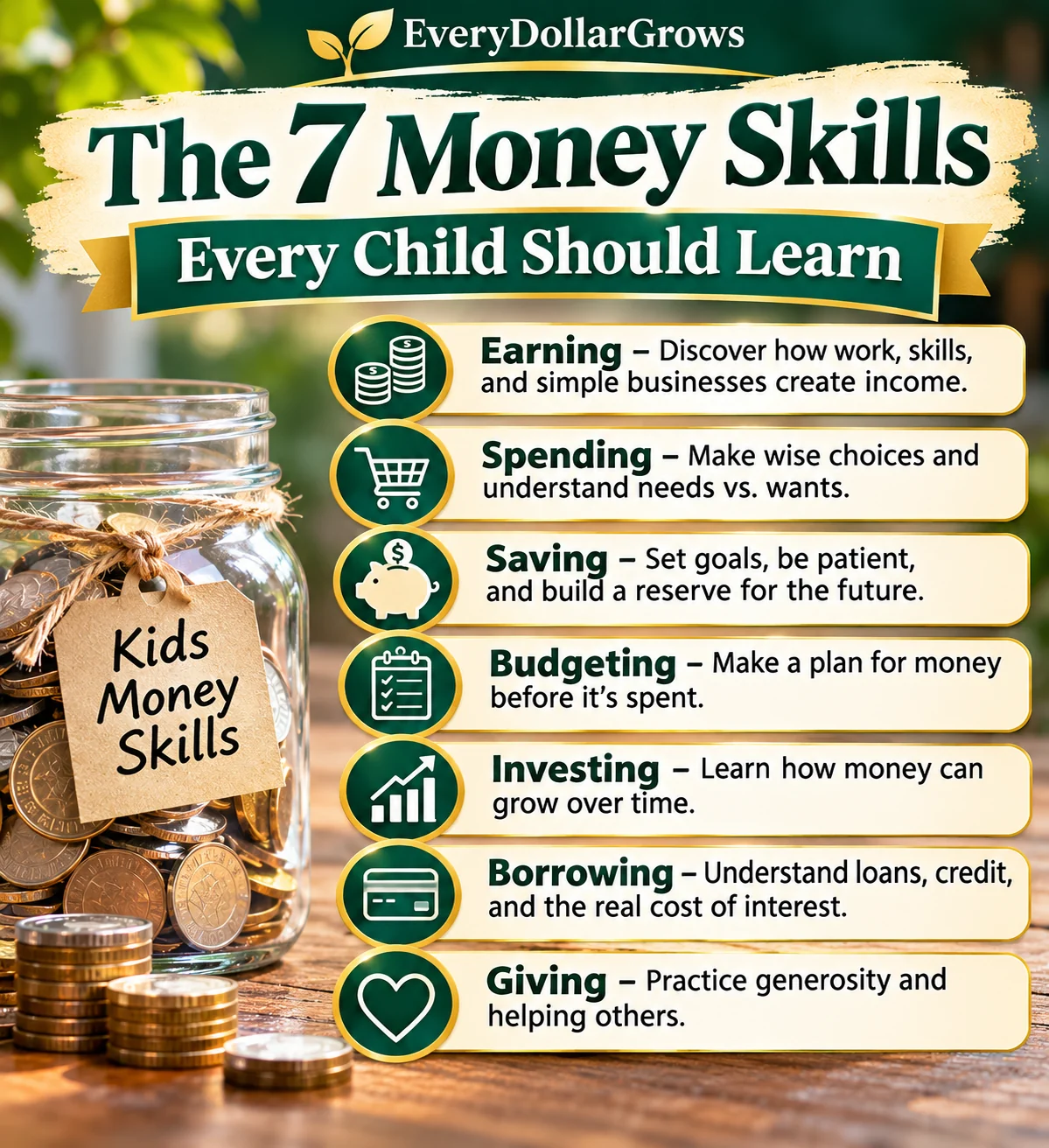
These skills grow with the child. A preschooler might practice saving coins, while a teenager learns how emergency funds, compound growth, and credit costs work.
1. Earning
Understand how work, skills, services, and businesses can produce income.
Activity: Plan a simple service or small-business idea and estimate earnings after expenses.
2. Spending
Recognize needs, wants, trade-offs, and how advertising influences decisions.
Activity: Compare two products by price, usefulness, and quality.
3. Saving
Learn to delay spending, set goals, and build reserves for future needs.
Activity: Calculate how many weeks it will take to reach a savings goal.
4. Budgeting
Make a plan for money before it disappears into unplanned purchases.
Activity: Divide a sample income among spending, saving, and giving.
5. Investing
Understand ownership, long-term growth, diversification, and risk.
Activity: Compare saving money with investing it using hypothetical growth examples.
6. Borrowing
Learn why borrowed money must be repaid and how interest increases costs.
Activity: Compare the full cost of paying cash versus borrowing.
7. Giving
Consider generosity, stewardship, and helping others as intentional money choices.
Activity: Choose a cause or need and plan a manageable gift.
Money safety belongs throughout these lessons. Teach children to protect passwords, recognize suspicious messages, and ask a trusted adult before sharing financial information or making digital purchases.
A Simple Four-Week Money Teaching Plan
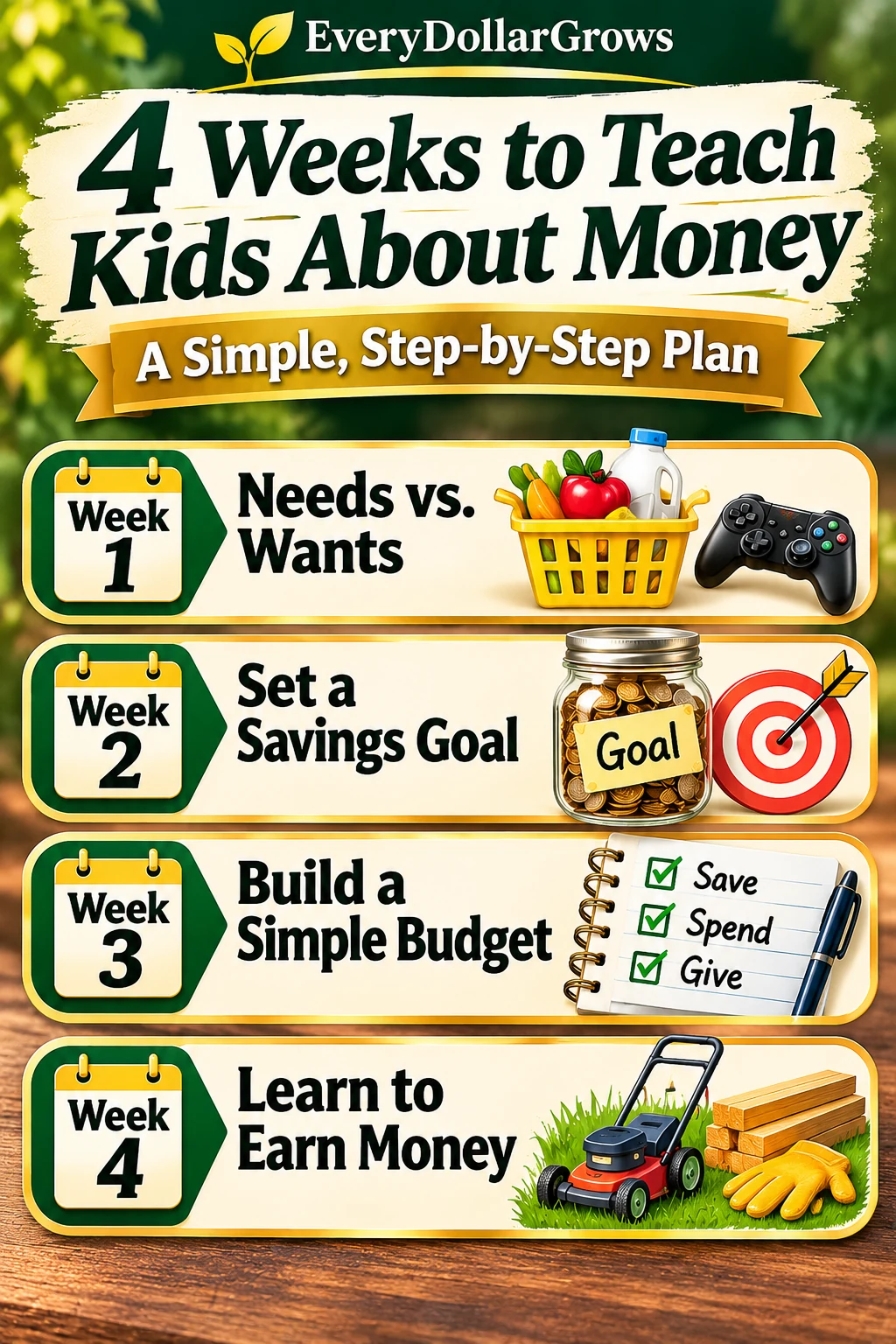
You can begin with one short lesson each week. Adjust the examples for the child’s age and interests.
| Week | Skill | What to Do |
|---|---|---|
| 1 | Needs vs. Wants | Sort purchases into needs and wants. Discuss examples during a shopping trip. |
| 2 | Saving | Choose a goal, estimate its cost, and track progress toward it. |
| 3 | Budgeting | Make a plan for spending, saving, and giving before money is used. |
| 4 | Earning | Discuss how work creates value and how earnings differ from profit. |
Start With These Kids Money Resources
Choose a resource that matches the skill your child is ready to practice. The full published directory appears below.
Kids Money Coloring Pages
Introduce younger children to financial concepts through familiar, visual activities. Use each page as a starting point for a short conversation about earning, saving, spending, or giving.
Explore Coloring PagesMoney Lessons for Kids
Follow a progressive sequence of age-appropriate money lessons rather than choosing unrelated activities.
Money Lessons Hub →Money Activities for Kids
Practice financial decisions with games, real-life scenarios, and family activities that reinforce understanding.
Activities Hub →Kids Money Worksheets
Use budgeting, saving, and spending exercises to help children put a new money concept into practice.
Worksheets Hub →Money Skills for Teens
Prepare for paychecks, banking, budgeting, digital purchases, credit, and increasingly independent decisions.
Teen Money Hub →How Parents Can Make Money Lessons Stick
Children notice how adults make decisions. Everyday situations provide opportunities to explain financial choices without sharing private household details or creating anxiety about money.
At the Grocery Store
Compare package sizes, prices, and unit costs. Ask which purchase offers better value and whether the larger package is actually needed.
When Receiving Money
Before spending a gift or earnings, discuss how much to save, spend, or give. Let the child help make the decision.
Before an Online Purchase
Explain the total cost, including subscriptions or recurring charges. Discuss the difference between a temporary want and lasting value.
When a Savings Goal Takes Time
Track progress visibly. If the goal changes, discuss whether the new choice is worth changing the plan.
Three useful questions to ask: What are your choices? What happens if you spend the money now? What might you want the money for later?
Browse the Kids Money Learning Library
Explore published lessons and resources across the Every Dollar Grows Kids Money collection. New articles will appear here as they are completed and published.
Frequently Asked Questions
At what age should I start teaching kids about money?
You can introduce simple money concepts during the preschool years. Young children can practice recognizing choices, understanding that purchases cost money, and distinguishing needs from wants. More advanced budgeting, banking, investing, and borrowing lessons can be introduced as their understanding develops.
What is the most important money lesson for a child?
A strong starting point is learning that money involves choices and trade-offs. Children who understand that spending money on one thing means it is unavailable for something else have a foundation for saving and budgeting.
Should children receive an allowance?
An allowance can provide money for practicing decisions, but it isn’t essential. Families can use small earnings, gifts, or fictional scenarios. Whatever approach you choose, provide opportunities to plan, save, and make manageable decisions.
How can I teach money skills without spending much money?
Use pretend stores, price comparisons, paper budgets, savings charts, and conversations about ordinary purchases. Many effective lessons require little or no additional spending.
When should teenagers learn about credit and investing?
Teenagers can begin learning the mechanics of credit, interest, repayment, investment risk, and compound growth before they use financial products independently. Start with examples and hypothetical calculations, then build toward real-world responsibilities.
Keep Learning With Every Dollar Grows
Teaching children money skills works best when those lessons connect to the decisions adults make every day. Explore practical resources for household budgeting, saving, and building long-term financial stability.

