
Free hands-on financial literacy activities
Money Activities for Kids That Teach Real Decisions
Make learning about money feel like play. Try a pretend shop, compare prices, build a simple plan, set a savings goal or practice thoughtful giving. Each activity teaches one practical skill without sharing your family’s financial information.

Five Money Games Kids Can Actually Play
Every game below includes instructions and an illustrated printable. Children get to draw, circle, choose, color or play—not fill out an adult spreadsheet. Print one activity at a time or use the complete Money Quest pack.
- Open for Business! — run a pretend shop.
- Price Detective! — investigate better deals.
- Give Every Dollar a Job! — plan how to save, spend and give.
- My Big Dream! — work toward a savings goal.
- Kindness Quest! — complete real acts of generosity.

Money Quest! Five Missions, One Adventure
Download the complete set: a mission passport plus five illustrated activities. Children color a star after each mission they complete.
Inside: pretend shop, price detective, three-part money plan, savings goal and cut-out kindness cards.

Pick a Mission and Start Playing
The images below are previews of the actual PDFs. Click an image or its download button to open the matching printable.
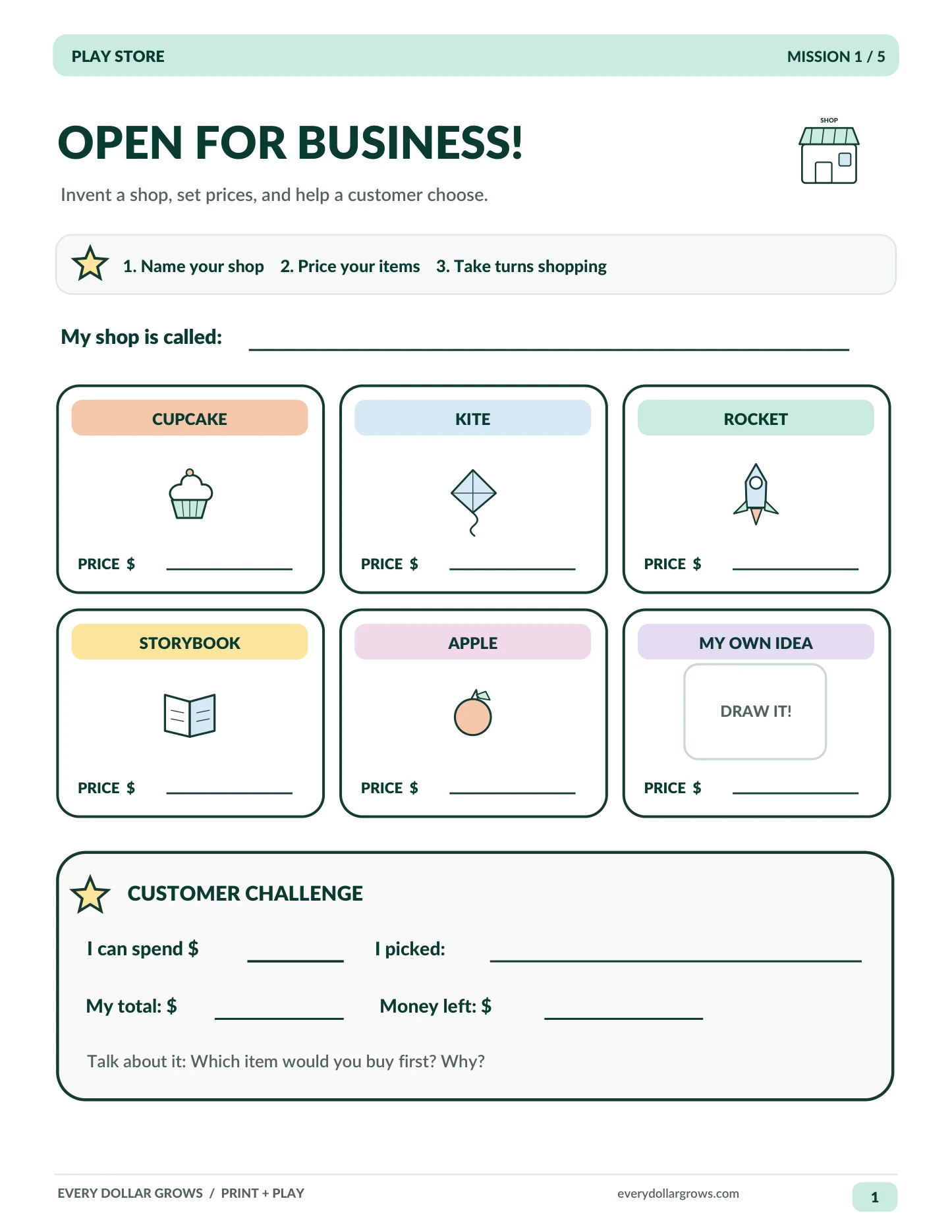
Open for Business! — Pretend Shop
Learn: setting prices, making purchases and staying within a limit.
You’ll need: the printable, a pencil and two players (or one player and an adult).
- Choose a shop name. Price the cupcake, kite, rocket, book and apple; draw and price your own sixth item.
- One person is the shopkeeper. The other is a customer with a pretend spending limit.
- The customer chooses items, adds the prices and records any money left.
- Swap roles and try again with a different budget.
Ask: What did you choose first, and why?
Download Pretend Shop PDF
Price Detective! — Find the Better Deal
Learn: price and quantity both matter when comparing choices.
You’ll need: the printable and a pencil or crayon.
- Look at each pair of illustrated products: toy cars, sticker sheets and marker packs.
- Circle A or B to show which you think is the better deal.
- Explain the clue you used—price, number of items, or what you actually need.
- Try the bonus question: would your answer change if you needed only one?
Ask: Does the lowest total price always give you the best value?
Download Price Detective PDF
Give Every Dollar a Job! — Make a Money Plan
Learn: plan how to save, spend and give before using your money.
You’ll need: the printable, a pencil and a pretend $10.
- Imagine you have $10 to plan with.
- Draw one thing to save for, one thing to spend on, and one way to give.
- Choose an amount for each part. Add them together.
- Change the amounts until save + spend + give equals exactly $10.
Ask: Why is it helpful to make a plan before buying something?
Download Money Plan PDF
My Big Dream! — Save for Something Special
Learn: bigger goals are reached through small, repeated steps.
You’ll need: the printable and crayons or colored pencils.
- Draw something you want to save for— big or small.
- Write what you think it will cost and how much you could save at a time.
- Color one star every time you make a real saving step toward the goal.
- Celebrate progress without needing to finish immediately.
Ask: What could you wait to buy so you can reach your dream?
Download Dream Goal PDF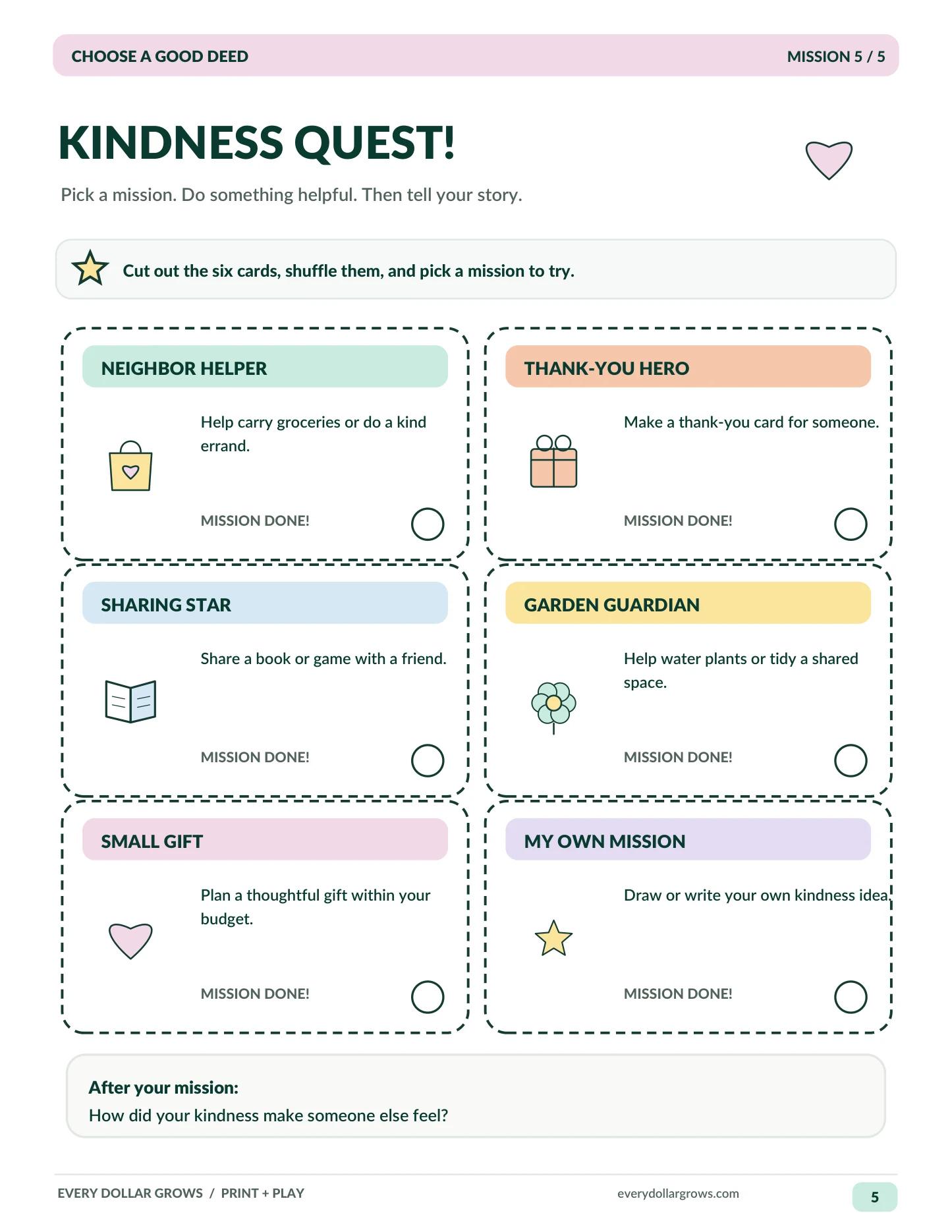
Kindness Quest! — Pick a Mission Card
Learn: generosity can involve time, effort, sharing or money.
You’ll need: the printable, child-safe scissors and crayons.
- Color and cut out the six mission cards, with adult help as needed.
- Shuffle them and select a kindness mission.
- Complete the mission, such as making a thank-you card or helping a neighbor.
- Mark the card done, then talk about how the other person felt.
Ask: How can you help someone even when you have no money to spend?
Download Kindness Cards PDFTry It: The $8 Market Game
You’re shopping for lunch with an $8 limit. Choose from the pretend prices below. Can you make a useful choice while staying within the budget? There is more than one good answer.
Make it a lesson: If you can’t afford every item, decide which matters most. Ask why your child made that choice. The amounts are pretend prices for this game, not real grocery estimates.

How to Turn Play Into a Money Lesson
- Choose one decision. Don’t try to teach saving, earning, budgeting and investing in a single game.
- Use imaginary amounts. Children can learn without discussing family income, bills or debt.
- Let your child decide. Allow small mistakes and let them try again.
- Ask one good question. “What would you do differently next time?” is often enough.
- Repeat with a twist. Change the prices, goal or situation next week to build confidence.
Keep Learning With Free EDG Resources
Lemonade Stand Budget Worksheet
Practice planning supplies, prices, costs and profit with a pretend small business.
Explore the lemonade activityKids Money Coloring Pages
Download coloring pages about saving, giving, planning and goals, with ready-to-print PDFs.
Browse coloring pagesTeaching Kids About Money
Explore Every Dollar Grows children’s money lessons and resources.
Visit the kids money hubBrowse More Published Money Activities
Use the activity directory below to find more practice by topic. The Kids Money plugin manages this collection, so unpublished activities should not appear as working links.
Money Activities for Kids: Frequently Asked Questions
What age should children start learning about money?
Preschoolers can start identifying simple needs and wants. Many children around ages 5–8 can make pretend shopping decisions; older children can compare prices, plan a small budget and work toward longer goals. Adapt each game to your child’s readiness.
Do we need real money or special supplies?
No. Paper, a pencil, household items and pretend prices are enough for most activities here. The interactive market game works directly on this page.
How long should each activity take?
Many first attempts take about 5–15 minutes; some activities, like the savings goal, continue over time.
Can teachers or homeschool families use these activities?
Yes. The activities work with individuals or small groups and can be adapted to classrooms, homeschool lessons or family discussions. Children don’t need to share private financial information.
What’s the most important lesson?
Money decisions involve choices. Children can learn to plan ahead, compare options, practice patience and consider the needs of others.
Make Money Lessons Part of Everyday Life
Choose one activity, let your child make a decision and revisit the lesson during a real-life opportunity.
Explore more in the Teaching Kids About Money hub .