
Best Money Psychology Books for Better Financial Habits
These money psychology books explore financial behavior, money beliefs, spending decisions, habits, scarcity, cognitive biases, and the emotions that can influence saving and investing.
Affiliate disclosure: As an Amazon Associate, Every Dollar Grows earns from qualifying purchases at no additional cost to you.
Money Psychology Books: Choose by Behavior or Habit
Use the Best For labels and EDG Quick Reviews to find the book that matches the financial behavior you want to understand.

The Psychology of Money
A collection of short lessons about how personal experience, expectations, risk, luck, patience, compounding, and emotion shape financial decisions.
EDG Quick Review
Strongest point: Makes complex financial-behavior ideas accessible through stories instead of academic language or formulas.
Know first: It is primarily a book about perspective and behavior, not a step-by-step budgeting or investing system.
Key idea: A financial plan has to work with human behavior, not only with mathematically optimal assumptions.
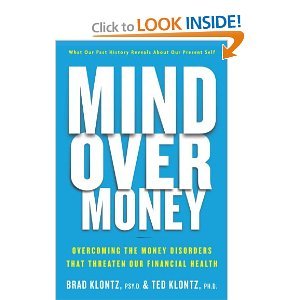
Mind Over Money
A financial-psychology book about subconscious money beliefs, childhood experiences, overspending, undersaving, anxiety, avoidance, and other recurring financial patterns.
EDG Quick Review
Strongest point: Gives language to deeply rooted beliefs about money that people may otherwise mistake for simple failures of discipline.
Know first: The book discusses serious financial and psychological patterns; it is broader than ordinary budgeting advice and is not a substitute for individualized professional care when that is needed.
Key idea: Repeated money behavior can be influenced by beliefs formed long before the current financial decision appears.

Thinking, Fast and Slow
An influential exploration of intuitive and deliberate thinking, judgment, loss aversion, overconfidence, framing, and the shortcuts people use when making decisions.
EDG Quick Review
Strongest point: Provides a framework for noticing the biases that can affect spending, investing, risk perception, and other financial judgments.
Know first: It is dense and not specifically a personal-finance book. Some individual findings discussed in older behavioral-science literature have also been debated or revisited over time.
Key idea: Human judgment relies on mental shortcuts, so confidence and rationality are not always the same thing.

Dollars and Sense
A money-specific behavioral-economics book about mental accounting, relativity, payment pain, expectations, pricing, and why spending decisions often feel rational when they are not.
EDG Quick Review
Strongest point: Applies behavioral economics directly to familiar purchases and money choices rather than keeping the discussion theoretical.
Know first: The tone is intentionally entertaining, so use the concepts as tools for examining decisions rather than rigid rules for every purchase.
Key idea: The way a price or choice is framed can change how money feels even when the underlying dollars have not changed.

Happy Money
A research-based look at how different kinds of spending can affect happiness, including experiences, anticipation, time, generosity, and the way purchases are consumed.
EDG Quick Review
Strongest point: Moves the spending conversation beyond simply asking whether a purchase is affordable and asks whether it actually improves life.
Know first: These are broad behavioral principles, not guarantees that a particular purchase will make any individual happier.
Key idea: How money is spent can matter as much as how much is spent when the goal is greater life satisfaction.

Scarcity
An exploration of how having too little money, time, or other resources can capture attention, narrow focus, and make longer-term planning harder.
EDG Quick Review
Strongest point: Helps explain why financial stress can make good decision-making harder precisely when careful decisions matter most.
Know first: The book is about scarcity broadly, including time and other resources, not only personal finance.
Key idea: Scarcity changes attention and mental bandwidth, so behavior under pressure cannot always be understood as simple lack of knowledge.

The Power of Habit
A general behavior-change book about habit loops, cues, routines, rewards, organizational behavior, and how repeated patterns can become automatic.
EDG Quick Review
Strongest point: Gives readers a useful way to examine recurring behaviors such as convenience spending, habitual shopping, or automatically skipping savings.
Know first: This is not specifically a finance book. Its value here is applying general habit concepts to money behavior.
Key idea: Repeated behavior often has identifiable cues and rewards, which makes the pattern easier to examine and redesign.

The Millionaire Next Door
A study of households that accumulated substantial net worth, emphasizing consumption patterns, planning, frugality, ownership, and the difference between income and wealth.
EDG Quick Review
Strongest point: Challenges the assumption that visible consumption is a reliable sign of financial wealth.
Know first: The research is decades old and should not be treated as a current demographic portrait of wealthy households.
Key idea: Looking wealthy and accumulating wealth can involve very different behaviors.
Turn Money Psychology Into Better Financial Habits
Understanding the behavior is useful. The next step is building systems that make better decisions easier to repeat.
More Money Psychology and Personal Finance Books
Continue into saving habits, budgeting behavior, investing, or the complete Every Dollar Grows Books Library.