Build your first financial buffer
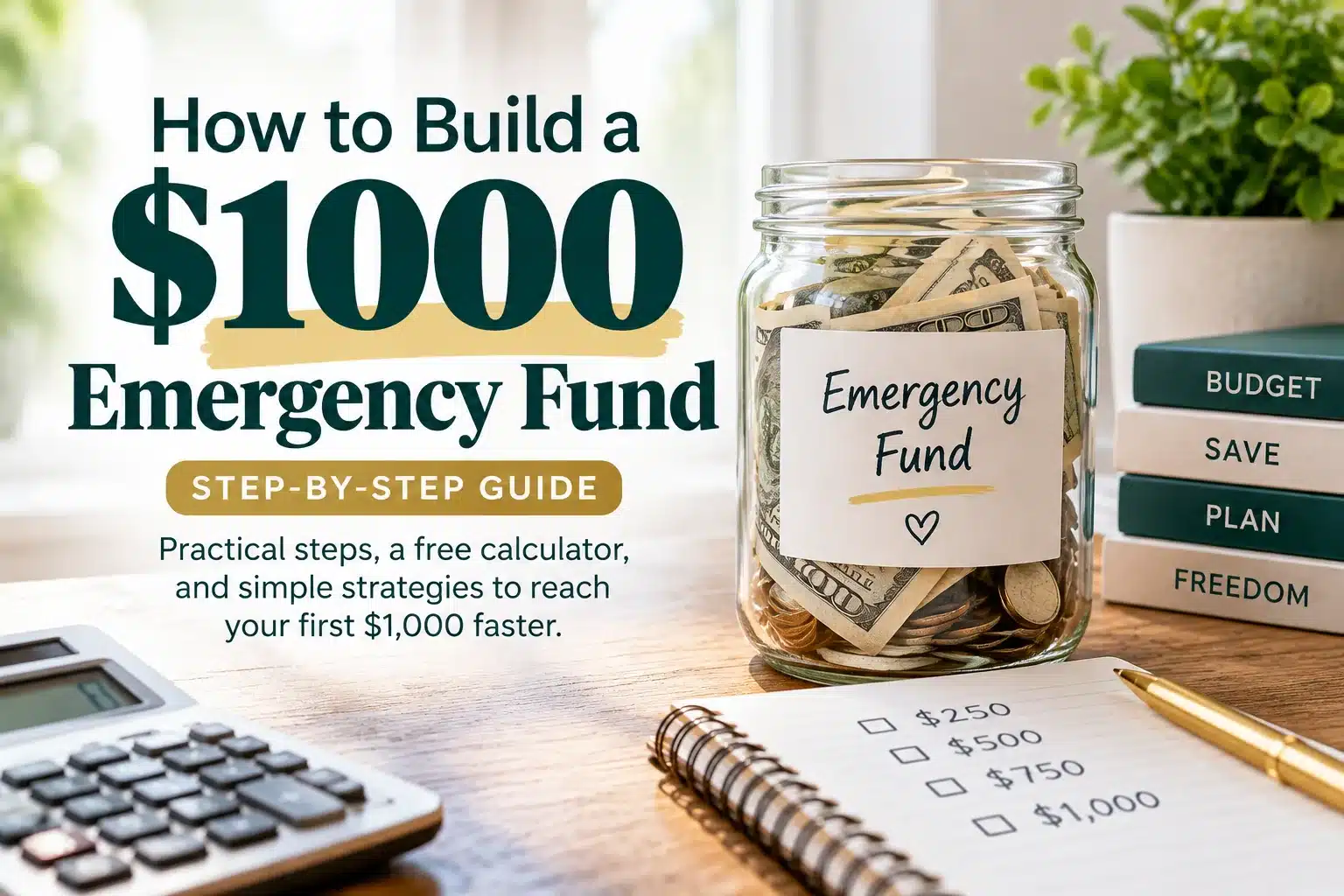
How to Build a $1000 Emergency Fund: Step-by-Step Guide
A $1000 emergency fund gives you a starter layer of protection when real life does something your monthly budget did not expect. This guide will help you build the first $1,000, calculate your timeline, decide what qualifies as an emergency, choose where to keep the money, and know what to do after you reach the goal.
If you only do four things
Your $1000 Emergency Fund Quick Start
A starter milestone, not a magic number
Why Build a $1000 Emergency Fund First?
The purpose of an emergency fund is simple: give yourself cash to handle an unexpected necessary expense without immediately putting it on a credit card, taking out a loan, or disrupting every other financial goal.
$1,000 is useful as a starter target because it is large enough to create meaningful breathing room while still being specific enough to work toward. It is not meant to be the perfect emergency-fund amount for every household.
It gives you options
A repair or urgent bill does not automatically have to become new debt.
It creates a finish line
You can see exactly how much remains and divide the goal into manageable deposits.
It builds the habit
The system you use to reach $1,000 can later help you build a larger emergency reserve.
$1000 emergency fund tool
Build Your $1,000 Emergency Fund Plan
Enter what you already have and what you can contribute. The tool will estimate your completion timeline and show what you would need to save per deposit to reach $1,000 faster.
Want to reach $1,000 by a specific pace?
Milestones
How Fast Can You Save $1,000?
There is no correct speed. The best contribution is one that moves you forward without leaving the rest of your budget unable to cover necessities.
| Amount saved each week | Approximate time from $0 |
|---|---|
| $10 | 100 weeks |
| $25 | 40 weeks |
| $50 | 20 weeks |
| $75 | About 14 weeks |
| $100 | 10 weeks |
| $125 | 8 weeks |
The actual plan
How to Build a $1000 Emergency Fund in 7 Steps
Know your starting number
Write down how much you already have in true emergency savings. Subtract that amount from $1,000. That remaining number is the goal you actually need to fund.
Keep the money separate
Use a dedicated savings account rather than leaving emergency money mixed into your everyday checking balance. Separation makes the purpose of the money clearer and reduces accidental spending.
Get to your first $100
Forget $1,000 for a moment. Find the first $100. You might combine a small paycheck transfer, returned purchases, items sold around the house, rebates, or a temporary spending cut.
Once the first $100 exists, the goal stops being theoretical.
Choose your normal contribution
Pick an amount that can move every payday, week, or month without creating another financial problem. Even a modest automatic transfer builds momentum when it happens consistently.
Add a temporary savings sprint
If you want to accelerate the goal, temporarily redirect optional spending. A few no-spend weekends, restaurant reductions, unused subscriptions, or convenience purchases can create extra room without requiring permanent extreme budgeting.
Use irregular money strategically
Bonuses, tax refunds, reimbursements, rebates, gifts, overtime, or side-income can shorten the timeline substantially. You do not need to send every unexpected dollar to savings for this strategy to help.
Track the balance and keep going
Update your progress whenever you deposit or withdraw money. When the balance hits $1,000, decide what your next emergency-savings milestone should be rather than simply stopping the habit.
Protect the money you worked to build
What Counts as an Emergency?
A simple test is whether the expense is necessary, unexpected, and time-sensitive. An emergency fund is not supposed to replace planning for expenses that happen every year.
Usually an emergency
- Car repair required for work or safety
- Urgent medical or dental expense
- Necessary home repair such as a major leak
- Temporary job or income loss
- Urgent pet medical care
- Insurance deductible after an unexpected event
Usually not an emergency
- Holiday spending
- Vacations
- Annual registrations
- Known insurance premiums
- Sales or limited-time deals
- Routine maintenance you knew was coming
- Optional upgrades
The fund exists to be useful
What If You Actually Need to Use the Money?
Use it. That is why you built it.
The goal is not to create a $1,000 balance that you are afraid to touch. The goal is to keep an unexpected necessary expense from immediately becoming new debt.
1. Confirm the expense
Ask whether it is necessary, unexpected, and time-sensitive.
2. Use only what you need
Pay the amount required to solve the immediate problem.
3. Refill the fund
Put emergency-fund contributions back into the budget after the immediate situation is stable.
Safe, accessible, separate
Where Should You Keep Your Emergency Fund?
Emergency savings has a different job than investment money. You need to be able to access it without depending on what the stock market happens to be doing that week.
Good places to consider
- Dedicated savings account
- High-yield savings account
- Money market deposit account
The priority is keeping the money protected, accessible, and separate from routine spending.
Usually poor places for starter emergency savings
- Individual stocks
- Stock index funds
- Cryptoassets
- Accounts with restrictions that make emergency access difficult
Want to compare the impact of earning interest while you save? Use the free high-yield savings calculators →
When every dollar already has a job
What If You Cannot Afford to Save Much?
Then your first goal does not have to be $1,000 tomorrow. Start with the amount your current cash flow can support.
Start at $100
A small buffer is still more protection than no buffer. Reach the first milestone, then keep building.
Try $250 next
Breaking the goal into smaller wins keeps progress visible and prevents $1,000 from feeling impossibly far away.
Budget by paycheck
If a monthly budget hides the problem, plan the next paycheck first.
When the budget still feels too tight
Find the Pressure Point Instead of Guessing
If you already have a budget but cannot see where the money for savings is supposed to come from, Budget Review helps you compare one real month of planned and actual spending and identify the area creating the most pressure.
Avoid the common mistakes
5 Emergency Fund Mistakes That Slow People Down
1. Waiting for a perfect month
There may never be a month with nothing competing for your money. Starting with $10 is better than repeatedly waiting to start with $500.
2. Keeping it inside checking
When savings and spending money share one balance, it becomes much harder to know what is truly available.
3. Treating known expenses as emergencies
Christmas, registrations, routine maintenance, and annual bills need planning rather than emergency-fund withdrawals.
4. Saving too aggressively
Do not transfer so much that you cannot pay required bills and then have to move the money right back.
5. Stopping forever at $1,000
The starter fund solves a different problem than a larger reserve designed to protect several months of essential expenses.
Bonus: forgetting to refill it
Using emergency savings is not failure. Leaving the balance depleted indefinitely is where future risk begins to return.
The next layer of protection
What Comes After Your First $1,000?
A starter emergency fund protects against smaller financial shocks. A larger reserve is designed for bigger disruptions such as job loss, reduced hours, or a major household expense.
Milestone 1
$1,000 starter fund
Creates an initial cash buffer for unexpected costs.
Milestone 2
1 month of essential expenses
Provides substantially more room for larger disruptions.
Milestone 3
Several months of essential expenses
Build the longer-term amount around your household, income stability, insurance, dependents, and financial obligations.
Your emergency reserve does not have to grow all at once. The same automatic contribution that built the first $1,000 can continue working toward the next milestone.
Connect the pieces
Emergency Savings Works Better Inside a Complete Money System
A strong emergency fund is easier to maintain when your monthly budget, paychecks, actual spending, bills, sinking funds, debt, and savings all work together.
Where to go next
Useful Next Steps
Build a working budget
Give savings a place in the monthly plan instead of waiting to see what remains.
Find money faster
Use practical short-term savings moves to accelerate the first emergency-fund milestone.
Create a debt plan
Once you have some cash protection, organize debt and build a realistic payoff strategy.
Use more free tools
Find EDG calculators for budgeting, saving, debt, student loans, housing, vehicles, groceries, and investing.
Common questions
$1000 Emergency Fund FAQ
Is a $1000 emergency fund enough?
It can be a useful starter emergency fund, but it is not necessarily enough for a major income interruption or expensive household emergency. Treat the first $1,000 as an initial layer of protection and build beyond it over time.
How long does it take to save $1,000?
It depends on what you already have and how much you contribute. From $0, saving $50 per week takes about 20 weeks, while $100 per week takes about 10 weeks. Use the calculator above for your own numbers.
Where should I keep my $1,000 emergency fund?
Look for a safe, accessible, separate savings option such as a dedicated savings account or high-yield savings account. Emergency savings should be easy enough to access when you genuinely need it.
Should I invest my emergency fund?
Starter emergency savings is designed for short-notice expenses. Investments can change in value, so money that may be needed unexpectedly generally has a different purpose than long-term investment money.
Should I pay off debt before saving $1,000?
A starter cash buffer can help prevent the next unexpected expense from creating additional debt. How aggressively you balance emergency savings and debt payoff depends on your cash flow, debt costs, required payments, and household circumstances.
What if I have to use the emergency fund?
Use it for a genuine emergency. That is its purpose. Once the immediate problem is handled, add rebuilding the balance back into your budget.
Should annual bills come from my emergency fund?
Usually no. Known expenses such as registrations, holiday spending, routine maintenance, and annual premiums are generally better planned through the normal budget or sinking funds.
What if I can only save $5 or $10 at a time?
Start there. Small deposits still increase the amount of cash between you and the next unexpected expense. You can increase the contribution later when your budget allows it.
Start with the first deposit
Your First $1,000 Does Not Have to Happen All at Once
Build the first $100. Then $250. Then $500. Keep repeating the process until your starter emergency fund is complete. The real win is not reaching one number overnight—it is building a system that leaves you better prepared the next time life gets expensive unexpectedly.