Investing Education · Every Dollar Grows
Portfolio Rebalancing: Rules, Thresholds, Taxes & Examples
Learn Portfolio Rebalancing with calendar, threshold, and cash-flow rules that restore your target allocation without turning routine portfolio maintenance into market timing.

Quick Answer
Portfolio Rebalancing means bringing a portfolio back toward its chosen asset allocation after market movement, contributions, withdrawals, or other changes cause the percentages to drift.
Rebalancing is primarily a risk-control process, not a prediction about which investment will perform best next.
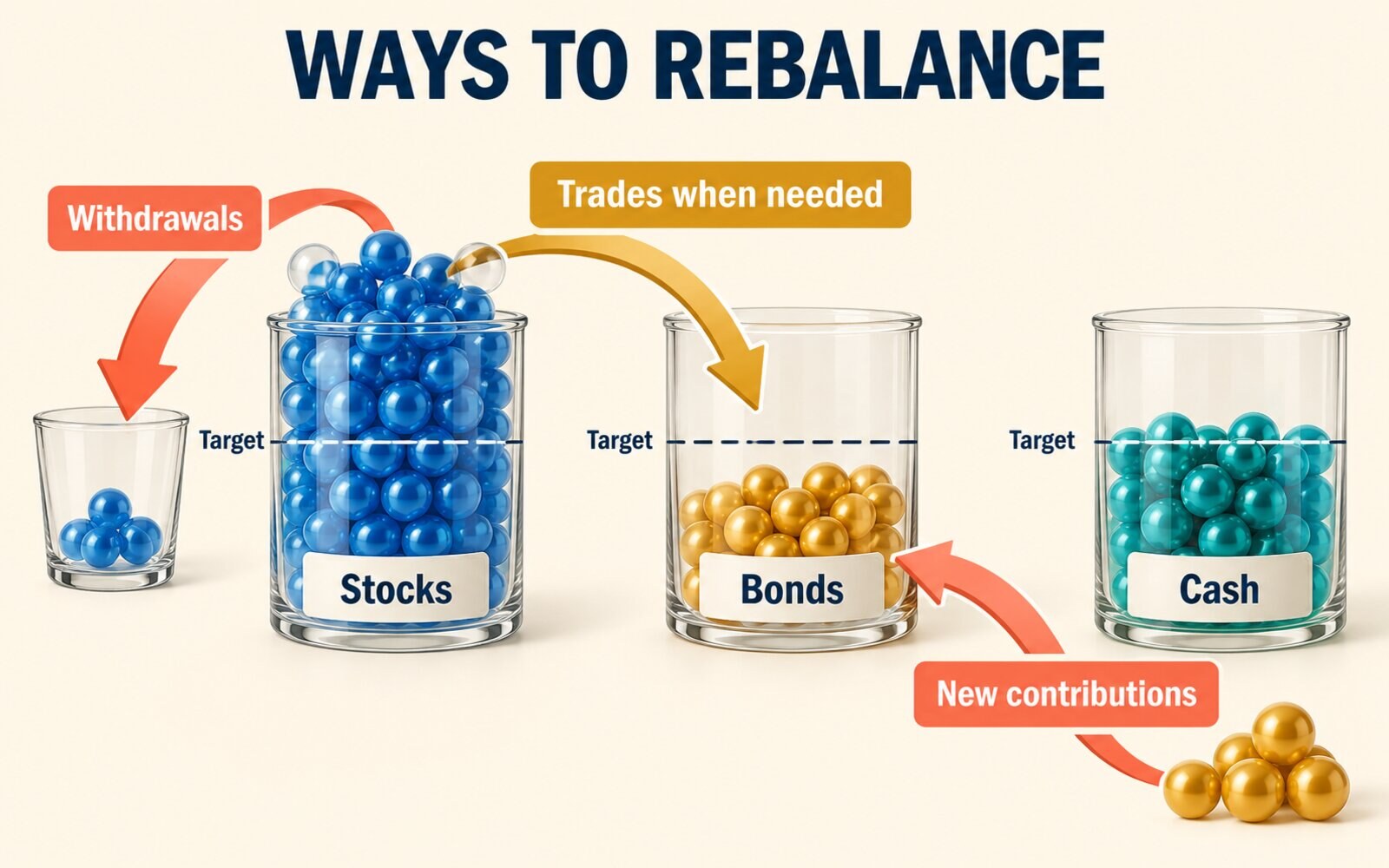
A practical system usually uses one of three approaches: check the portfolio on a schedule, rebalance when an allocation crosses a preset threshold, or direct new contributions and withdrawals toward the assets that move the portfolio back toward target.
What Portfolio Rebalancing Actually Does
Suppose you intentionally build a portfolio with:
- 70% stocks,
- and 30% bonds.
That allocation represents a decision about growth potential, volatility, time horizon, and the amount of investment risk you are willing and able to accept.
If stocks later outperform bonds, the portfolio might become:
- 78% stocks,
- and 22% bonds.
You did not deliberately choose a 78/22 portfolio. Market movement chose it for you.
Rebalancing restores the portfolio toward the allocation you intentionally selected.
Rebalancing is not a forecast
Selling part of an overweight stock allocation does not mean stocks are expected to fall.
Adding to an underweight bond allocation does not mean bonds are expected to outperform.
The purpose is to restore the portfolio's planned level of risk.
Why Investment Portfolios Drift
Different investments do not earn identical returns.
A portfolio can drift because of:
- rising stock prices,
- falling stock prices,
- changes in bond values,
- new contributions,
- dividend or interest distributions,
- withdrawals,
- employer contributions,
- or changes inside funds already owned.
Drift becomes meaningful when it changes the overall risk of the portfolio enough that the current allocation no longer represents the original plan.
A portfolio intended to be 60% stocks that has drifted to 61% stocks generally presents a different decision from one that has drifted to 75%.
This is why a written rebalancing rule can be more useful than reacting to every small movement.
How to Calculate a Portfolio Rebalancing Trade
When rebalancing only by trading existing investments, the basic calculation is straightforward.
Target dollar amount = Total portfolio value × Target percentage
Rebalancing amount = Target dollar amount − Current dollar amount
Example: $100,000 portfolio
Assume the target is:
- 70% stocks,
- 30% bonds.
After a strong stock market, the portfolio contains:
- $78,000 stocks,
- $22,000 bonds.
At a $100,000 total balance, the target values are:
- $70,000 stocks,
- $30,000 bonds.
A full rebalance using only existing assets would therefore involve moving approximately:
$8,000 from stocks to bonds.
But selling is not the only way to rebalance.
Calculate Your Own Rebalancing Amount
Instead of doing the allocation math manually, use the Every Dollar Grows Portfolio Rebalancing Calculator to compare current weights with your target percentages.
Open the Portfolio Rebalancing Calculator →Calendar Portfolio Rebalancing
A calendar rule reviews the portfolio at predetermined intervals.
Examples could include:
- every six months,
- once per year,
- or another deliberately chosen review schedule.
Investor.gov notes that some investors use six- or twelve-month intervals and that rebalancing generally tends to work best when done relatively infrequently.
Advantage
A schedule is simple. You do not need to watch portfolio percentages every week.
Limitation
The calendar does not know whether the portfolio actually needs a trade.
A review date could arrive when the portfolio is still very close to target.
Reviewing the allocation does not mean you must trade every time.
Threshold Portfolio Rebalancing
A threshold rule waits until an asset allocation moves outside a predefined band.
For example, an investor targeting 60% stocks might decide in advance to review or rebalance if stocks move five percentage points away from target.
Under that hypothetical rule, action could be considered when stocks reach:
- 65%,
- or 55%.
The five-percentage-point band is only an example. There is no universal threshold appropriate for every portfolio.
Advantage
Small market movements can be ignored. The rule acts only after the allocation has drifted by an amount the investor defined beforehand.
Limitation
Threshold rules require some way to monitor the allocation, and narrow thresholds can create unnecessary trading.
Calendar Plus Threshold: A Practical Hybrid Rule
Calendar and threshold methods do not have to be mutually exclusive.
A simple household rule might be:
Review the allocation twice each year, but trade only when an asset class has moved outside the predetermined acceptable range.
This separates:
- review frequency, which determines when you look,
- from trade frequency, which determines when you actually change investments.
That distinction can reduce the temptation to make a trade simply because the portfolio was opened.
Use Contributions and Withdrawals Before Selling
Investor.gov identifies adding money to underweight assets and redirecting ongoing contributions as legitimate ways to rebalance a portfolio.
This can be especially useful for investors who are still accumulating assets.
Example
Return to the $100,000 portfolio with:
- $78,000 stocks,
- $22,000 bonds.
You could avoid immediately selling appreciated stocks and instead direct future contributions toward bonds.
One important detail: adding new money changes the total portfolio value, so simply contributing $8,000 to bonds would not produce an exact 70/30 allocation.
If no stock value changed and all new money went to bonds, approximately $11,429 of new bond contributions would bring this simplified example to 70% stocks:
$78,000 ÷ ($100,000 + $11,429) ≈ 70%
In real life, investment prices will continue moving while contributions are made, so exact precision is usually unnecessary.
Withdrawals can work the same way
A retiree taking money from a portfolio may be able to take more of the withdrawal from an overweight asset class rather than selling the underweight one.

Rebalance the Household Portfolio Across Accounts
A household's investment allocation can span:
- 401(k) accounts,
- 403(b) accounts,
- traditional IRAs,
- Roth IRAs,
- HSAs,
- and taxable brokerage accounts.
Rebalancing each account independently can create unnecessary duplication.
Example
Imagine a household wants an overall 70/30 stock/bond allocation.
Its taxable brokerage account might be mostly stocks, while a 401(k) contains a larger bond allocation.
Neither account individually needs to be 70/30 for the household's combined portfolio to reach 70/30.
Think portfolio first, account second
Calculate the household's total exposure first. Then decide which account is the most practical place to make the adjustment.
Taxable Accounts Change the Rebalancing Decision
Rebalancing inside a retirement or other tax-advantaged account generally does not create a current capital-gains tax bill merely because one investment is exchanged for another inside the account.
A taxable brokerage account is different.
Selling an appreciated investment can realize a capital gain. The tax result can depend on:
- cost basis,
- holding period,
- realized gains and losses,
- other taxable income,
- and applicable federal and state tax rules.
This is one reason cash-flow rebalancing can be useful.
Before selling an appreciated taxable holding, consider whether the household can move closer to target by:
- directing new contributions elsewhere,
- changing dividend reinvestment,
- using retirement-account trades,
- or taking planned withdrawals from the overweight asset.
Tax consequences should not automatically prevent rebalancing, but they belong in the decision.
Watch for Wash Sales When Rebalancing at a Loss
Tax-loss situations require an additional check.
Under federal wash-sale rules, a loss can be disallowed when stock or securities are sold at a loss and substantially identical securities are acquired within 30 days before or after the sale.
That can become relevant when:
- automatic dividend reinvestment is turned on,
- recurring purchases continue during the rebalancing period,
- substantially identical investments are purchased in another account,
- or an IRA or Roth IRA acquires substantially identical securities.
The IRS also addresses purchases by a spouse or certain controlled entities in its wash-sale rules.
A loss trade deserves an account-wide check
Do not look only at the brokerage account where the loss occurred. Automatic transactions elsewhere can matter.
Wash-sale rules are tax rules, not merely investment-allocation rules. When the loss is material, verify the current IRS rules or consult a qualified tax professional.
Rebalancing Is Different From Changing Your Target Allocation
This distinction prevents a common form of disguised market timing.
Rebalancing
Your desired allocation is still 70/30, but market movement changed the portfolio to 78/22.
You move it back toward 70/30.
Changing the allocation
You intentionally decide that the household should now hold 60/40 because something meaningful changed.
Legitimate reasons to reconsider the target can include:
- a shorter time horizon,
- approaching retirement,
- a major change in financial circumstances,
- a change in the financial goal,
- or a genuine change in risk capacity or tolerance.
A stock-market rally by itself is not the same thing as a change in the household's financial plan.
Investor.gov similarly distinguishes changing an asset allocation because circumstances changed from changing it simply because one asset class has recently performed well.
Target-Date Funds Can Handle Portfolio Rebalancing Automatically
Some investors do not need to manually rebalance individual stock and bond funds.
Target-date funds generally manage:
- asset allocation,
- diversification,
- ongoing rebalancing,
- and gradual allocation changes through the glide path.
That can make them useful for investors who want a single diversified retirement fund rather than maintaining several separate asset classes.
But adding other investments around a target-date fund changes the household's overall allocation.
If a target-date fund is intended to be the complete retirement portfolio, repeatedly adding separate stock or bond funds can undermine the allocation the fund is managing.
See Target-Date Funds Explained for a deeper look at glide paths and retirement allocations.
Portfolio Rebalancing Mistakes Worth Catching
- Rebalancing every time the market moves slightly.
- Making trades without a written calendar or threshold rule.
- Treating rebalancing as a prediction about future market direction.
- Letting recent winners permanently determine the portfolio's risk level.
- Selling in a taxable account before considering new contributions.
- Ignoring realized capital gains.
- Selling at a loss without checking wash-sale rules.
- Forgetting automatic dividend reinvestment when evaluating a wash sale.
- Rebalancing every account separately instead of looking at the household allocation.
- Changing the target allocation during a market decline simply because losses feel uncomfortable.
- Using an exact allocation percentage as though being a few tenths of a percentage point off target is an emergency.
- Adding investments around a target-date fund without checking the resulting overall allocation.
Portfolio Rebalancing Checklist
- Write down the target asset allocation.
- Calculate the current allocation across all relevant accounts.
- Decide whether the target itself has changed or the portfolio has merely drifted.
- Choose a calendar, threshold, or hybrid review rule.
- Avoid creating trades for insignificant drift.
- Direct new contributions toward underweight assets when practical.
- Use planned withdrawals from overweight assets when practical.
- Consider whether a retirement-account trade can accomplish the adjustment.
- Review capital gains before selling appreciated taxable investments.
- Check wash-sale exposure before realizing a taxable loss.
- Include automatic purchases and dividend reinvestment in that wash-sale review.
- Check transaction fees or trading restrictions.
- Record what was changed and why.
- Return to the written rule rather than monitoring markets for the next prediction.
Use the Portfolio Rebalancing Calculator to measure allocation drift, Asset Allocation for Beginners to choose the underlying mix, and Investment Diversification Explained to evaluate concentration within the asset classes.
Helpful Primary Sources
Portfolio Rebalancing FAQs
What is portfolio rebalancing?
Portfolio rebalancing means adjusting investments to move a portfolio back toward its chosen asset allocation after market movement or cash flows cause the percentages to drift.
How often should I rebalance my portfolio?
There is no universal schedule. Investors can use calendar reviews, preset allocation thresholds, or a combination of the two. Investor.gov notes that rebalancing generally tends to work best when done relatively infrequently rather than through constant trading.
Should I rebalance every time my allocation changes?
Not necessarily. Small changes are normal. A written tolerance band or review schedule can prevent minor market movements from triggering unnecessary trades.
Can I rebalance without selling investments?
Yes. New contributions can be directed toward underweight asset classes, and withdrawals can sometimes be taken from overweight assets. This can gradually restore the allocation without immediately selling.
Does portfolio rebalancing increase returns?
Rebalancing is primarily a risk-management process, not a guarantee of higher returns. Its purpose is to keep the portfolio aligned with the asset allocation and risk level the investor selected.
Can rebalancing create taxes?
Yes. Selling appreciated investments in a taxable brokerage account can realize capital gains. The result depends on cost basis, holding period, other gains and losses, income, and applicable tax rules.
Can a wash sale happen while rebalancing?
Yes. If an investment is sold at a loss and substantially identical securities are acquired during the wash-sale period, the loss can be disallowed under federal tax rules. Automatic purchases and activity in other accounts can matter.
Should each investment account have the same allocation?
Not necessarily. A household can manage its target allocation across multiple accounts. One account can hold more stocks and another more bonds while the combined household portfolio still matches the target.
Is changing my allocation the same as rebalancing?
No. Rebalancing restores an existing target. Changing the allocation creates a new target because the investor's time horizon, goals, financial circumstances, or risk capacity have changed.
Do target-date funds rebalance automatically?
Generally, yes. Target-date funds typically handle allocation, diversification, rebalancing, and gradual allocation changes according to the fund's glide path.
Keep learning