
Money Skills Checklist for Kids: An Age-by-Age Roadmap
What money skills should a child understand before becoming an adult? This practical roadmap helps families teach earning, saving, budgeting, spending and financial responsibility from the preschool years through the teen years.
Not a test. Not a scorecard. Identify what your child can already do, choose one skill to practice, and plan the next real-life experience.

Money Skills Checklist for Kids: What to Teach at Each Age
Children do not all learn financial skills at the same pace. A child’s reading ability, math skills, interests and opportunities to handle money will influence when a concept makes sense.
Use these age ranges as starting points, not deadlines. A 12-year-old learning to budget for the first time should begin with a simple budget—not a complicated lesson merely because of their age.
- Notice: Find one skill your child already understands or demonstrates.
- Practice: Choose one concept that still needs explanation or repetition.
- Apply: Give your child one small, age-appropriate money decision.

Money Skills Lab: Eight Printable Learning Challenges
Download the complete Money Skills Lab workbook to support the lessons below. It’s designed primarily for elementary-age learners, with age-appropriate support from an adult.
- Eight illustrated money worksheets
- Drawing, circling, math and decision-making
- An introductory cover
- Adult answers and teaching notes
You can also download individual activity PDFs beside the lessons they reinforce.

First Money Skills: Recognizing Choices
Young children do not need to understand a household budget. At this age, focus on recognizing money, noticing choices, and understanding that we cannot purchase everything we see.
A child begins to recognize that money is used to buy goods and services.
Try: Let the child act as the cashier in a pretend store.Some things help meet important needs. Other things are enjoyable but optional.
Try: Talk about food, shoes, toys and treats using picture cards.A child begins to understand that something wanted does not always need to be purchased immediately.
Try: Save small pretend tokens toward a chosen reward.Introduce generosity and caring for possessions without requiring a child to use actual money.
Try: Help prepare a homemade gift for someone else.- Choose three everyday household items.
- Give each item a pretend price of one, two or three tokens.
- Give the child three tokens and let them decide what to purchase.
- Ask what they might choose differently if they could play again.
The objective is making a choice, not completing difficult arithmetic.
For more visual activities at this stage, visit the free kids money coloring pages .
Learning to Earn, Save, Spend and Give
At this stage, children can often connect money to work, saving and everyday decisions. They can begin handling simple amounts, comparing two choices and explaining what they want to do with money.
Count familiar coins or pretend money and understand that different amounts buy different things.
Try: Make purchases in a pretend shop using whole-dollar prices.Learn that work can provide income and that earning money requires effort and responsibility.
Try: Plan a supervised, optional money-earning project.Decide what to save, spend and give before using a small amount of money.
Try: Make a pretend $10 plan and explain the choices.Begin noticing when waiting, comparing or sharing may be better than impulsively purchasing something.
Try: Talk about two possible purchases and choose one.Printable Practice for These Skills
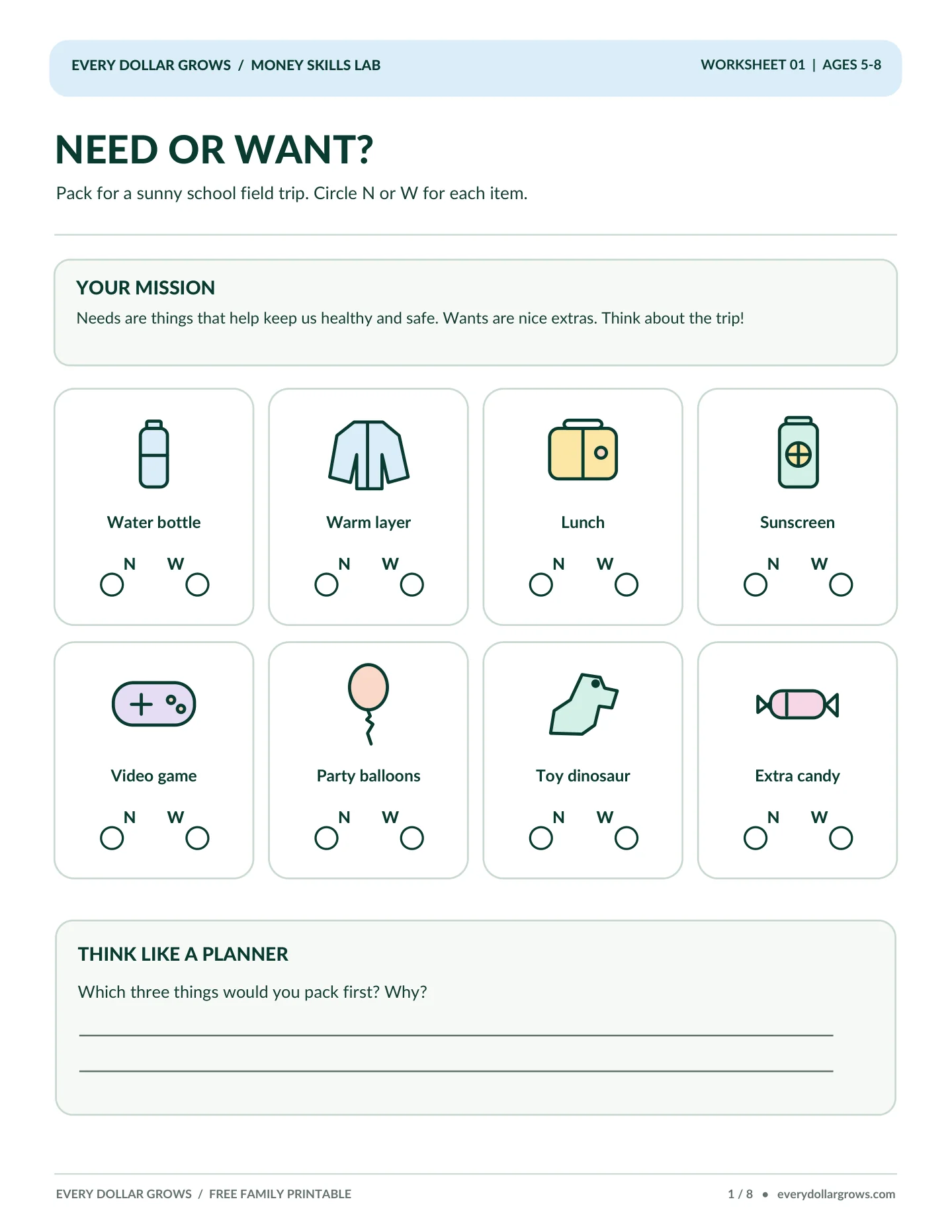
Need or Want? — Field Trip Challenge
Children sort everyday choices and learn that the reason for a purchase matters. Ask why each choice is a need or want, rather than insisting every answer is universal.
Download Worksheet PDF
Smart Move Spotter! — Money Choices
Practice recognizing helpful money habits. Use each scenario to discuss patience, planning and considering consequences.
Download Worksheet PDFDeveloping Budgeting and Saving Skills
Older elementary and middle-school-age children can begin moving beyond individual purchases. They can learn to plan limited money, read basic transaction information, track progress and think through financial decisions over time.
Plan a limited amount across several priorities without spending more than is available.
Try: Plan the cost of a small picnic or family activity.Determine a target amount, a regular saving amount and an approximate timeline.
Try: Make a six-week savings plan and update it regularly.Understand that earning adds to the available balance while spending reduces it.
Try: Record a few imaginary transactions and calculate what remains.Look at a receipt, compare what was expected with what was charged, and notice errors.
Try: Check a pretend receipt against a shopping list.Recognize that game purchases, subscriptions and digital items involve real money.
Try: Discuss a fictional in-game purchase before accepting it.Understand that a budget can change after an unexpected expense or a change in earnings.
Try: Rework a pretend spending plan after one price increases.- Choose a pretend budget for a small family activity.
- List what is needed and estimate costs.
- Compare the total with the amount available.
- Adjust the plan if the total is too high.
- Ask which choices were easiest and which involved giving something up.
Printables for Budgeting, Saving and Planning
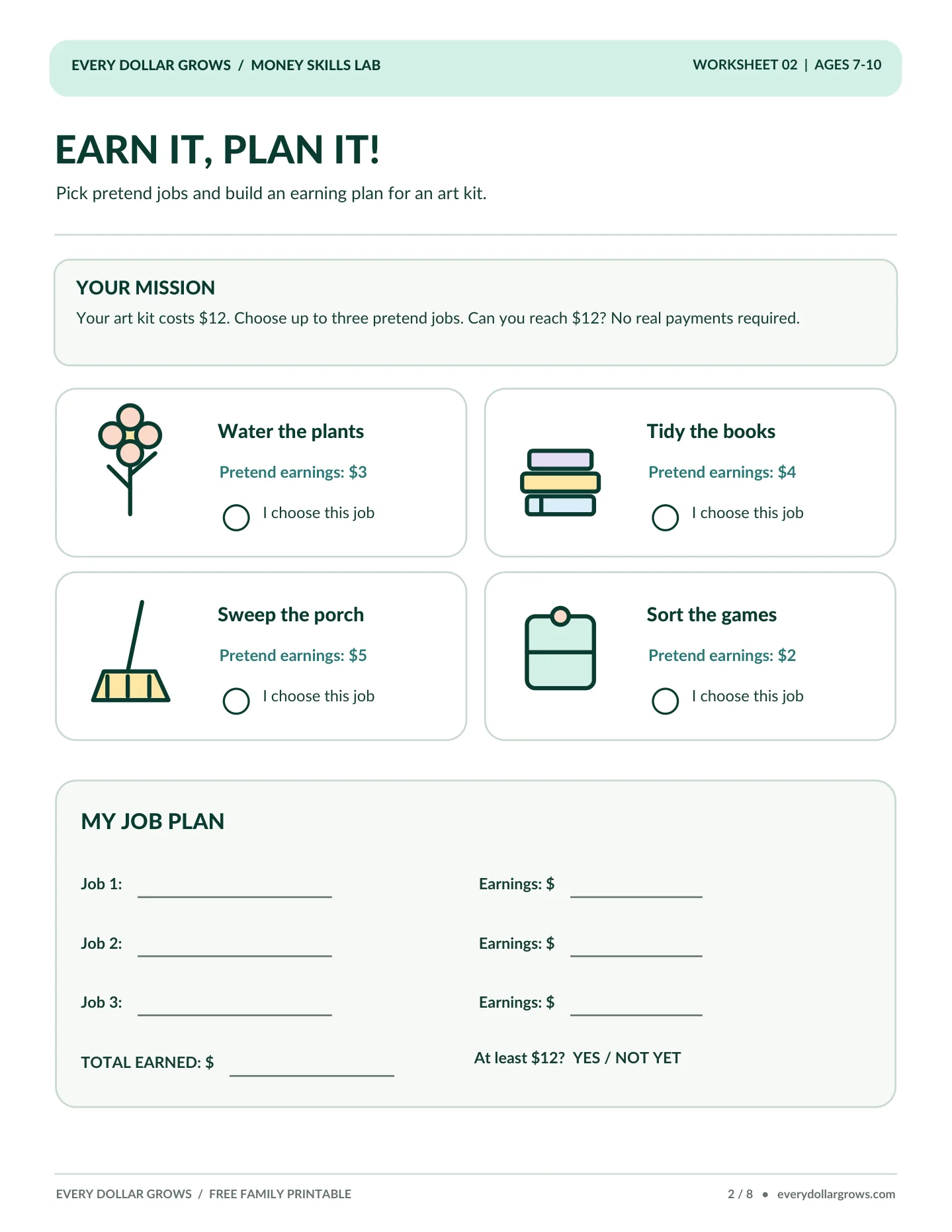
Earn It, Plan It! — Pretend Jobs
Connect earning to a realistic decision about how money will be used. Explain the difference between receiving money and deciding what to do with it.
Download Worksheet PDF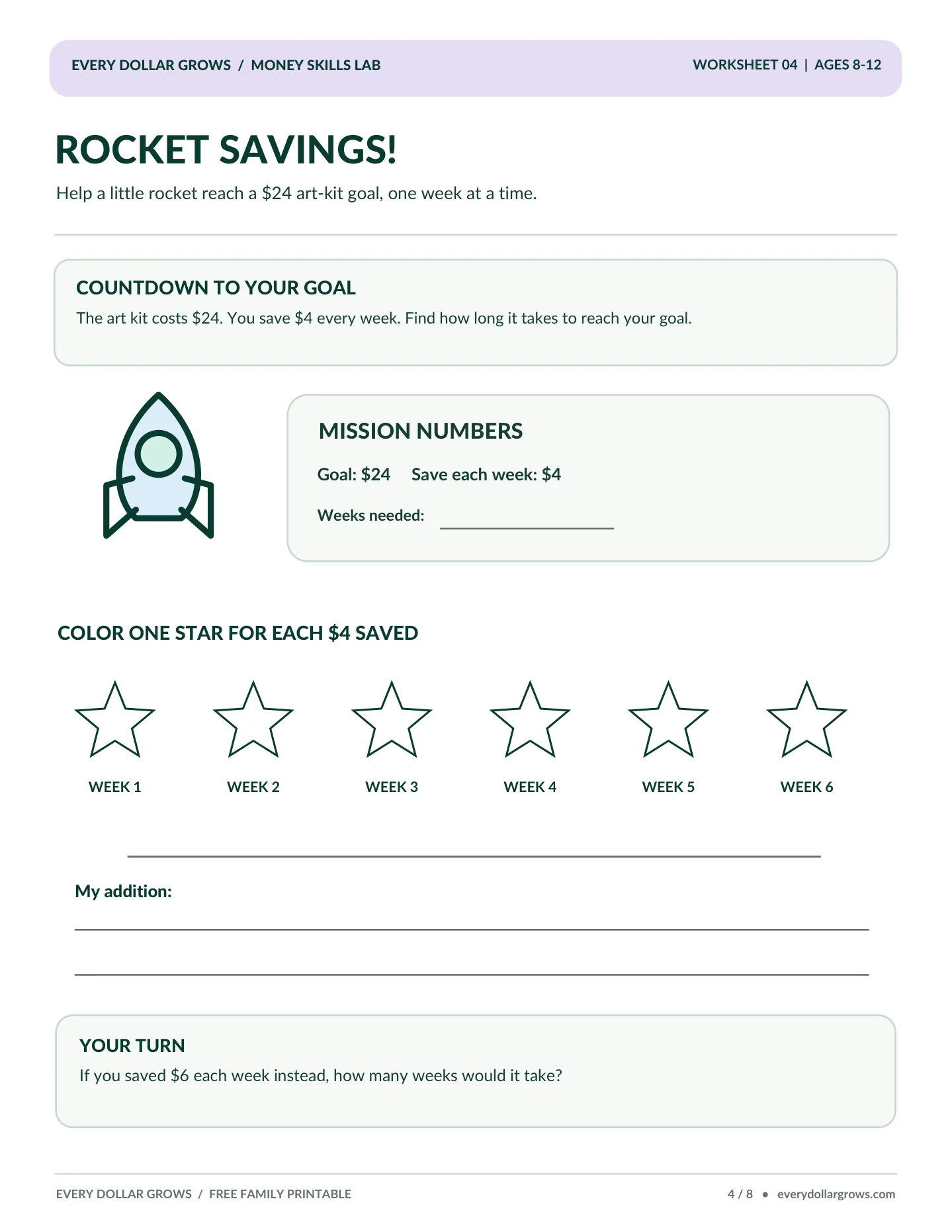
Rocket Savings! — Six-Week Goal
Turn saving into a series of visible steps. Children see how repeated small amounts make progress toward a goal.
Download Worksheet PDF
Picnic Party Plan! — $20 Budget
Practice choosing items for an event while working within a limited budget. Discuss what can be changed if the total exceeds the amount available.
Download Worksheet PDF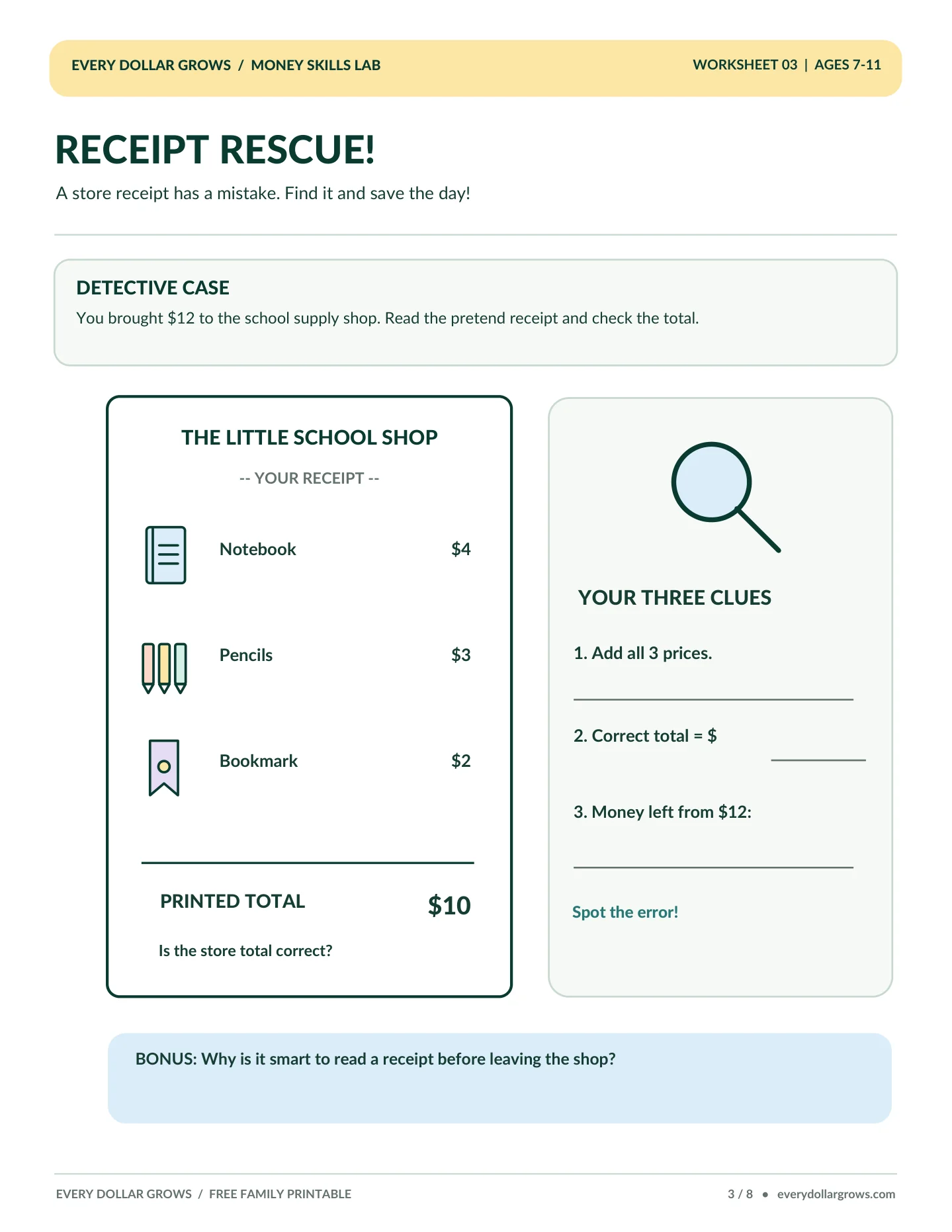
Receipt Rescue! — Find the Mistake
Show children how to read a receipt, check a total and recognize when a charge doesn’t match a purchase.
Download Worksheet PDF
Click Carefully! — Digital Spending
Introduce the real costs of digital purchases, subscriptions and games. Teach children to ask permission before spending online.
Download Worksheet PDF
Maya’s Savings Story! — Money Math
Follow a fictional savings story and calculate how earnings, savings and spending change the amount available.
Download Worksheet PDFMoney Skills for Teens Before Financial Independence
Teenagers begin preparing for decisions with bigger consequences: working, banking, driving, education, borrowing and eventually living independently. They should gradually learn to make a plan using realistic numbers and understand the risks involved.
Distinguish gross pay from take-home pay and recognize common payroll deductions.
Try: Review a fictional pay stub and estimate monthly take-home income.Plan income against savings, transportation, personal spending and recurring expenses.
Try: Make a budget using a hypothetical part-time paycheck.Understand the difference between a car’s purchase price and the total cost of ownership.
Try: Estimate insurance, fuel, registration and maintenance.Learn about account balances, fees, debit cards, credit and interest.
Try: Compare the total cost of paying cash with a simple loan example.Begin thinking about education, moving out, long-term savings and eventually housing.
Try: Set a goal, deadline and monthly saving amount.Learn that investing carries risk, that diversification matters, and that returns are not guaranteed.
Try: Compare a short-term savings goal with a much longer investment horizon.Imagine earning $800 in monthly take-home pay. Your planned expenses and savings are:
- Car savings: $200
- Transportation: $150
- Phone and subscriptions: $50
- Other spending: $200
Total assigned: $600. That leaves $200 to plan. Ask the teen where the remainder should go and how the plan would change if income dropped.
These are fictional teaching figures, not recommended spending amounts.
The teen stage builds on the printable skills above. The site’s more advanced budgeting, car and savings planning tools can support the next step as those resources are published.
Create a Simple Family Money Learning Plan
Choose your child’s approximate learning stage, identify one skill already demonstrated, and select one to practice next.
This is a private planning aid, not a test. It doesn’t assign grades or compare children.

Select a skill to practice to see an age-appropriate activity.
A child may already understand a skill but still benefit from practicing it. You can revisit this plan whenever interests or responsibilities change.
Printing opens your browser’s print dialog. You can choose Save as PDF if supported. Your selections are not submitted to this website.
How to Teach Money Skills Without Overwhelming Kids
Shopping, saving birthday money, planning an event and comparing prices all provide useful lessons.
Show how you make a purchase decision. You don’t need to disclose private household income or debt.
A disappointing low-cost purchase can teach patience and trade-offs when the consequences are manageable.
One useful money habit practiced repeatedly matters more than finishing a large list of lessons.
More Free Money Lessons for Families
Frequently Asked Questions
What money skills should kids learn first?
Begin with simple money choices: understanding that purchases cost money, recognizing needs and wants, and learning that saving means waiting for a future goal. Add budgeting, banking and borrowing as children become ready.
Does my child need to complete every checklist item?
No. The checklist is a flexible roadmap, not a required curriculum or developmental assessment. Choose relevant skills and revisit them as needed.
Are the Money Skills Lab printables free?
Yes. The complete workbook and eight individual PDFs are available without payment or an email signup.
What should teens understand before their first job?
Understanding take-home pay, taxes, spending decisions, budgeting and saving goals gives teenagers a useful foundation before earning regular income.
Can I use these lessons for homeschooling?
Yes. The lessons can support homeschool, classroom and family instruction. Adapt the activities to the child’s reading, mathematics and financial experience.
One Good Money Decision at a Time
Children become more confident with money through explanation, practice and experience. Your job isn’t to rush them through a checklist. Help them understand one decision, make a plan and try again when something changes.
Find more lessons in the Teaching Kids About Money hub .
View the activity pages


