
Reduce Monthly Bills: 7 Bills to Review and Lower
Reduce monthly bills by identifying expensive recurring charges, comparing better-value options, negotiating rates, and tracking the savings you actually keep.

1. Reduce Monthly Bills by Starting With a Bill Audit
The first step to reduce monthly bills is to identify exactly what you currently pay. Instead of guessing where you might save, review actual statements and focus on recurring expenses that can realistically be changed.
Gather two or three months of checking account and credit card transactions, along with recent insurance, utility, internet, phone, and housing statements. Include expenses billed quarterly or annually, not just monthly subscriptions.
Get the Free Monthly Money Plan
Plan your income, expenses, savings, sinking funds and debt on one simple printable page.
Your 20-Minute Monthly Bill Audit
- List every recurring charge. Include monthly services, memberships, insurance, and periodic bills.
- Convert charges to monthly amounts. Divide annual bills by 12 and quarterly bills by 3.
- Record renewal and promotion dates. Identify contracts, automatic renewals, and temporary discounts.
- Choose three bills to investigate. Prioritize reasonable savings opportunities without cutting necessary services.
Example: A Simple Household Bill Audit
Consider a household reviewing internet, mobile phone, and streaming expenses. These figures are illustrative, not promised savings.
| Monthly Bill | Current | Alternative | Difference |
|---|---|---|---|
| Internet | $85 | $65 | $20 |
| Mobile phone | $110 | $80 | $30 |
| Streaming | $42 | $27 | $15 |
| Total | $237 | $172 | $65 |
If those prices remain unchanged for 12 months and there are no switching fees, the household could save $780 over the year.
Why recurring savings matter: Lowering a bill by $20 per month can save $240 annually. A one-time $100 discount saves $100. Both can help, but an ongoing reduction continues to improve monthly cash flow.
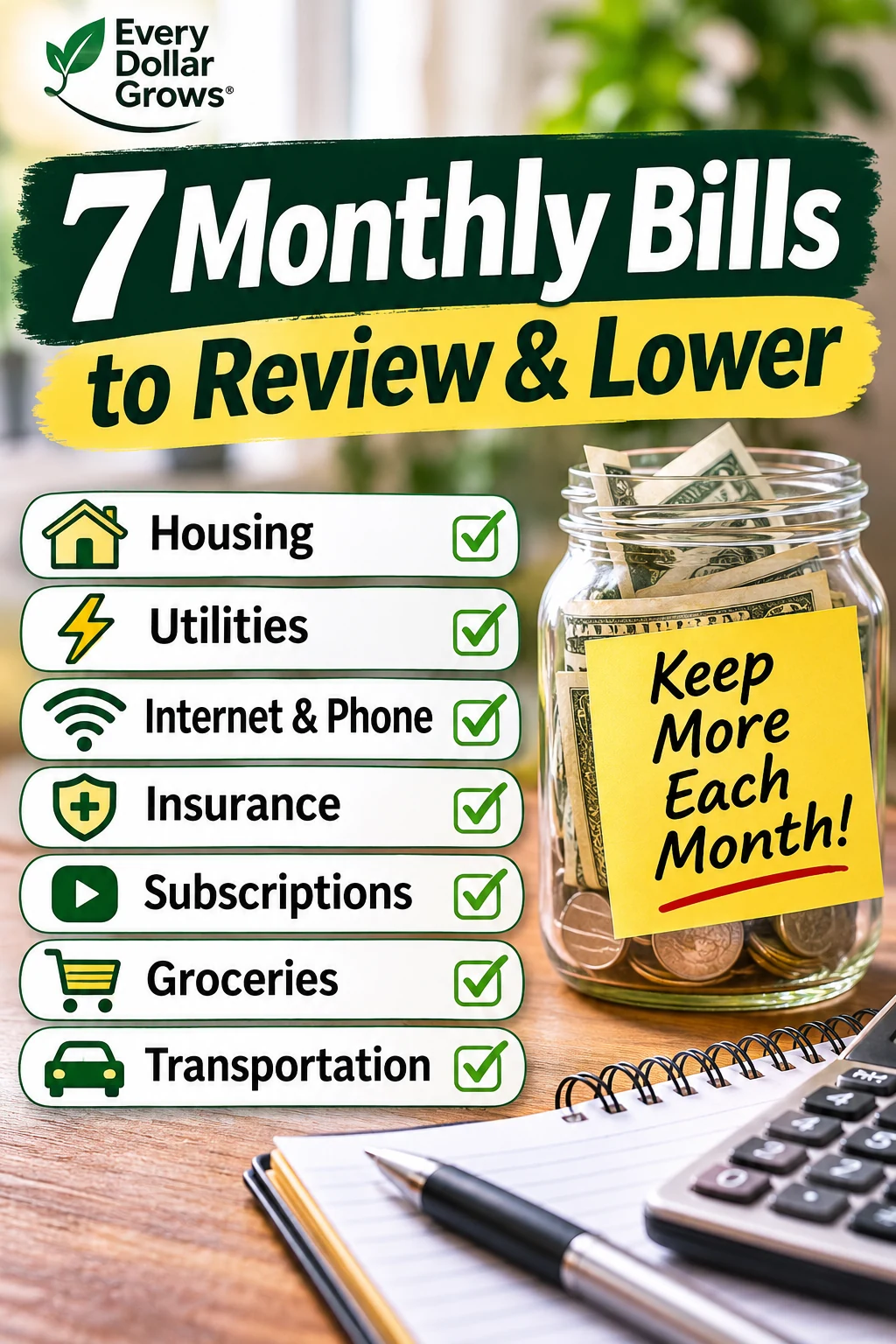
2. Seven Bills to Review and Lower
You do not need to eliminate every optional purchase to reduce household expenses. Start by finding better value for services you already use.
These seven categories cover many common recurring costs. Your best opportunities depend on local prices, contracts, family size, and household needs.
Use this checklist to identify which monthly bills deserve a closer look.
1. Internet and Mobile Phone Bills
Internet and phone plans deserve regular reviews because providers change prices and features while existing customers may remain on older plans.
- Check whether a promotional rate expired.
- Compare speed, data, and coverage against your needs.
- Ask about lower-cost plans and eligible discounts.
- Compare equipment, activation, and other fees.
- Check device compatibility and remaining payments before switching.
Example: Reducing an internet bill from $90 to $70 saves $20 per month, or $240 annually, before switching costs.
2. Auto, Home, and Renters Insurance
Insurance premiums vary between companies, but a lower price does not necessarily mean better value.
Request quotes using comparable liability limits, deductibles, coverage, and endorsements.
- Request multiple comparable quotes.
- Ask about available discounts.
- Compare bundled and separate policies.
- Consider higher deductibles only if you can afford the additional risk.
- Keep existing coverage active until replacement coverage begins.
The National Association of Insurance Commissioners provides consumer insurance guidance.
3. Electricity, Natural Gas, and Water
Utility bills depend on weather, usage, rates, and home efficiency. Compare consumption as well as the amount charged before deciding what to change.
- Repair leaking faucets and running toilets.
- Use efficient lighting when practical.
- Seal accessible air leaks.
- Maintain heating and cooling equipment.
- Review utility efficiency and assistance programs.
The Department of Energy’s Energy Saver offers practical household energy guidance.
Safety first: Do not reduce necessary heating, cooling, ventilation, or medical-related electricity use to unsafe levels.
4. Streaming Services and Subscriptions
Subscription charges can continue long after you stop using a service. Review entertainment, memberships, apps, software, and delivery programs.
- Cancel services you no longer use.
- Rotate entertainment subscriptions where practical.
- Check annual renewal dates.
- Keep cancellation confirmations.
- Verify the next statement for unexpected charges.
The Federal Trade Commission explains subscription and automatic-renewal problems.
5. Groceries and Household Supplies
Groceries are essential. The goal is not to buy less food than your family needs, but to reduce waste and unnecessary spending.
- Plan meals around food already available.
- Compare unit prices.
- Track grocery spending over several weeks.
- Reduce food waste.
- Watch delivery and convenience fees.
Use the EveryDollarGrows Grocery Budget Calculator to build a realistic grocery spending plan.
6. Transportation Costs
Transportation expenses include fuel, insurance, maintenance, parking, tolls, and financing. Review these separately without compromising reliability or safety.
- Combine errands when practical.
- Maintain proper tire pressure.
- Compare estimates for major repairs.
- Review unnecessary parking and toll costs.
- When refinancing, compare total interest and fees, not just the payment.
Delaying necessary maintenance can lead to more expensive repairs. Distinguish genuine savings from postponed costs.
7. Rent, Mortgage, and Housing Costs
Housing is often a household’s largest expense, but changing it can involve significant costs. Treat housing decisions as long-term financial comparisons.
Renters can review lease terms, optional services, and alternatives when moving is already being considered.
Homeowners may review insurance, property tax assessments, mortgage terms, and maintenance costs.
A lower mortgage payment does not automatically make refinancing worthwhile. Compare closing costs, loan length, and total interest.
Important: Moving expenses, deposits, commuting changes, and financing costs can outweigh a lower monthly housing payment.
3. Negotiate Lower Bills Before Switching Providers
One practical way to reduce monthly bills is to ask existing providers about lower-cost plans or discounts. A clear, informed request is usually a better starting point than an aggressive complaint.
Prepare Before Contacting a Provider
- Know your current total monthly charge.
- Understand which features you use.
- Find one or two comparable offers.
- Review contract and cancellation terms.
- Decide what price would make a change worthwhile.
Script: Request a Lower Ongoing Rate
“Hello, I’m reviewing our household expenses. I’m currently paying [amount] per month. I’d like to keep the service, but I’ve found comparable options at a lower price. Could you check whether there’s a less expensive plan or an available discount for my account?”
Script: Question a Price Increase
“My bill increased from [old amount] to [new amount]. Can you explain what changed? I’d like to know whether I can keep the features I need at a lower monthly price.”
Script: Confirm the Total Cost
“Before making a change, can you confirm the full monthly price including fees, how long the rate lasts, whether there are contract requirements, and what the price becomes after any promotion?”
Record the date, offer, confirmation number, and any promised discount. Check the next statement to confirm the reduction appears.
4. Monthly Bill Savings Calculator
Use this calculator to compare your current monthly charge with a proposed replacement. It accounts for promotional pricing and one-time switching costs.
Calculate Your First-Year Savings
Example: Why Promotional Prices Matter
Suppose your current internet bill is $90 per month. A competitor offers $60 per month for six months, followed by $85 per month for six months.
| Comparison | Calculation | Annual Cost |
|---|---|---|
| Current service | $90 × 12 | $1,080 |
| New service | ($60 × 6) + ($85 × 6) | $870 |
| First-year savings | Before switching fees | $210 |
The advertised $30 monthly discount lasts only six months. Comparing the full-year cost prevents you from overestimating your savings.
5. Which Bills Should You Lower First?
To reduce monthly bills efficiently, start with expenses that offer a reasonable combination of savings potential, low effort, and limited risk.
| Expense | Typical Effort | What to Check |
|---|---|---|
| Unused subscriptions | Low | Renewal and cancellation terms |
| Internet and phone | Low to medium | Coverage, fees, promotional rates |
| Insurance | Medium | Coverage and deductibles |
| Utilities | Low to high | Usage, safety, upgrade costs |
| Groceries | Medium | Food needs and waste reduction |
| Housing | High | Contracts, financing, moving costs |
Choose three expenses, compare realistic alternatives, and complete one worthwhile change before moving to the next.
6. A 30-Day Plan to Reduce Monthly Bills
This 30-day plan breaks the work into four manageable stages. Compare offers carefully, make informed changes, and track the results.
Week 1 — Review Your Bills
Gather statements, identify recurring charges, and select three expenses to investigate.
Week 2 — Compare Your Options
Research alternatives, request quotes, and review fees, coverage, and contract terms.
Week 3 — Make Smart Changes
Cancel unused services, negotiate better rates, or switch providers when the numbers justify it.
Week 4 — Track Your Savings
Save confirmations, verify new statements, and update your household budget with confirmed savings.

Monthly Bill Reduction Checklist
7. Give Your Monthly Savings a Purpose
Learning to reduce monthly bills is only part of improving your finances. The next step is deciding where the money should go.
For example, reducing recurring expenses by $65 per month creates $780 in annual cash flow if those reductions last all year.
Depending on your financial priorities, you could direct that money toward:
- Emergency savings: Build a reserve for unexpected costs.
- High-interest debt: Reduce balances and future interest.
- Irregular expenses: Prepare for repairs, insurance, and other predictable costs.
- Long-term goals: Strengthen savings and investments when appropriate.
The EveryDollarGrows Free Budget Tracker can help you assign savings to budget categories.
Use the Free Savings Goal Planner to work toward a defined goal.
8. Mistakes That Can Erase Your Savings
Choosing Lower Prices Without Comparing Value
A cheaper insurance policy may have weaker coverage or a higher deductible. A cheaper phone plan may have inadequate coverage where you live or work.
Ignoring Switching Costs
Activation charges, equipment purchases, installation fees, and cancellation penalties can reduce or eliminate savings.
Counting Temporary Discounts as Permanent
Record when a promotional rate expires. Calculate the first-year cost and consider the ongoing price.
Cutting Essentials Too Aggressively
Avoid reducing necessary food, medication, heating, insurance, or reliable transportation just to reach a savings target.
Failing to Verify the New Bill
Confirm that negotiated rates and cancellations actually take effect. Keep documentation in case a charge needs correction.
Frequently Asked Questions About Reducing Monthly Bills
How can I reduce monthly bills without sacrificing essentials?
Start with unused subscriptions, outdated plans, unnecessary fees, and comparable lower-cost options. Keep essential insurance, food, heating, medical care, and transportation in your budget.
Which monthly bills can you negotiate?
Internet, mobile phone, and some other service bills may have negotiable plans or discounts. Results depend on providers, contracts, alternatives, and your account.
How much can I save by lowering monthly bills?
There is no universal savings amount. Compare actual charges with alternatives, subtract switching costs, and account for promotional prices. Use the calculator above.
How often should I perform a monthly bill audit?
Review statements briefly each month. A detailed comparison every six to twelve months, or before major renewals, can reveal outdated plans and unexpected increases.
Should I switch insurance companies to reduce expenses?
Switching may help if another insurer offers better value. Compare coverage, deductibles, exclusions, and total premiums. Keep existing coverage active until replacement protection begins.
What if my household bills are already very low?
Avoid cutting essential services beyond safe or practical levels. Focus on cash-flow management, preventing fees, assistance programs, and sustainable income opportunities.
Trusted Consumer Resources
These independent resources can help you evaluate recurring expenses.
- FTC — Subscription Renewals and Cancellations
- NAIC — Consumer Insurance Information
- Department of Energy — Energy Saver
Turn Lower Bills Into Financial Progress
Once you reduce monthly bills, build the savings into a budget that supports your household’s needs and long-term financial goals.
Start with the EveryDollarGrows Budgeting Guide or organize your money with the Free Budget Tracker .
Editorial note: This article is educational. Examples are illustrative, and actual savings depend on prices, contracts, coverage, and household circumstances. Verify costs before changing services.