How to Build a Grocery Budget You Can Actually Follow
Stop guessing at the checkout. Set a realistic grocery number, divide it into usable targets, and always know what is safe to spend.
Free calculator below. No email required.
Your Grocery Budget Is Not Your Checking Balance
Seeing $1,200 in checking does not mean you have $1,200 available for groceries.
Get the Free Monthly Money Plan
Plan your income, expenses, savings, sinking funds and debt on one simple printable page.
That money may already be needed for your mortgage, electric bill, gasoline, insurance, school expenses, and everything else that has not cleared yet.
A grocery budget works only when it is separated from the rest of your money—at least mentally.
Choose a real number
Not a fantasy number. Not last month’s accidental total. A target your household can realistically use.
Know your pace
A monthly number is hard to feel. Weekly, daily, and per-trip targets are easier to use.
Check before shopping
Look at your grocery money—not your bank balance—before adding another item to the cart.
Check the Grocery Number, Not the Bank Number
Most Grocery Budgets Fail in the Middle of the Month
The first grocery trip usually feels fine. The second still looks manageable.
Then a warehouse-club run, household supplies, an extra dinner, or several small trips quietly eat the rest of the budget.
You usually do not know you overspent until the money is already gone.
A useful grocery system should tell you what remains before the next trip—not after the month ends.
Grocery Budget Calculator
Use this as a practical starting estimate. Then adjust it using what your family actually eats and what food costs where you live.
Estimate a Realistic Monthly Grocery Budget
Enter your household details. Results update when you select “Calculate My Budget.”
This is a planning estimate, not an official spending standard. Use recent receipts and local prices to fine-tune it.
Grocery Envelope™ helps you keep track of what remains after each trip.
See how Grocery Envelope works →Do Not Treat the Calculator Like a Command
The result gives you a starting point. Your actual grocery budget may need to be higher or lower.
Compare it with your recent spending
Look at the last four to eight weeks of grocery purchases. Ignore one unusually high or low trip.
For the full weekly process—from the calendar and pantry to portions and the grocery list—use the family meal planning guide.
Pick a realistic first target
A family spending $1,200 is unlikely to succeed by suddenly forcing the budget down to $650.
Reduce it in small steps
Cutting $50 and sticking to it is more useful than choosing an impressive number you abandon in ten days.
Reduce overspending without making groceries feel like a punishment.
You Set the Budget. Now How Do You Stick to It?
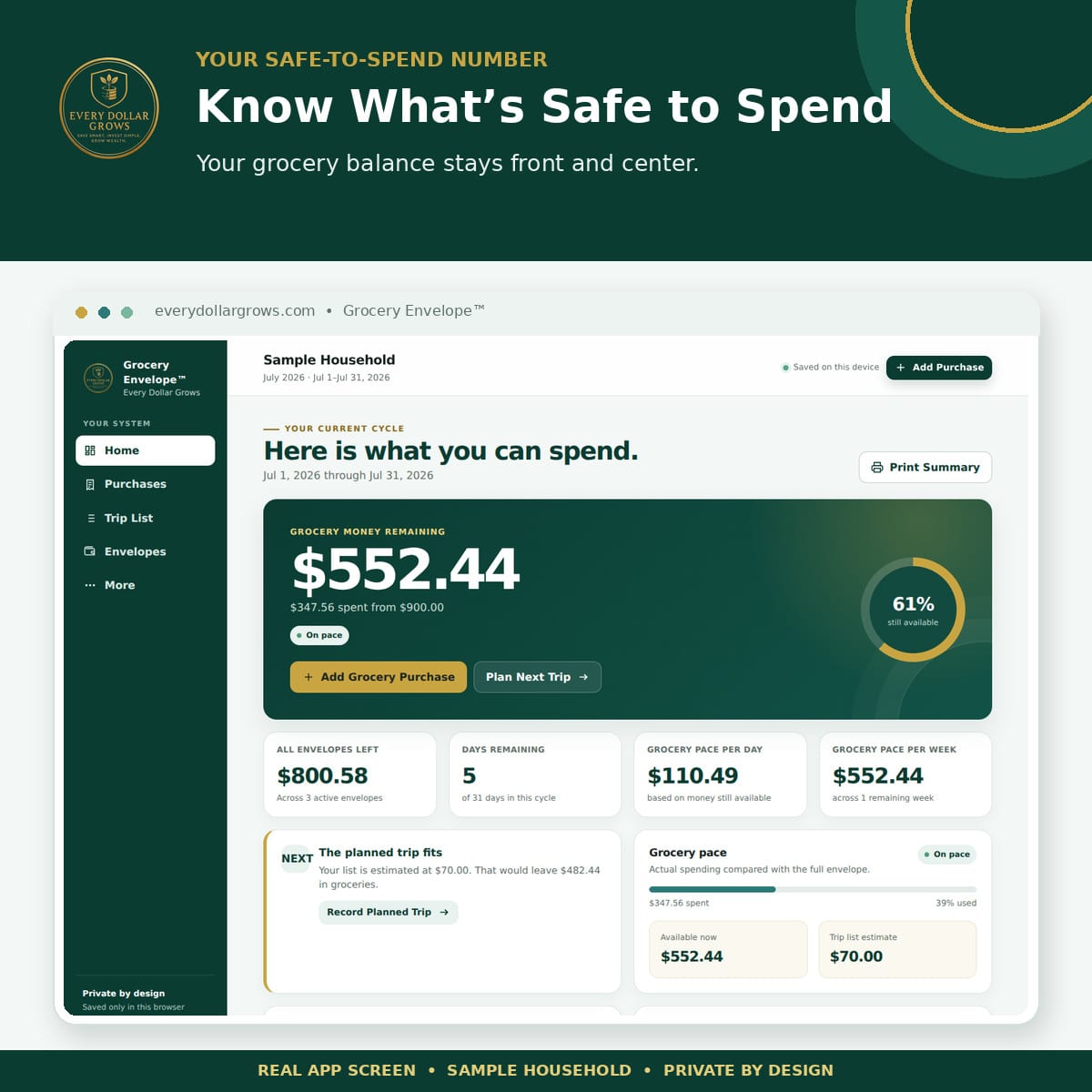
A monthly grocery number does not tell you what is safe to spend today.
After three grocery trips, a warehouse-club purchase, and a receipt containing both food and household items, the math gets messy.
Grocery Envelope™ was built to keep that number clear.
See how much grocery money remains.
Check whether your spending pace is on track.
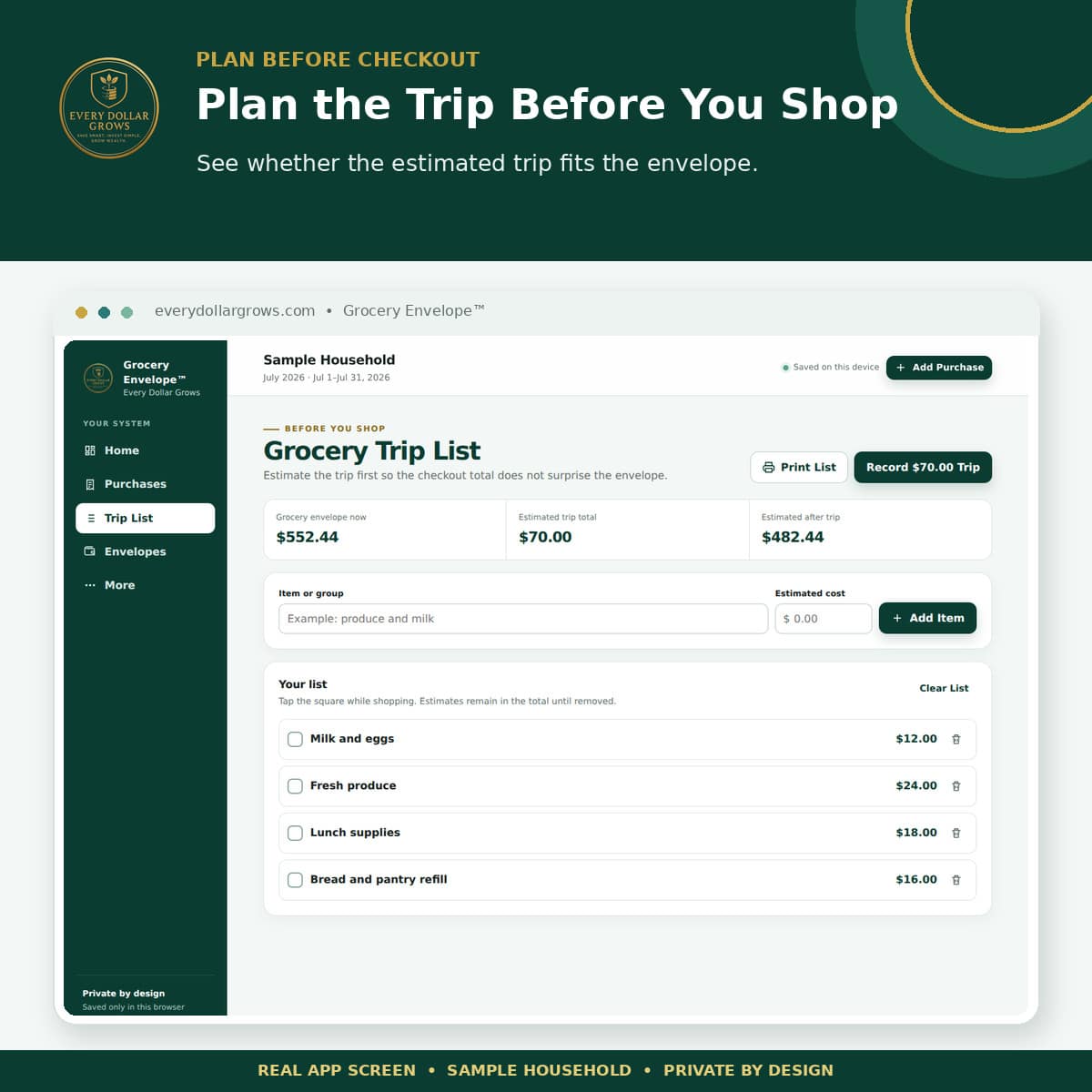
Plan the next trip before entering the store.
Split mixed receipts between grocery and household envelopes.
A Monthly Number Is Too Easy to Ignore
A $900 monthly grocery budget sounds clear until you are standing in the store on the 19th.
What matters then is not the original budget. It is how much remains, how many days are left, and how many trips you still expect to make.
Use a weekly target, a daily pace, and a rough per-trip limit so you can tell whether the next purchase fits.
Grocery Envelope Starter Calculator
Already know your monthly grocery budget? Turn it into practical paycheck, weekly, daily, and shopping-trip targets.
Break Your Grocery Budget Into Smaller Targets
This calculator does not track spending. It helps you set up the numbers you will use.
A small amount left unassigned can absorb price changes, forgotten ingredients, or an extra milk-and-bread trip.
Your trips will not all cost the same. Use the trip number as a planning average, not a hard rule.
Grocery Envelope™ keeps the remaining balance and spending pace updated after each purchase.
Get Grocery Envelope™ for $9 →What a $900 Grocery Budget Looks Like in Real Life
Suppose your family chooses a $900 monthly grocery budget and keeps 10% in reserve.
$810 for planned spending
This is the amount you expect to use across regular grocery trips during the month.
$90 held back
This covers forgotten items, price surprises, or a necessary extra trip.
About $162 per trip
With five planned trips, this gives you a useful average before you enter the store.
You may spend $210 on one large trip and $95 on the next. That is fine.
The goal is not to make every trip identical. The goal is to keep the full month under control.
Know Three Numbers
Open the Grocery Number Before You Open the Cart
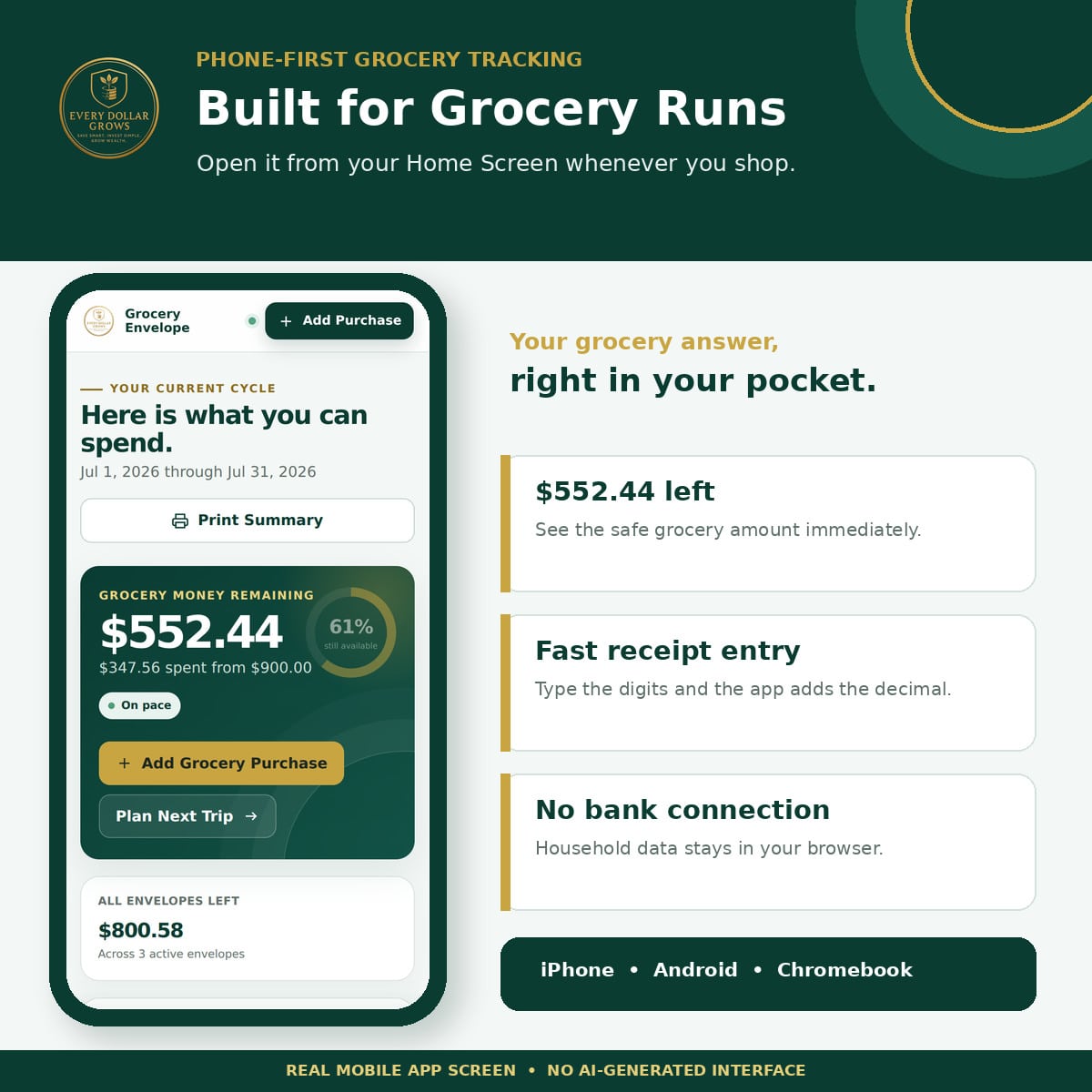
The most useful moment to check your budget is before shopping—not after the receipt prints.
Check how much grocery money remains.
Look at the suggested amount for the next trip.
Adjust the shopping list before entering the store.
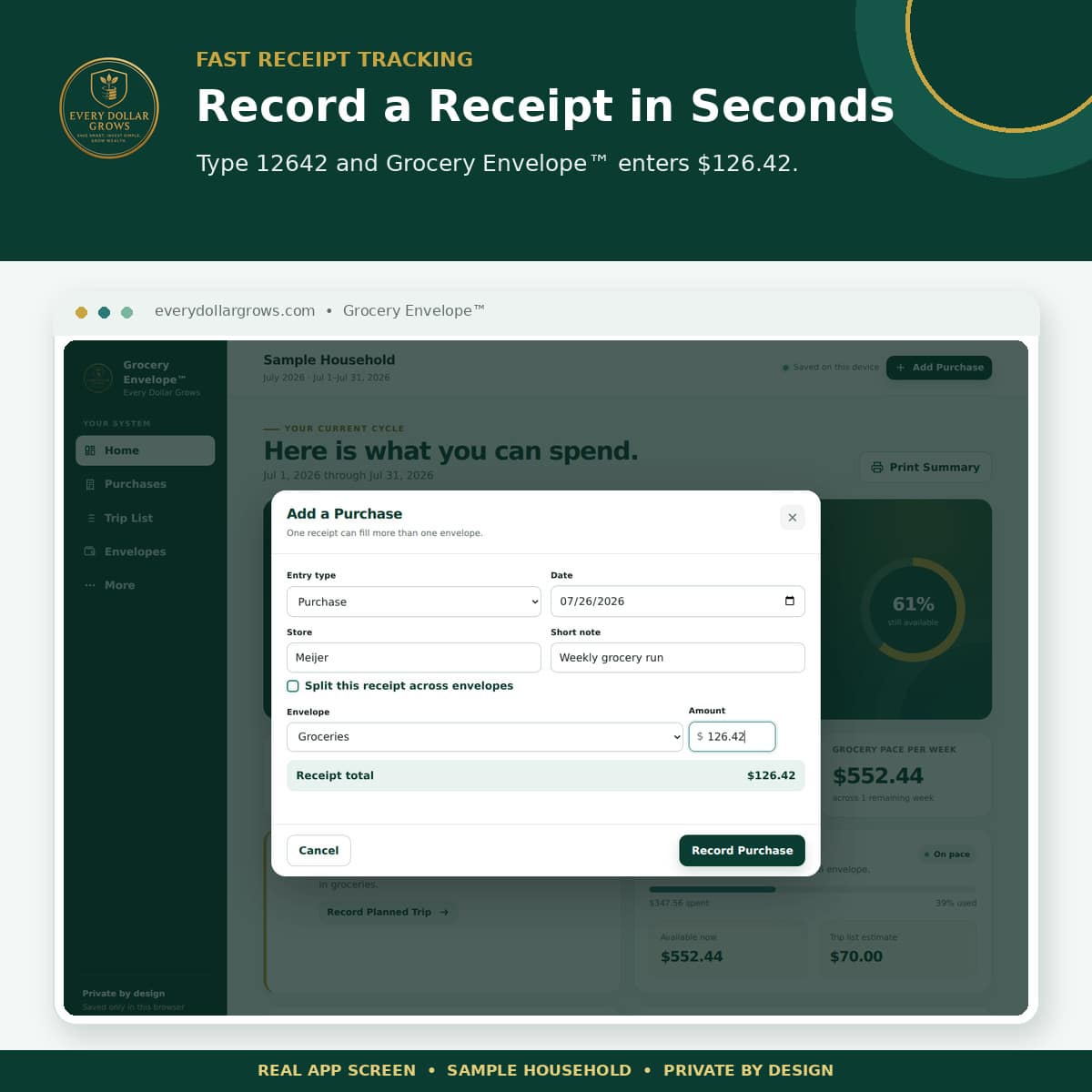
Record the purchase while the receipt is still in your hand.
That short routine turns the budget into a shopping decision instead of an end-of-month report.
Do Not Let Paper Towels Ruin Your Grocery Numbers
A typical store receipt may include food, cleaning supplies, toiletries, medicine, pet items, and clothing.
If every dollar is recorded as groceries, the grocery category looks worse than it really is.
Record food as groceries and move non-food items to the envelope or category where they belong.
$112 total receipt
This is what left your bank account at checkout.
$84 groceries
Food and grocery items reduce the grocery envelope.
$28 household
Paper products and cleaning supplies reduce the household envelope.
Grocery Envelope™ includes receipt splitting so one purchase can reduce the correct envelopes without distorting your food spending.
Five Grocery Habits That Actually Help
You do not need a complicated system. Start with the few habits that change what reaches the checkout.
Shop your kitchen first
Check the refrigerator, freezer, and pantry before building the list. Use what is already open or close to expiring.
Plan a few dependable meals
Choose meals your household will actually eat. A simple plan is better than an ambitious plan that becomes takeout.
Build the list around the budget
If the expected cart is too expensive, change the list before you reach the store.
Use pickup when impulse buying is a problem
Online ordering can make it easier to see the running total and remove unnecessary items before checkout.
Record the purchase immediately
Waiting several days makes the budget less trustworthy and turns receipt entry into a chore.
The Cheapest Grocery Budget Is Not Always the Best Grocery Budget
A budget that causes constant frustration, repeated shortages, and emergency trips is not truly working. Choose the lowest amount your household can follow consistently—not the lowest number that looks impressive.
What Usually Causes Grocery Overspending?
Too many unplanned trips
A $22 stop does not feel serious, but several small stops can consume the remaining budget.
No separation from checking
The bank balance makes the cart feel affordable even when the grocery category is nearly empty.
Household items mixed in
Non-food purchases can make grocery spending look higher and hide where the money actually went.
A budget set too low
An unrealistic number creates repeated failure rather than useful spending limits.
No plan for the final week
Spending too quickly early in the month leaves too little for milk, produce, and basic restocking.
Receipts entered too late
A budget cannot guide the next decision when the balance is several purchases behind.
Grocery Envelope™ Keeps the Important Number Visible
It is not a full bank-connected budgeting platform.
It is a focused grocery-budget tool designed to answer one practical question:
How much is safe to spend?
No bank connection required.
No monthly subscription.
Your entries stay in your browser unless you export a backup.
Use custom envelopes for groceries, household items, or other store spending.
A Grocery Budget Should Make Shopping Easier
The goal is not to track every crumb or feel guilty about every purchase.
The goal is to make one household expense predictable enough that it stops surprising the rest of your budget.
How much did we set aside? How much is left? What is safe to spend next?
Set the starting amount
Choose a realistic monthly number using your recent spending, household size, and local prices.
Record each purchase
Keep the remaining balance accurate so it can guide the next shopping trip.
Adjust as you learn
Change the budget when real spending shows that your first target was too high or too low.
Use This 30-Day Grocery Budget Reset
You do not need to rebuild your entire financial life. Focus on one month and learn from what happens.
Choose your monthly grocery amount
Use the calculator above or review your last several weeks of grocery purchases.
Decide what counts as groceries
Choose whether household supplies, pet food, toiletries, and other store purchases belong in separate envelopes.
Set aside a small buffer
Reserve 5% to 10% for forgotten items, price changes, or an extra restocking trip.
Check the balance before every trip
Use the remaining grocery balance and expected trips to decide what is safe to spend.
Review the month without judging it
If the budget was too low, raise it. If money was left, decide whether to lower the target or carry the extra forward.
Lower the Grocery Budget Without Cutting Everything
Start with the spending that adds cost without adding much value.
Reduce duplicate snacks and drinks before cutting full meals.
Use ingredients already in the pantry and freezer.
Replace a few convenience foods with simpler alternatives.
Choose two or three low-cost meals your family already likes.
Reduce unplanned store visits that turn into extra purchases.
A grocery budget should still provide enough food. The goal is to remove waste and overspending—not create shortages.
A Good Grocery Budget Can Be Checked in Seconds
If your system takes too long to update, you will stop using it. Keep the number visible, enter purchases quickly, and make the next decision from the remaining balance.
Keep Building a Grocery Budget That Works
Use these practical guides and trusted resources to strengthen your grocery budget, improve your overall monthly plan, and compare your spending with broader food-cost guidance. For the full household framework, start with the complete budgeting guide.
Independent food-planning resources: Compare your starting estimate with USDA monthly food-cost reports and find meal-planning guidance through USDA meal-planning and budgeting resources .
External resources are provided for general education. Your household’s actual grocery needs and local prices may differ.
Grocery Budget FAQ
How much should I budget for groceries each month?
Your grocery budget depends on household size, food prices, dietary needs, where you shop, and how often you eat away from home.
Use the calculator above as a starting estimate, then compare it with four to eight weeks of actual grocery spending.
Should household supplies be included in the grocery budget?
They can be, but separating them usually gives you a clearer picture of food spending.
Grocery Envelope™ lets you create separate envelopes and split one receipt between grocery and household purchases.
What if I go over my grocery budget?
First, identify why it happened. The budget may have been unrealistic, or one unusual trip may have caused the overage.
Adjust the next month using what you learned instead of repeatedly choosing a number that does not fit your household.
Should I use a weekly or monthly grocery budget?
Use both.
The monthly budget sets the full limit. The weekly pace helps you avoid spending too much early in the month.
How much should I spend on each grocery trip?
Divide the usable grocery budget by the number of expected trips to create an average trip target.
Do not force every trip to match that number exactly. Large restocking trips and smaller fill-in trips will naturally cost different amounts.
How can I stop overspending at the grocery store?
Check the remaining grocery balance before shopping, use a list, plan a rough trip limit, and record the purchase immediately.
Online pickup may also help if impulse purchases are a consistent problem.
Does Grocery Envelope™ connect to my bank?
No. Grocery Envelope™ does not require a bank connection.
You enter purchases manually so the app can update your grocery balance and spending pace.
Is Grocery Envelope™ a subscription?
No. Grocery Envelope™ is available as a $9 one-time purchase.
Can I use Grocery Envelope™ on my phone?
Yes. The app can be used in a mobile browser and added to an iPhone home screen for easier access.
Never Wonder What Is Safe to Spend on Groceries Again
Your checking balance cannot tell you how much grocery money is left.
Grocery Envelope™ gives you one clear place to see your remaining balance, spending pace, trip target, and purchase history.
No bank connection required. Purchases are entered manually.
More Practical Budgeting Help
A grocery budget works best when the rest of your money also has a clear job.
How to Make a Budget for Beginners
Build a simple monthly plan for income, bills, spending, saving, and debt.
Digital Budgeting Tools
Explore practical tools designed to make budgeting decisions easier.
More Budgeting Guides
Find straightforward help for managing bills, spending, saving, and everyday money.