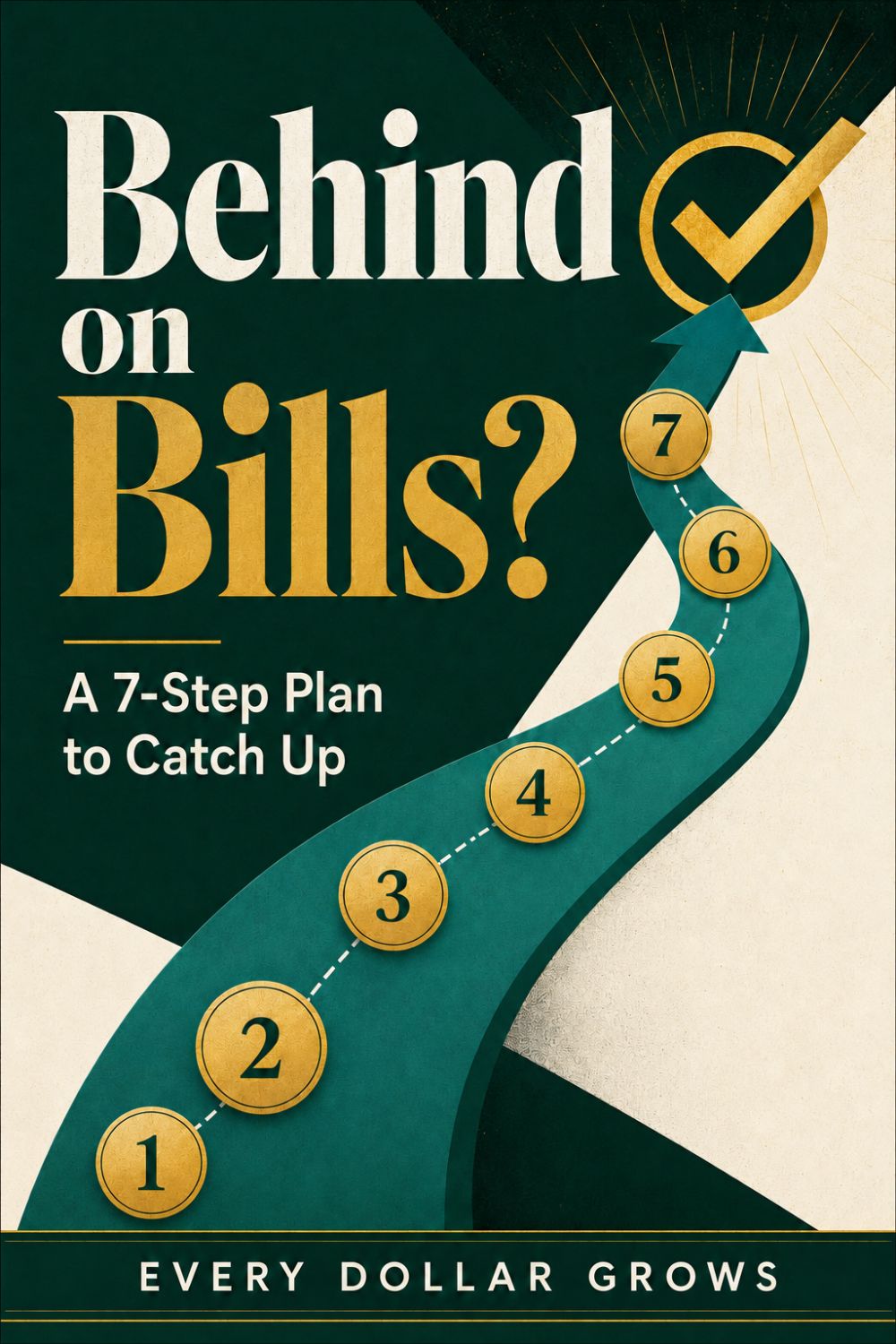
A practical 7-step recovery plan
How to Catch Up on Bills: Start Here
When there is not enough money to pay everything, the goal is not to create a perfect budget overnight. The goal is to protect what matters most, stop the situation from getting worse, and give every available dollar a job.
If you are behind on bills, it can feel as if every payment is urgent. The phone rings, past-due notices arrive, late fees grow, and the pressure makes it hard to decide what to do first. Learning how to catch up on bills starts with separating real consequences from financial noise.
Get the Free Monthly Money Plan
Plan your income, expenses, savings, sinking funds and debt on one simple printable page.
But every unpaid bill does not carry the same consequence. Missing a housing payment, allowing essential utilities to be disconnected, losing the transportation that gets you to work, or letting required insurance lapse can damage the rest of your financial life much faster than a late payment on an unsecured debt.
This guide will help you build that plan. It is designed for a temporary cash shortage or a household trying to recover from missed payments. If your income cannot cover basic living expenses even after reasonable cuts, the real problem may be an ongoing income or fixed-cost gap. We will address that honestly too.
What You Will Do
- Get every current and past-due bill onto one page
- Separate immediate household risks from lower-priority pressure
- Calculate the exact amount available for catching up
- Call creditors and service providers before the next missed payment
- Build a paycheck-by-paycheck recovery schedule
- Create a small buffer so one surprise does not restart the cycle
Table of Contents
- The first move when you are behind
- The 7-step catch-up plan
- Past-due bill catch-up calculator
- Free Bill Catch-Up Planner
- Which bills should be paid first?
- What to say when you call
- A realistic catch-up example
- When the income truly is not enough
- Mistakes that make the problem worse
- What to do after you catch up
- Frequently asked questions
The First Move When You Are Behind on Bills
Your first move is not to pay the smallest bill, the oldest bill, or the company calling most often. When you need to catch up on bills, your first move is to see the entire situation clearly.
Gather your bank balance, expected income, bill statements, past-due notices, minimum payments, and due dates. Include bills that are current. A catch-up plan can fail when all available cash goes toward old balances and there is nothing left for the rent, mortgage, utilities, groceries, or transportation coming due next.
If your numbers are scattered, start with the free Every Dollar Grows Budget Tracker. You need one honest snapshot—not a complicated new system.
How to Catch Up on Bills: The 7-Step Plan
Use these seven steps in order. They turn the broad goal to catch up on bills into a series of decisions that fit the money and deadlines in front of you.
List Every Bill in One Place
Create one list that includes current bills and past-due amounts. For each account, write down:
- The normal monthly amount
- The total amount currently past due
- The next due date
- Any shutoff, cancellation, repossession, eviction, foreclosure, or court deadline
- The smallest payment or arrangement the company will accept
Do not rely on memory. Financial stress makes details feel louder and less organized than they really are.
Calculate the Cash Available Before the Next Payday
Add only money you know will arrive: the cash currently available, confirmed paychecks, dependable benefits, or other certain income. Do not build the plan around overtime, a sale, a tax refund, or side income that has not happened yet.
The result may be uncomfortable, but it gives you the one number your plan must respect. If the catch-up amount is $85, assigning $400 to old bills will only create a new shortage somewhere else.
Protect Housing, Income, and Essential Services
Prioritize the expenses that keep your family housed, keep essential services running, protect your ability to earn income, maintain necessary insurance, and satisfy required legal obligations.
The Consumer Financial Protection Bureau’s bill-prioritizing guidance uses this same consequence-first approach. The loudest bill is not automatically the most important bill.
Pause Optional Spending for One Pay Cycle
This is a short recovery period, not a permanent punishment. Pause expenses that can safely wait: restaurant meals, nonessential shopping, paid entertainment, convenience purchases, and subscriptions you can cancel without a costly penalty.
Focus on a defined window—such as the next 14 or 30 days. An endless restriction plan is hard to follow. A short stabilization sprint creates a clear finish line.
Call Every Company You Cannot Pay on Time
Call before the due date when possible. Ask about a changed due date, short-term hardship plan, fee waiver, payment arrangement, temporary extension, or a way to divide the amount between paychecks.
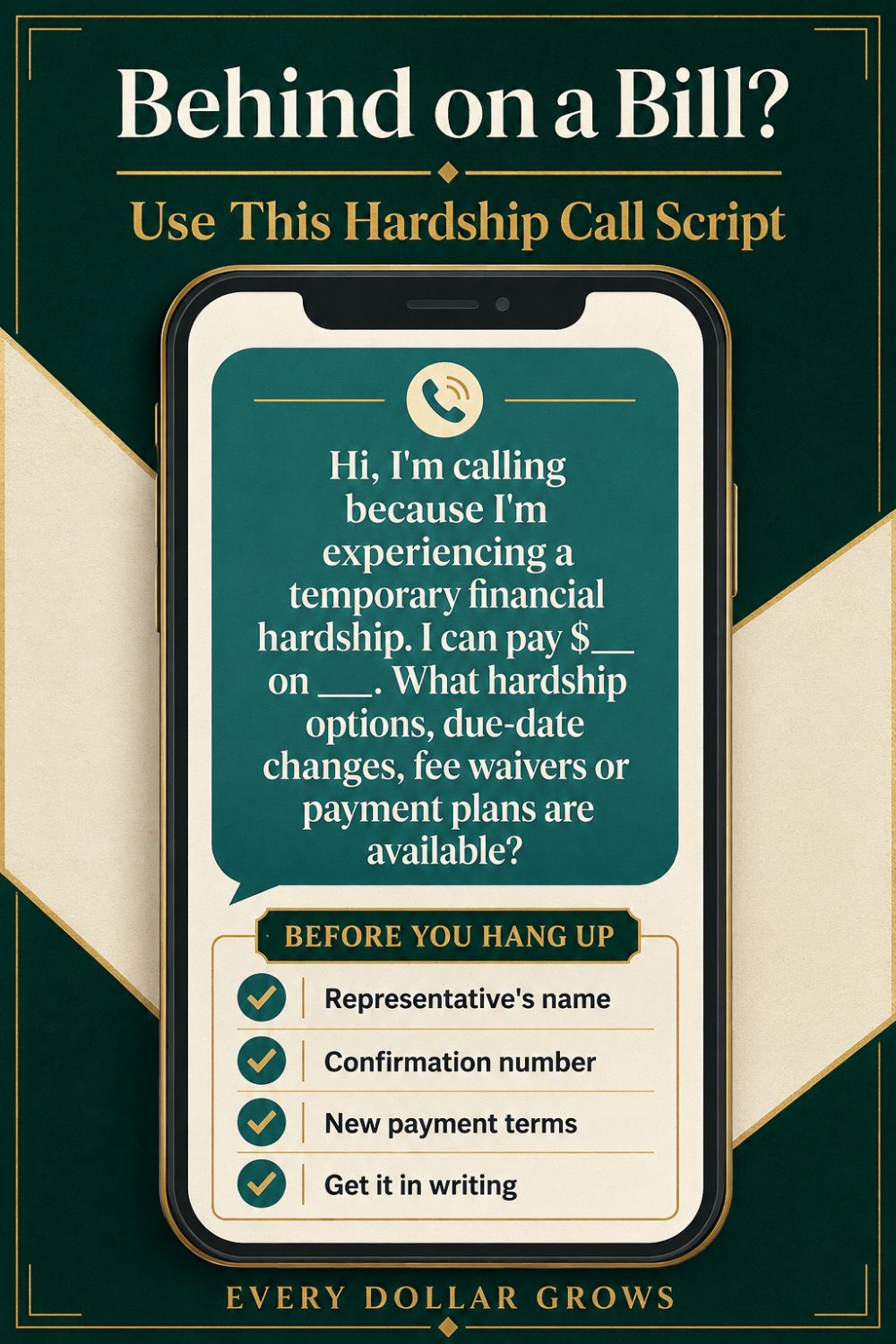
Get the representative’s name, confirmation number, agreed amount, and deadline. Ask whether the arrangement changes interest, account status, service, or credit reporting. Keep notes and request written confirmation when available.
Assign Past-Due Amounts to Specific Paychecks
Do not write “catch up on bills” as one giant monthly goal. Give each paycheck a short job list:
- Essential household bills due before the next paycheck
- Food and work transportation needed until the next income arrives
- A small protected buffer so one surprise does not restart the cycle
- The catch-up payment that safely fits after those needs are covered
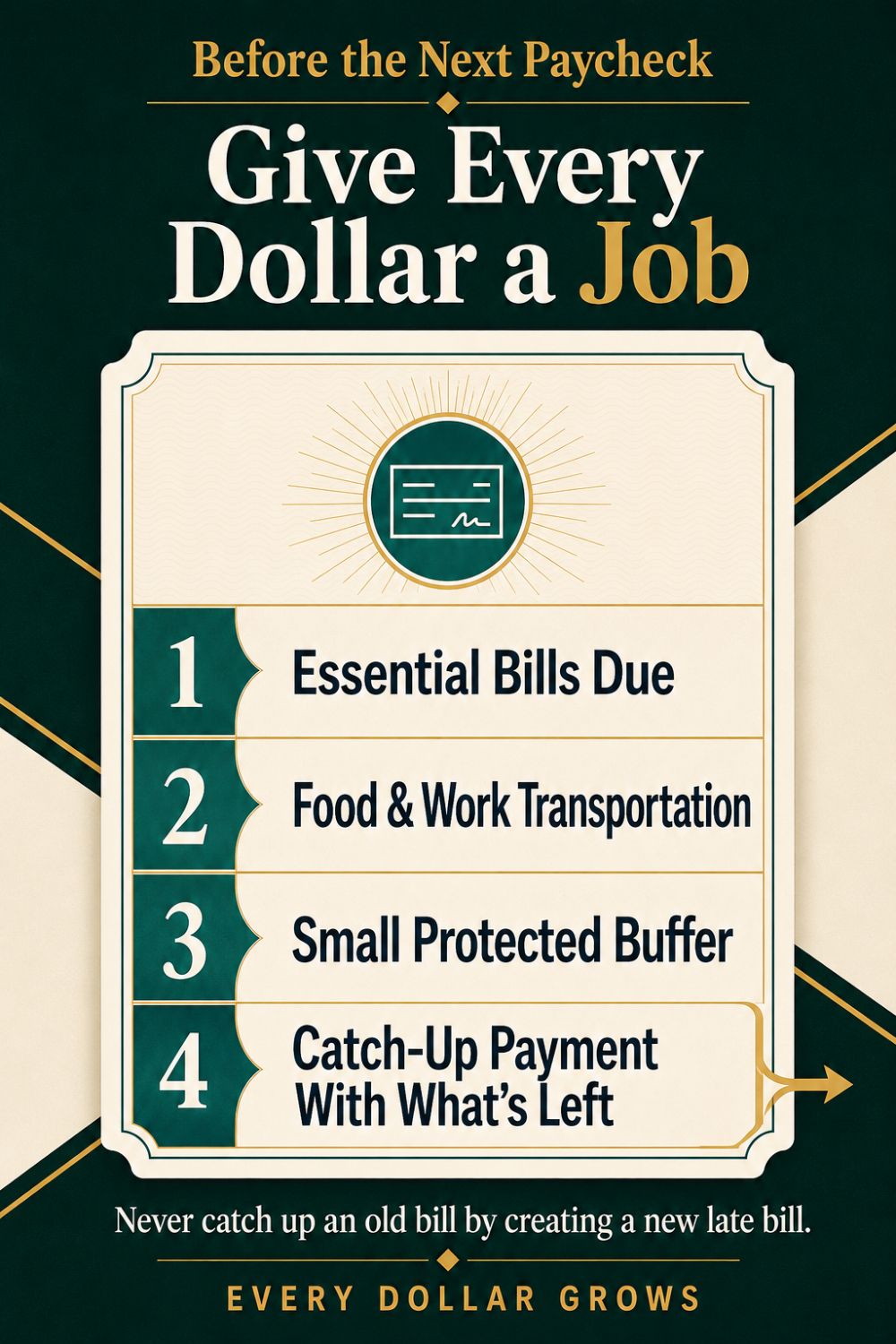
This is a cash-flow budget. It solves the timing problem that a broad monthly budget can hide.
Review the Plan Every Seven Days
Update balances, confirm arrangements, and adjust the next paycheck before it arrives. Do not wait until the end of the month to discover that groceries, gas, or an irregular bill used the money intended for catching up.
A weekly review should take about five minutes: What cleared? What changed? What must the next dollar do?
Free interactive tool
Past-Due Bill Catch-Up Calculator
See how much you can safely put toward overdue bills before your next payday—without using money needed for current essentials or your protected buffer.
Next move: Enter your numbers to create a catch-up estimate.
This calculator is an educational planning tool. It does not determine the legal priority of a debt or guarantee that a provider will accept a payment. Contact each provider about deadlines, account consequences, and available arrangements.
Which Bills Should You Pay First?
There is no universal list that fits every household, contract, or state law. The best order is based on the consequence of not paying. This is the central rule when you are trying to catch up on bills. In general, work through these categories first:
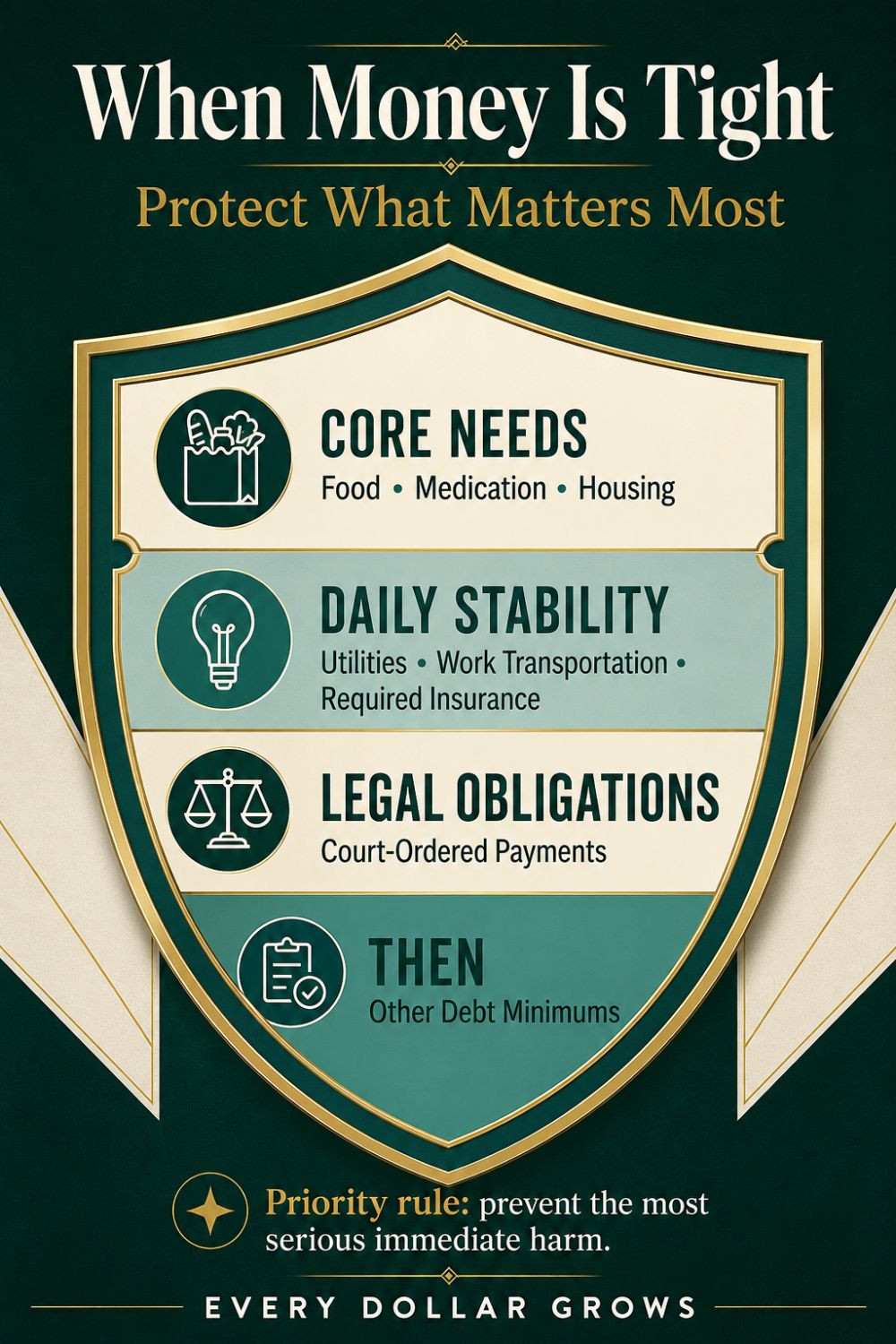
Cover basic groceries, essential medication, and urgent household needs before unsecured debts.
Rent or mortgage, electricity, heat, water, and other services required to keep the home safe and usable.
Transportation, fuel, necessary car payments, childcare required for work, and essential work expenses.
Auto, health, home, renters, or other coverage whose lapse could create a larger financial or legal risk.
Child support, tax arrangements, fines, or other obligations with legal consequences need individual attention.
Credit cards, medical balances, personal loans, and collection accounts still matter, but often offer more room to negotiate than immediate household necessities.
Use a Consequence Column, Not Just a Due-Date Column
A due date tells you when a payment was expected. A consequence column tells you what is at risk. That is the information you need when cash is short.
| Bill | Amount Due | Consequence | Next Action |
|---|---|---|---|
| Rent or mortgage | Current + past due | Fees, eviction, or foreclosure risk | Contact provider and protect housing |
| Electric or heat | Past-due balance | Possible disconnection | Ask about a payment plan or assistance |
| Vehicle payment | Past-due amount | Transportation or repossession risk | Call lender and protect work transportation |
| Credit card | Minimum + past due | Fees, interest, credit damage, collection | Request hardship options before sending money |
| Medical balance | Past-due amount | Collection risk; options vary | Ask about an itemized bill, assistance, or payment plan |
What to Say When You Call About a Past-Due Bill
You do not need a long explanation. Be direct, calm, and specific about what you can pay.
“I am dealing with a temporary cash shortage and I want to keep this account from falling further behind. I can pay $___ on ___ and $___ on ___. What short-term hardship options, payment arrangements, due-date changes, or fee waivers are available? Before I agree, can you explain how the arrangement affects my account status, interest, service, and credit reporting?”
Never promise an amount you cannot keep. A smaller agreement that fits your cash flow is more useful than a larger promise that creates another missed payment.
Questions Worth Asking
- Can the due date be moved closer to my payday?
- Can the past-due amount be divided across several payments?
- Is there a temporary hardship or reduced-payment program?
- Can any late fee, reconnection fee, or penalty be waived?
- What exact amount prevents cancellation, shutoff, or further action?
- How will this arrangement be reported, and can I receive it in writing?
The Federal Trade Commission also advises consumers who are behind to contact creditors directly and try to arrange manageable payments. Be cautious with companies promising fast debt relief. Review the FTC’s current guidance on avoiding debt-relief scams before paying a third party.
A Realistic Catch-Up Budget Example
The situation
A household has $3,900 available this month. Current essential expenses total $3,360. The household is also $940 behind across a utility bill, vehicle payment, credit card, and medical bill.
The household cannot responsibly send $940 to old bills this month. Doing that would leave current expenses short by $400 and restart the cycle.
Instead, it protects the $3,360 needed for current essentials. It then calls each provider. The utility agrees to accept $180 to prevent disconnection, the auto lender accepts a $250 catch-up payment, and the credit card company waives one fee and schedules a smaller payment. The remaining money stays available for the agreed credit-card payment and a small margin rather than being spent casually.
Next month, the household continues the arrangements and directs the new catch-up amount toward the highest-consequence remaining balance. The recovery takes more than one paycheck, but it stops producing new late bills.
The lesson is simple: you catch up on bills by becoming more current after every paycheck without allowing today’s essentials to fall behind. The goal is not to erase every past-due balance immediately.
Put the Numbers on One Page
Use the free Every Dollar Grows Budget Tracker to organize your income, current expenses, and available catch-up money before deciding what each paycheck can cover.
What If Your Income Truly Is Not Enough?
A plan to catch up on bills works only when there is eventually enough income to cover ongoing essentials plus some portion of the past-due balances. If the regular numbers remain negative after reasonable cuts, you do not have a motivation problem. You have a structural gap.
That gap usually comes from one or more of four places:
- Fixed costs are too high. Housing, transportation, insurance, childcare, or debt payments consume too much of the household income.
- Income is temporarily lower. Reduced hours, job loss, illness, or another disruption created a short-term shortage.
- Variable spending is leaking. Groceries, eating out, convenience spending, subscriptions, or irregular purchases are using more cash than expected.
- The monthly plan ignores irregular bills. Repairs, school costs, annual fees, gifts, and seasonal expenses keep appearing as “surprises.”
Do not try to solve a $700 monthly deficit by finding $40 in subscriptions. Cuts can help, but the solution must be large enough to match the gap. You may need a combination of temporary assistance, creditor arrangements, additional income, a lower fixed cost, or professional housing or credit counseling.
When Outside Help Makes Sense
Consider qualified help when you are facing eviction or foreclosure, repeated utility shutoffs, possible repossession, court action, collection lawsuits, or a monthly deficit that cannot be closed. A reputable nonprofit credit counselor or certified housing counselor can help evaluate options. Avoid anyone who guarantees that debt will disappear or demands money before explaining the service in writing.
Six Mistakes That Make Falling Behind Worse
What to Do After You Catch Up on Bills
Once you catch up on bills, keep directing the old catch-up amount toward stability. If you were putting $200 per paycheck toward past-due balances, that money should not automatically disappear back into everyday spending. Once the immediate crisis is stable, use the complete budgeting guide to rebuild the full monthly system around bills, spending, savings, and debt.
For the full sequence from budgeting through saving and financial stability, use the budgeting and saving money guide.
- Build a checking-account cushion. Start with enough to reduce timing problems and accidental overdrafts.
- Create sinking funds for predictable irregular costs. Car repairs, school expenses, annual fees, holidays, and home maintenance are not monthly, but they are not truly unexpected.
- Build a starter emergency fund. Use this guide to build your first $1,000 emergency fund.
- Attack expensive debt with a deliberate method. Once the household is stable, follow a debt payoff plan that works in real life.
- Keep the weekly review. Five minutes of early attention is easier than another month of emergency decisions.
Catching up is a real financial milestone. You are not merely paying old bills. You are rebuilding control over the order in which your money moves.
Still Unsure What Is Keeping You Stuck?
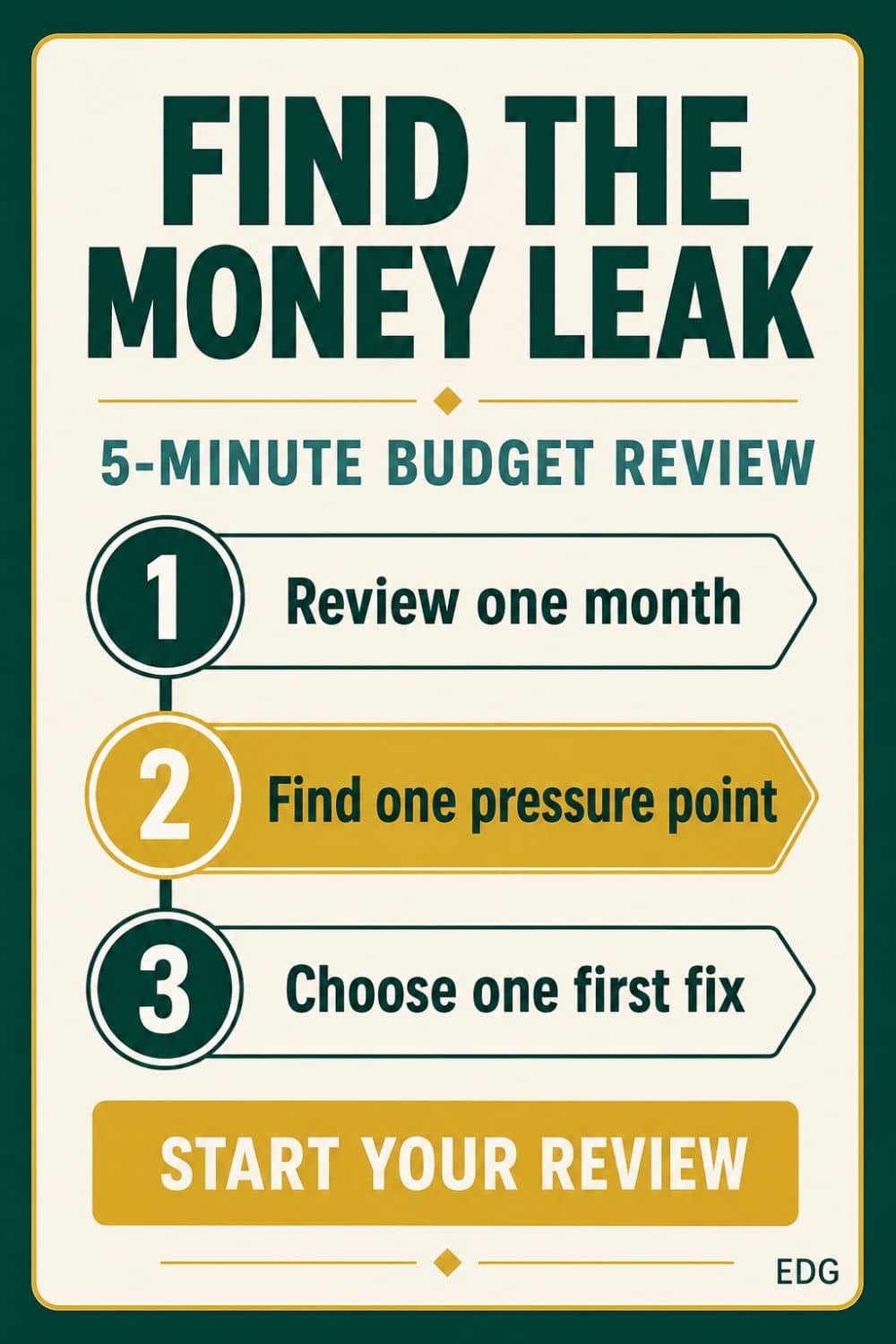
The Budget Review System helps you review one month of spending, identify the category or payment creating the most pressure, and choose one clear next step.
Frequently Asked Questions
How long does it take to catch up on bills?
To estimate how long it will take to catch up on bills, divide the total past-due amount by the realistic amount you can direct toward catching up each month. Then adjust for fees, interest, and any payment arrangements. For example, $1,200 of past-due bills with $300 available each month takes roughly four months before added charges. A slower plan you can maintain is better than an aggressive plan that causes new missed payments.
What bill should I pay first when I cannot pay everything?
Prioritize according to consequences. Protect food, medication, housing, essential utilities, your ability to earn income, necessary insurance, and required legal obligations. Then address other debts. Exact priorities depend on your contracts, deadlines, household needs, and local law.
Should I pay the smallest past-due bill first?
Not automatically. Paying off a small balance can create momentum, but it should not come before a payment that prevents eviction, utility shutoff, repossession, loss of insurance, or another serious consequence. Stabilize the household first.
Can creditors change my due date or waive a late fee?
Some companies may offer due-date changes, short-term hardship plans, split payments, or fee waivers, but availability varies. Ask before the payment is due when possible, understand how the arrangement affects the account, and request confirmation.
Should I use savings to catch up on bills?
Emergency savings may be appropriate for protecting housing, essential utilities, necessary transportation, medical needs, or another genuine emergency. Avoid draining every dollar without fixing the reason the bills fell behind. Preserve some margin when possible so the next small surprise does not force new borrowing.
Should I take out a loan to catch up?
A new loan can add another required payment and may only postpone the problem. Before borrowing, confirm that the regular monthly budget will be positive after the new payment begins. Compare the total cost and risks carefully, and be especially cautious with payday, title, or high-fee loans.
One Clear Next Step
If you feel frozen and do not know how to catch up on bills, do only this today: write down the cash available, the income arriving before your next payday, and the bills that could threaten housing, utilities, transportation, insurance, or legal standing. That one page will tell you where the first call and the first dollar should go.
You do not have to solve the entire month today. You need to make the next decision in the right order.
Educational note: This article provides general personal-finance education and is not individualized financial, legal, tax, or credit advice. Account terms, assistance programs, collection rights, and legal consequences vary. Contact the relevant provider or a qualified professional about your situation.