
Student Loan Repayment Plans in 2026: Compare the Plans Your Loans Can Use
This student loan repayment plans 2026 guide starts with loan dates and types, then compares payment, total cost, forgiveness credit, taxes, and risk—not just the smallest first bill.
Part of the Complete EDG Student Loan Guide.
The short answer
- New eligible Direct Loans disbursed on or after July 1, 2026 generally use RAP or Tiered Standard.
- Borrowers with only older loans may retain IBR and certain transition options; SAVE ended and PAYE/ICR sunset no later than July 1, 2028.
- Parent PLUS and mixed loan histories require separate eligibility review.
- Compare total outcome: payment, term, interest, forgiveness credit, taxes, and flexibility.
The first question is when—and what—you borrowed
A generic repayment chart cannot determine the menu. Start with the first disbursement date for each loan and the exact type. If at least one eligible Direct Loan was disbursed on or after July 1, 2026, the new RAP/Tiered Standard framework generally applies to eligible Direct Loans. If every loan is older, the borrower may have additional choices.
Get Your Free Student Loan Snapshot
Create your free Every Dollar Grows account to save your Student Loan Snapshot and access it anytime.
Then identify Direct, FFEL, Perkins, Parent PLUS, graduate PLUS, and consolidations. FFEL and Perkins loans can be eligible for IBR but may require Direct Consolidation for RAP or PSLF. Parent PLUS debt remains excluded from RAP even after consolidation.
Use the consolidation guide before changing an older loan merely to unlock a plan.
Which fixed plan applies depends on the same July 1 cutoff
The fixed-plan choice is not simply “Standard.” If at least one Direct Loan was first disbursed on or after July 1, 2026, Tiered Standard can become the applicable new fixed option for Direct Loans. If every relevant loan is older, the traditional Standard, Graduated, or Extended plans may remain available instead.
This distinction matters for both cost and forgiveness. Tiered Standard can stretch a large balance to 20 or 25 years, but current servicer guidance says it is not a PSLF- or TEPSLF-qualifying plan. A borrower seeking PSLF should not assume a longer fixed term will produce qualifying months.
Student Loan Repayment Plans 2026: Federal Plan Comparison
| Plan | Payment basis | Typical maximum period | PSLF? | Main issue to verify |
|---|---|---|---|---|
| RAP | 1%–10% of full AGI by band, minus $50 per dependent; $10 floor | 30 years / 360 qualifying payments | Can qualify when all PSLF rules are met | Eligible Direct Loans; Parent PLUS excluded |
| IBR | 10% or 15% of discretionary income, generally capped at applicable Standard payment | 20 or 25 years | Can qualify when all PSLF rules are met | Borrower and loan dates; older-loan eligibility |
| Tiered Standard | Fixed amortized payment; $50 minimum | 10, 15, 20, or 25 years by balance | No under current guidance | Requires at least one Direct Loan first disbursed on/after July 1, 2026 |
| Traditional Standard | Fixed payment | Generally 10 years; longer for some consolidations | Check current PSLF rules; a full 10-year payoff normally leaves nothing to forgive | Generally used when all loans are older or otherwise outside the new framework |
| Graduated | Lower payment first, usually increases every two years | Generally 10 years; longer for some consolidations | Not the normal PSLF path | Older-loan availability and higher total interest |
| Extended | Fixed or graduated | Up to 25 years | Not the normal PSLF path | Older-loan availability and more-than-$30,000 balance requirement |
| PAYE | 10% of discretionary income with cap | 20 years | Can qualify during eligible transition period | Limited legacy eligibility; ends no later than July 1, 2028 |
| ICR | Legacy income-contingent formula | Up to 25 years | Can qualify during eligible transition period | Limited transition/Parent PLUS history; ends no later than July 1, 2028 |
The official Repayment Calculator should be the final source for the menu. This table explains why two borrowers with the same balance can receive different plan choices.
RAP vs. Tiered Standard quick estimator
Compare a basic RAP payment estimate with the fixed-payment structure of Tiered Standard. This is not an eligibility determination.
Runs in your browser. No entries are stored or transmitted by this calculator.
Income-driven versus fixed repayment
Income-driven repayment changes the required payment when the income information changes. It can protect cash flow when debt is high relative to earnings and can create a path to forgiveness. The tradeoff can be a longer time in debt, recertification requirements, higher future payments as income grows, and potential tax on long-term IDR discharge.
Fixed repayment ignores income. The payment is designed to repay principal and interest over a set term. It is easier to forecast and can produce a clear payoff date, but it can be unaffordable after job loss or in a low-income career.
Neither category is universally safer. A borrower pursuing PSLF may intentionally use an eligible income-driven plan. A high-income borrower with modest debt may minimize cost under a fixed plan. Use the calculator below for scale, then compare RAP and Tiered Standard in depth.
Stress-test the plan before selecting it
Run the required payment through a household failure scenario before submitting the plan request. Reduce take-home income by 20%, add a realistic emergency expense, and ask whether the payment can still be made without putting groceries, utilities, or insurance on a credit card.
For an income-driven plan, also run a higher-income scenario. A plan that looks attractive only because the current payment is low may become expensive as AGI grows. For a fixed plan, test whether the payment survives an income drop. The strongest plan is often the one with the best combination of present affordability and future resilience.
How the legacy-plan transition works
IBR remains a statutory option for eligible older loans. The payment is generally 10% of discretionary income for an eligible newer IBR borrower or 15% for other eligible borrowers, with a cap tied to the applicable Standard payment. The maximum period is generally 20 or 25 years.
PAYE and ICR are scheduled to end no later than July 1, 2028. Their temporary availability is not a reason to ignore the transition. A current borrower should identify the likely replacement, estimate the payment change, and preserve payment records well before the last month.
SAVE is different: it already ended. Former SAVE borrowers should use the 90-day transition checklist.
Consolidation can change the repayment menu
Older FFEL, Perkins, or Parent PLUS-related debt can tempt borrowers to consolidate simply to reach a newer plan. Consolidation can be useful, but it creates a new loan. That can change the disbursement-date framework, interest treatment, repayment eligibility, and qualifying-payment credit.
Before consolidating, capture the current loan list and qualifying counts, identify exactly which new plan the consolidation is supposed to unlock, and verify that the plan will actually be available after the new consolidation is disbursed. If the purpose cannot be stated in one sentence, pause and investigate before submitting.
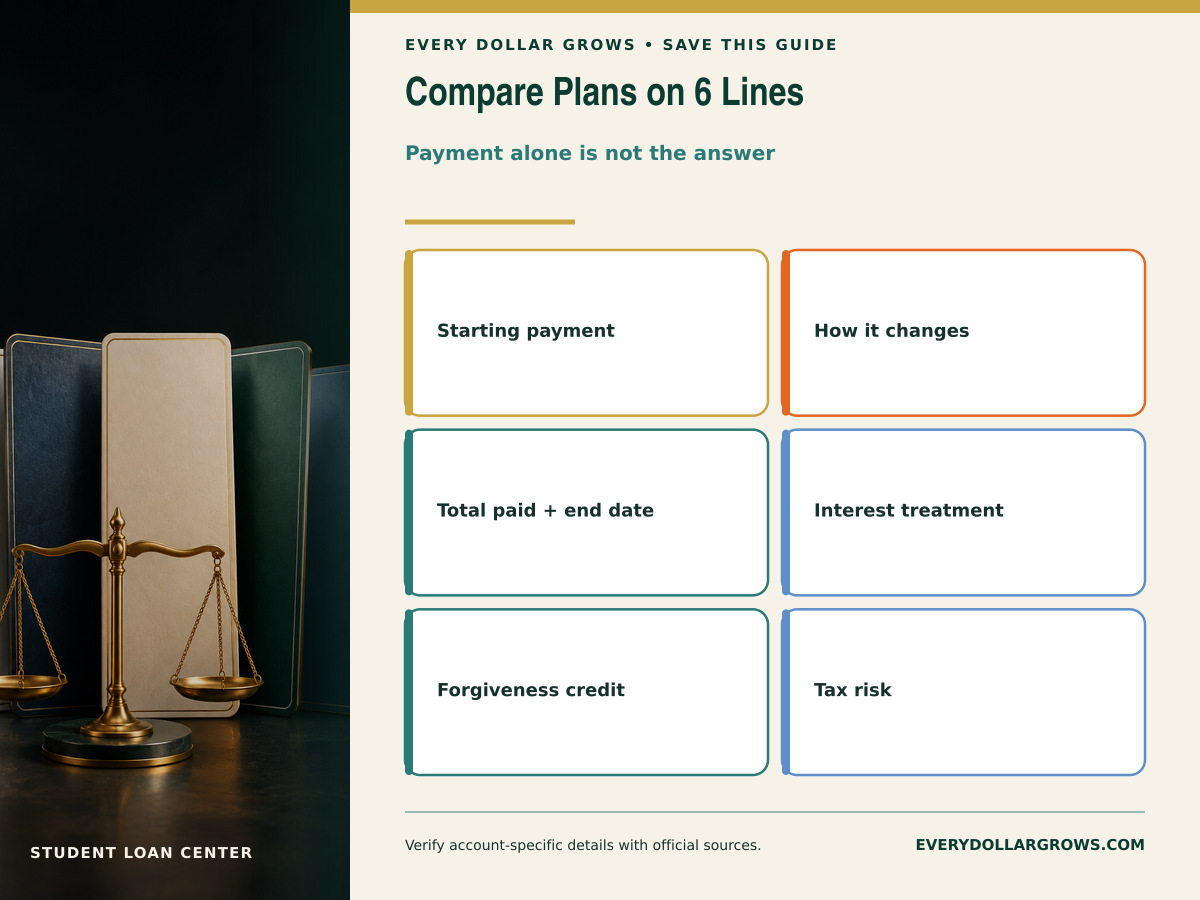
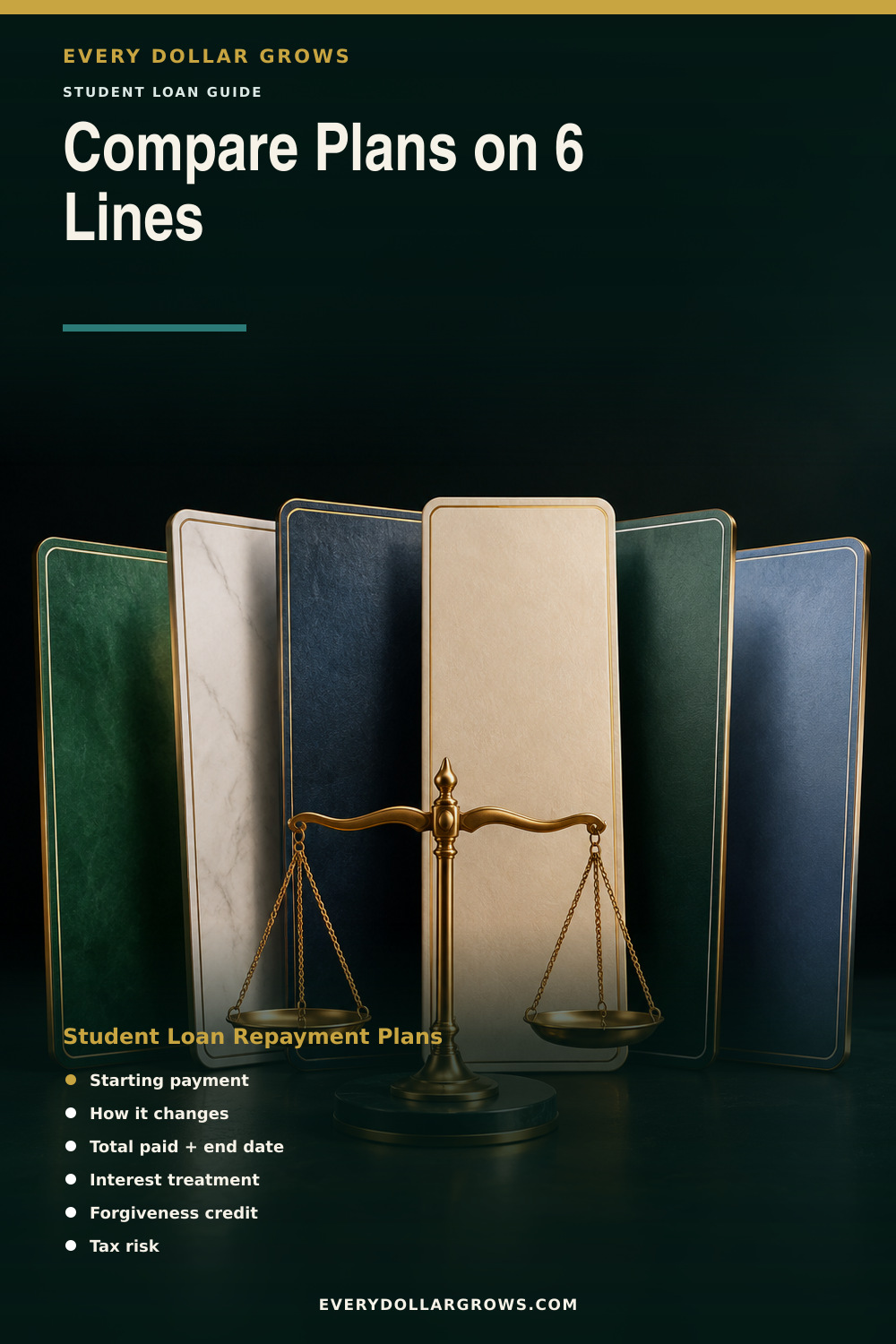
Use a six-line decision sheet
For every plan the official tool displays, record the following:
- Starting required monthly payment
- How and when that payment can change
- Estimated total paid and end date
- Interest subsidy, waiver, or capitalization treatment
- PSLF or IDR qualifying-payment treatment
- Potential federal and state tax on discharge
Add one stress test: reduce income by 20% and increase essential expenses by 10%. A plan that works only in the best year is not a resilient household plan.
Three borrower examples show why the menu matters
Borrower A: all Direct Loans from 2024
This borrower may compare eligible older-loan IDR plans, RAP, and the traditional fixed plans. Tiered Standard should not be assumed merely because it now exists.
Borrower B: Direct Loans from 2024 plus a new Direct Loan in fall 2026
The new loan can move eligible Direct debt into the RAP/Tiered Standard framework. If the borrower works for a qualifying public-service employer, the fact that Tiered Standard does not qualify for PSLF becomes a major decision point.
Borrower C: Parent PLUS consolidated before July 1, 2026
This borrower needs a Parent PLUS-specific review. RAP remains unavailable. Depending on consolidation and ICR-payment history, IBR or temporary ICR treatment may be relevant. Generic “best IDR plan” charts are not enough.
The same balance can produce very different total outcomes
Imagine a $75,000 balance at 6.52%. A 20-year fixed amortization produces a much lower required payment than a 10-year payoff, but the longer term can add tens of thousands of dollars of interest. An income-driven payment could start lower or higher than either fixed amount depending on AGI and family circumstances, and the eventual total may include interest relief or discharge.
That is why “monthly payment” and “cost” are not synonyms. For every plan, record both the payment now and what the plan is designed to do over time. If the official calculator projects forgiveness, add the expected tax treatment and the probability that the borrower will remain on the strategy long enough to reach it.
If the payment is unaffordable, act before the due date
An unaffordable required payment is a planning problem before it becomes a delinquency problem. Contact the servicer, verify whether an income-driven or other eligible plan can lower the requirement, and confirm how a pending application will affect the account.
Do not intentionally miss payments to “force” a lower plan. Late payments can create delinquency, collection consequences, and lost progress toward benefits. If the entire household is behind, protect housing, utilities, food, transportation, and insurance while using the delinquency and default guide to address the federal account.
Five repayment-plan mistakes to avoid
- Choosing the lowest first payment without seeing the term and total cost.
- Assuming every loan moves together when mixed types or dates create separate eligibility.
- Consolidating blindly and changing payment credits or Parent PLUS treatment.
- Ignoring taxes on a projected long-term IDR discharge.
- Failing to verify the completed change on the first statement and official account.
Once the plan is chosen, fit it into the EDG budgeting system and review it after every annual recertification, marital change, job change, or new loan.
Review the plan after the events that can change the answer
Recheck the repayment strategy after a new loan, consolidation, marriage or divorce, a major income change, a move into or out of public-service employment, a servicer transfer, or a substantial change in federal rules. Income-driven plans also require attention to recertification and tax information.
Keep the previous plan comparison. It helps explain why a change was made and whether the new plan actually improved the expected outcome.
Questions to ask the servicer before changing plans
- Which repayment plans are currently available for each loan group?
- What loan or disbursement date makes Tiered Standard available or unavailable?
- Will this plan qualify for PSLF for my account?
- What payment and income information is being used?
- Will any interest capitalize or be waived during the change?
- How will existing qualifying-payment credit be treated?
- When should I expect the first bill under the new plan?
Save the secure message or call notes with the application confirmation. The purpose is not to outsource the decision to the servicer; it is to document the account-specific facts the public chart cannot show.
Save this student loan repayment plan comparison for later
Keep the 2026 repayment-plan table, eligibility rules, fixed-versus-income-driven tradeoffs, and decision checklist handy while comparing options.

Official sources used
Rules and dates can change. These primary sources were checked for this guide; confirm account-specific details with Federal Student Aid and your loan servicer.
Frequently asked questions
What are the two new federal repayment plans?
RAP is the new income-driven plan and Tiered Standard is the new fixed plan.
Can older borrowers still use IBR?
Eligible borrowers with loans disbursed before July 1, 2026 may still use IBR. Exact eligibility depends on the borrower and loans.
Are PAYE and ICR still available?
Only for limited eligible transition borrowers, and both are scheduled to end no later than July 1, 2028.
What is the best student loan repayment plan?
There is no universal best plan. Compare payment, term, total cost, interest treatment, forgiveness, taxes, flexibility, and household risk for the plans the loans can actually use.
Educational information only. This page does not provide legal, tax, investment, or individualized financial advice and cannot determine your eligibility, official payment, qualifying-payment count, or tax liability. Verify your loans, dates, and options through StudentAid.gov, your servicer, and a qualified professional when appropriate.