
Student Loan Repayment Changes 2026: What Changed and What to Do
The July 1 rules changed both how some borrowers repay and how much students and parents can borrow. This guide to student loan repayment changes 2026 separates the dates, the loan groups, and the next actions.
Part of the Complete EDG Student Loan Guide.
The short answer
- RAP and Tiered Standard became available July 1, 2026; Tiered Standard generally requires at least one Direct Loan first disbursed on or after that date, while borrowers with only older loans can have a different fixed-plan menu.
- SAVE ended. Affected borrowers must follow the individual 90-day action window stated in their servicer notice.
- New annual and aggregate limits affect graduate, professional, and Parent PLUS borrowing, with narrow transition rules for some continuing programs.
- PAYE and ICR are scheduled to end no later than July 1, 2028; eligible older borrowers may still compare IBR.
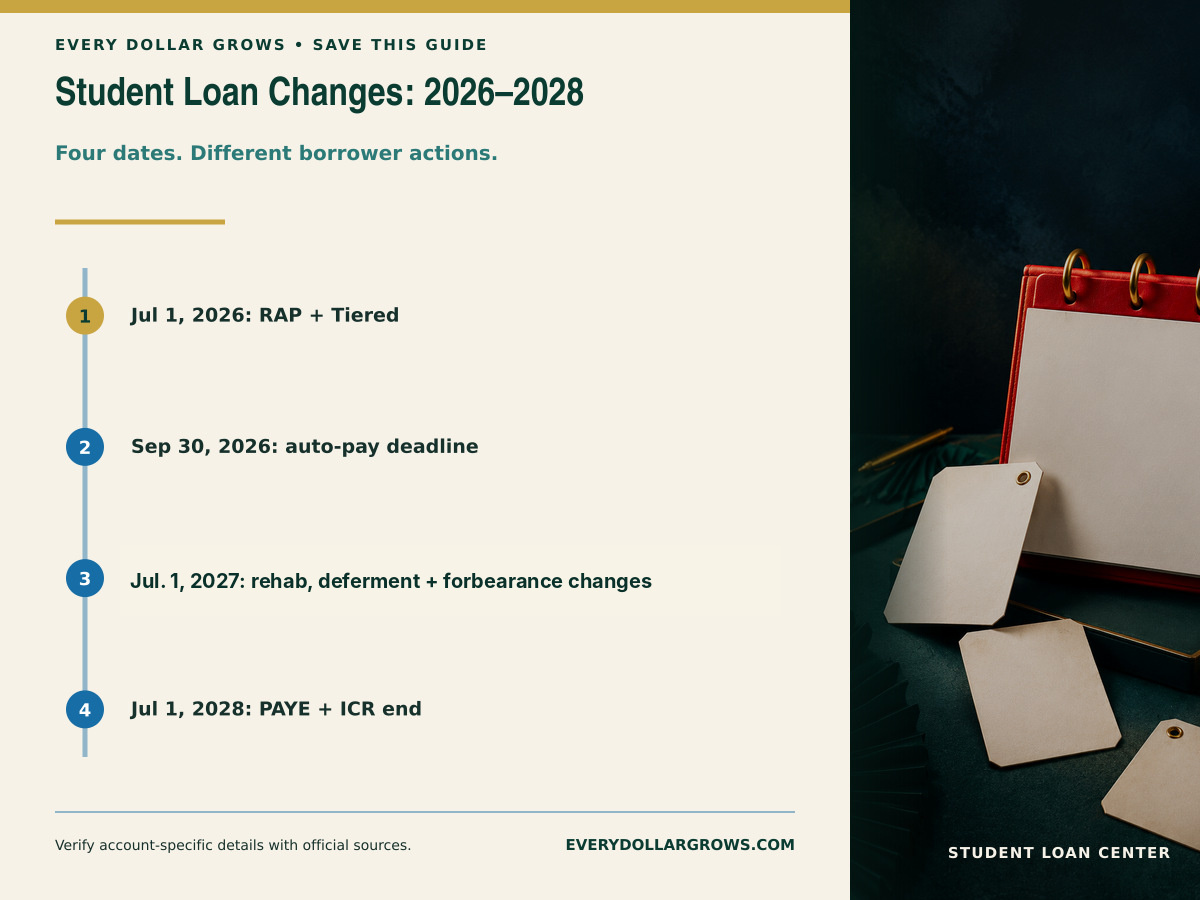
Student Loan Repayment Changes 2026: Four Dated Milestones
| Date | What changes | Who should act |
|---|---|---|
| July 1, 2026 | RAP and Tiered Standard become available; most new borrowing limits and Grad PLUS restrictions begin. | New borrowers, current borrowers comparing plans, graduate students, parents, and schools. |
| September 30, 2026 | Deadline to newly enroll in auto pay for the temporary total 1% federal Direct Loan interest-rate reduction through June 30, 2028. | Eligible Direct Loan borrowers who were not already enrolled in auto pay. |
| July 1, 2027 | Default rehabilitation, deferment, and forbearance changes begin, including a second rehabilitation opportunity per loan and narrower options for certain newer loans. | Borrowers in or near default and borrowers relying on postponements. |
| No later than July 1, 2028 | PAYE and ICR sunset; eligible borrowers must move to an available plan. The temporary auto-pay rate reduction ends June 30, 2028. | PAYE/ICR borrowers, affected Parent PLUS consolidations, and auto-pay participants. |
SAVE adds a separate borrower-specific deadline: affected borrowers generally receive a 90-day action window tied to the date of their individual servicer notice. Use the SAVE transition checklist instead of assuming another borrower’s deadline is yours.
Get Your Free Student Loan Snapshot
Create your free Every Dollar Grows account to save your Student Loan Snapshot and access it anytime.
The new repayment framework: RAP or Tiered Standard
If you receive at least one Direct Loan first disbursed on or after July 1, 2026, eligible Direct Loans generally must be repaid under RAP or Tiered Standard. RAP is income-driven; Tiered Standard is fixed. If all loans were disbursed before the cutoff, additional legacy plans may remain available while the transition runs.
RAP applies a single percentage band to full AGI: a $120 annual base at $10,000 or less, then 1% through 10% in $10,000 AGI bands. After division by 12, the formula subtracts $50 for each dependent claimed on the federal return and applies a $10 minimum. Full, on-time payments can trigger unpaid-interest relief and principal reduction under the federal formula.
Tiered Standard assigns the maximum term from outstanding principal: less than $25,000 receives 10 years; $25,000 to $49,999 receives 15; $50,000 to $99,999 receives 20; and $100,000 or more receives 25. The minimum scheduled payment is $50.
See the complete RAP guide, Tiered Standard guide, and repayment-plan comparison.
RAP vs. Tiered Standard quick estimator
Compare a basic RAP payment estimate with the fixed-payment structure of Tiered Standard. This is not an eligibility determination.
Runs in your browser. No entries are stored or transmitted by this calculator.
Traditional fixed plans did not disappear for every older borrower
The phrase “new two-plan system” is easy to overgeneralize. It is most important for borrowers with a post-July 1, 2026 Direct Loan. Borrowers whose loans are all older can still encounter the traditional Standard, Graduated, and Extended plans, subject to their eligibility rules. Extended generally requires more than $30,000 in the applicable loan program.
That distinction matters when comparing fixed payments. A 10-year Standard payment, a 25-year Extended payment, and a 20-year Tiered Standard payment are different legal plans even if a generic calculator can produce a number for all three.
Which rules apply to older, newer, and mixed loan portfolios
Only Direct Loans first disbursed before July 1, 2026
You may be able to choose RAP, IBR, the traditional Standard plan, Graduated, Extended, or a still-available legacy income-driven plan depending on loan type and history. SAVE is no longer available. PAYE and ICR are temporary transition options for borrowers who satisfy their eligibility rules and must end no later than July 1, 2028. Do not assume Tiered Standard applies when every Direct Loan is older than the cutoff.
At least one Direct Loan first disbursed on or after July 1, 2026
The new RAP/Tiered Standard framework generally controls eligible Direct Loans. RAP is the income-driven route. Tiered Standard is the new fixed route and is available when at least one Direct Loan in the borrower’s portfolio was first disbursed on or after the cutoff.
Mixed types or consolidation history
FFEL and Perkins loans may need Direct Consolidation for RAP access, but consolidation changes the loan and can change payment-credit treatment. Parent PLUS debt remains excluded from RAP even when included in a consolidation. A new consolidation on or after July 1, 2026 can also change which repayment framework applies. Never consolidate from a date-only flowchart without checking the exact loan history.
What the changes mean for five common borrower groups
Current undergraduate borrower with only pre-July 2026 Direct Loans
Inventory the existing repayment plan and compare RAP against the older plans that remain available. Do not assume a new fixed plan applies merely because the calendar says 2026.
Student taking a first federal loan in fall 2026
Expect the new RAP/Tiered Standard framework to shape repayment. Borrow conservatively because the payment system is simpler, but the debt is not automatically cheaper.
Parent considering Parent PLUS for 2026–27
Apply the $20,000 annual and $65,000 aggregate cap when the new limits apply, but also test retirement and household cash flow. RAP is not a Parent PLUS escape valve.
Graduate student starting a new program after the cutoff
Assume Grad PLUS is unavailable unless the transition exception clearly applies. Confirm whether the program receives graduate or professional loan limits under the current court-order guidance.
Borrower pursuing PSLF
Prioritize qualifying repayment plans and accurate employment certification. Tiered Standard is not a PSLF-qualifying plan under current guidance, and the separate 2026 employer-attestation rule was vacated before taking effect.
What did not change on July 1, 2026
The new law did not erase existing balances, convert federal loans into private loans, or guarantee lower payments. Existing federal loans keep their underlying loan identity and fixed interest rate unless the borrower takes an action such as consolidation. Private student-loan contracts are still governed by their own terms rather than RAP or federal forgiveness rules.
PSLF still requires a qualifying loan, employer, repayment path, and qualifying monthly payments. Federal loan servicers still manage billing and account processing for the Department. Borrowers still need to verify their own account because a national rule does not tell you whether a particular consolidation, Parent PLUS history, or disbursement date satisfies the eligibility test.
Before July 1 versus after July 1: what changed in practice
| Decision | Before July 1, 2026 | After July 1, 2026 |
|---|---|---|
| New income-driven borrowing framework | Multiple legacy IDR plans existed depending on loan history | RAP is the new IDR route for borrowers with post-cutoff Direct Loans |
| New fixed Direct Loan route | Traditional Standard/Graduated/Extended structure | Tiered Standard applies when at least one Direct Loan is post-cutoff |
| Graduate gap borrowing | Grad PLUS could fill much of cost of attendance | New Grad PLUS generally ended outside transition exception |
| Parent PLUS amount | Could reach cost of attendance minus other aid | New annual and aggregate caps apply unless transition exception applies |
| Professional program limits | Different pre-2026 structure | Higher professional limits exist, with current classification affected by court-order guidance |
This table describes the national framework. Account-level eligibility can still differ because of old FFEL or Perkins debt, Parent PLUS history, consolidation dates, default status, and the transition exceptions.
The 2026 borrowing limits
| Borrower | Annual cap beginning July 1, 2026 | Aggregate cap |
|---|---|---|
| Graduate student | $20,500 | $100,000 |
| Professional student meeting the federal definition | $50,000 | $200,000 |
| All parents for one dependent undergraduate | $20,000 | $65,000 per dependent student |
| Affected borrower lifetime total | Not an annual category | $257,500, with specified exclusions and transition rules |
New Grad PLUS loans generally ended for borrowers who do not qualify for the interim exception. A borrower enrolled before July 1, 2026 who already received a loan for that program may be able to continue under prior limits for the lesser of three years or the remaining expected time to credential, if continuous-enrollment conditions are met.
Schools can also apply lower, consistent program-level caps, and part-time enrollment can reduce annual eligibility. The federal maximum is therefore not a promise that every borrower can receive the full amount.
Professional-program limits are under an active court-order overlay
The $50,000 annual and $200,000 aggregate limits for professional students make program classification financially significant. But the 2026 regulatory definition is not operating exactly as originally published. On June 24, 2026, a federal district court preliminarily stayed part of the Department’s professional-degree definition.
Federal Student Aid then published an interim list of programs that it is treating as professional programs for loan-limit administration while the stay remains in effect. That interim list includes specified credentials and CIP codes and can change as the litigation proceeds.
SAVE ended, but the next plan depends on the loans
A federal court order ended SAVE. Borrowers with a pending SAVE application or active SAVE enrollment must choose another legal repayment plan. The servicer notice should state the individual action deadline. Inaction can result in placement into a Standard or Tiered Standard plan, depending on the loans.
Do not assume the lowest-looking payment in a generic example is your best route. Compare RAP, IBR if eligible, and the applicable fixed plan. Save the notice, the submitted application, the confirmation number or screenshot, and the first statement under the new plan.
PSLF and tax treatment did not disappear—but details matter
Full, on-time RAP payments can qualify for PSLF when the borrower also has eligible Direct Loans, full-time qualifying employment, and the other PSLF conditions. Tiered Standard is not currently a qualifying repayment plan for PSLF or TEPSLF. Borrowers pursuing PSLF should therefore verify the eligible income-driven or other qualifying path shown by Federal Student Aid rather than selecting Tiered Standard only because its fixed payment looks manageable.
PSLF also had a separate 2026 legal development. A federal judge vacated the Department’s new employer rule on June 30, 2026, one day before it was scheduled to take effect. The Department removed the related employer attestation from the PSLF form and stated that no other form changes were being made at that time. Use the current PSLF Help Tool rather than pre-July articles describing the vacated rule.
IDR balances discharged in 2026 or later are generally federally taxable cancellation-of-debt income unless an exception or exclusion applies. PSLF, Teacher Loan Forgiveness, death discharge, and total and permanent disability discharge are among the categories currently treated differently for federal tax purposes. State law can differ.
See the PSLF Guide and 2026 Forgiveness Tax Guide.
A seven-step action plan for September 2026
- Log in to StudentAid.gov and download the exact loan list.
- Separate loans by type and first disbursement date.
- Save any SAVE, PAYE, ICR, auto-pay, or servicer notice.
- Use the official Repayment Calculator and record the available plans.
- Compare payment, term, interest treatment, forgiveness credit, tax risk, and marital treatment.
- Submit the plan request through the official site and save proof.
- Verify the first bill, auto-pay rate, and official plan after processing.
If the payment does not fit the rest of the household, use the EDG catch-up-on-bills plan before the account drifts toward delinquency.
Keep a “before and after” record during the 2026 transition
When a plan or servicer status changes, save evidence from both sides of the change. Download the loan list before applying, save the application and confirmation, and then save the first statement after the change processes. If the payment or qualifying count later looks wrong, those snapshots make the dispute much easier to reconstruct.
- Pre-change loan list and repayment plan
- Servicer notice and deadline
- Repayment Calculator comparison
- Submitted plan request or consolidation application
- Processing messages or forbearance notices
- First bill after processing
- Updated PSLF/IDR qualifying-payment count when applicable
Six mistakes that are especially expensive during the transition
- Using graduation year instead of loan disbursement date. The repayment framework follows the loans.
- Assuming Tiered Standard is available to every older borrower. It generally requires at least one Direct Loan first disbursed on or after July 1, 2026.
- Moving Parent PLUS debt into a consolidation expecting RAP. Parent PLUS history remains excluded from RAP.
- Choosing Tiered Standard while pursuing PSLF. Current guidance says Tiered Standard is not PSLF- or TEPSLF-qualifying.
- Relying on a static “professional degree” list. The current classification is affected by ongoing litigation and interim federal guidance.
- Missing a dated notice. SAVE and the temporary auto-pay benefit involve deadlines that should be documented from the official account.
Save this student loan update for later
Keep this 2026 student-loan changes guide handy while you compare repayment plans, deadlines, and borrowing rules.


Official sources used
Rules and dates can change. These primary sources were checked for this guide; confirm account-specific details with Federal Student Aid and your loan servicer.
- U.S. Department of Education: 2026 RISE final rule
- U.S. Department of Education: final-rule fact sheet
- Federal Student Aid: 2026 student aid and repayment updates
- Federal Student Aid: income-driven repayment FAQs
- U.S. Department of Education: next steps for SAVE borrowers
- U.S. Department of Education: temporary 1% auto-pay interest reduction
- Federal Student Aid servicer: repayment-plan comparison and Tiered Standard eligibility
- Federal Student Aid: professional-degree programs under June 2026 court order
- Federal Student Aid: PSLF form update after June 30, 2026 court decision
Frequently asked questions
Do the 2026 repayment changes apply to every borrower?
No. Loan type, first disbursement date, consolidation history, and Parent PLUS history determine which rules and plans apply.
What plans can a new borrower use after July 1, 2026?
For eligible Direct Loans, the new framework is RAP or Tiered Standard. RAP is the income-driven option; Tiered Standard is fixed.
Did the SAVE plan end for everyone?
SAVE is no longer an available federal repayment plan. Affected borrowers must follow the individual transition instructions and deadline from their servicer.
Did Parent PLUS become eligible for RAP?
No. Parent PLUS loans and Direct Consolidation Loans that contain Parent PLUS debt are excluded from RAP.
When do PAYE and ICR end?
The plans are scheduled to end no later than July 1, 2028. Borrowers should not wait until the final month to identify their next eligible plan.
Educational information only. This page does not provide legal, tax, investment, or individualized financial advice and cannot determine your eligibility, official payment, qualifying-payment count, or tax liability. Verify your loans, dates, and options through StudentAid.gov, your servicer, and a qualified professional when appropriate.