Federal Student Loan Auto Pay Interest Rate Reduction Cuts 1%—But the Deadline Is September 30
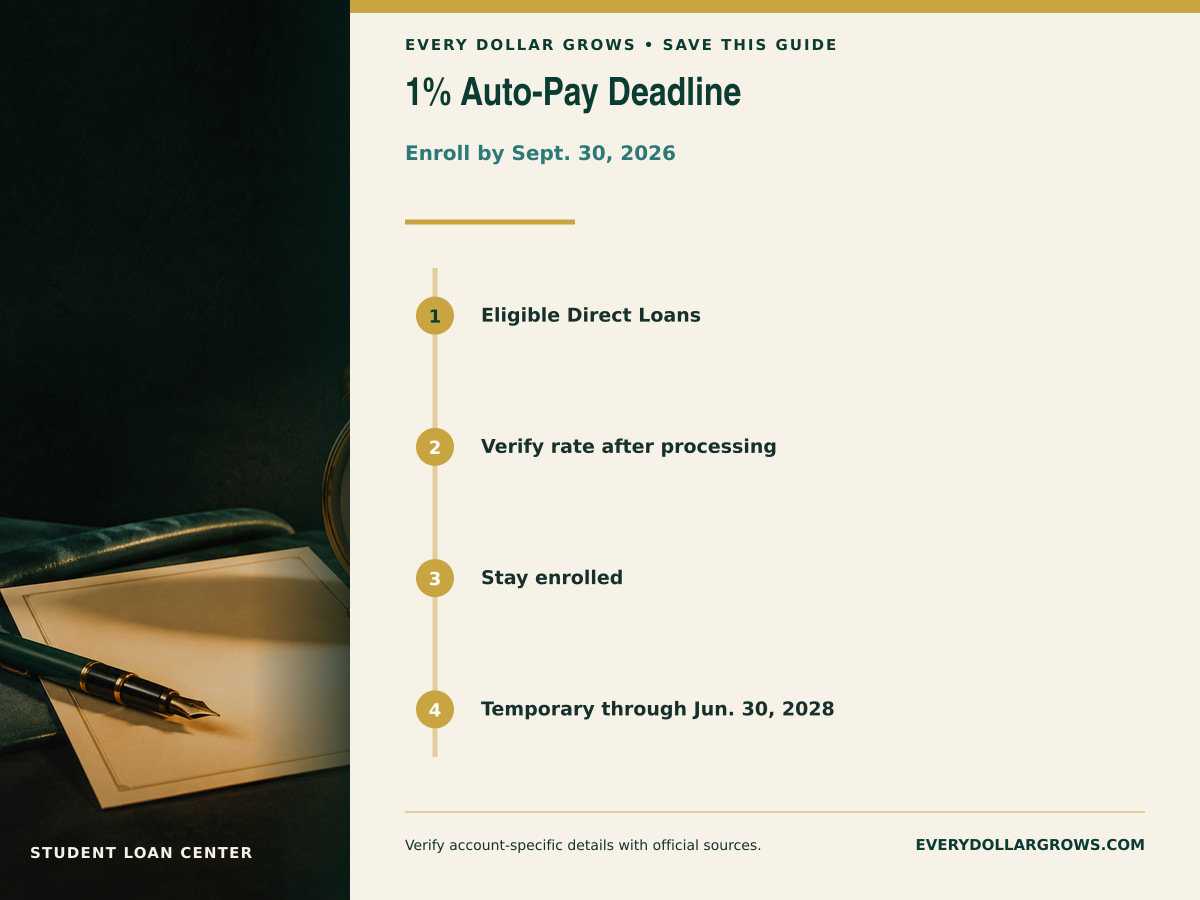
Eligible Direct Loan borrowers who enrolled by September 30, 2026 can receive a temporary 1% interest-rate reduction through June 30, 2028. This student loan auto pay interest rate reduction guide explains how to verify the benefit and estimate what it may save.
Part of the Complete EDG Student Loan Guide.
The short answer
- The enrollment deadline is 11:59 p.m. ET on September 30, 2026.
- The temporary reduction lasts through June 30, 2028 while the borrower remains enrolled in auto pay.
- Borrowers already enrolled in auto pay receive an extra 0.75 percentage point on top of the normal 0.25%, for a temporary total reduction of 1%.
- The benefit applies to eligible Federal Direct Loans originated after July 1, 2012; account status and continued auto pay matter.
Student Loan Auto Pay Interest Rate Reduction: What the Temporary 1% Benefit Does
The Department of Education announced a temporary interest-rate reduction for eligible federal student loan borrowers enrolled in auto pay. The normal auto-pay reduction is 0.25 percentage point. During the temporary window, qualifying borrowers receive another 0.75 percentage point, bringing the total reduction to 1 percentage point.
Get Your Free Student Loan Snapshot
Create your free Every Dollar Grows account to save your Student Loan Snapshot and access it anytime.
A 6.52% eligible loan would temporarily accrue interest at 5.52% while the benefit applies. The original fixed rate does not permanently change; the benefit is a conditional reduction tied to auto-pay enrollment and the federal end date.
The deadline is not the end of the benefit. Enrollment had to occur by September 30, 2026, and the temporary reduction can continue through June 30, 2028 for a borrower who remains enrolled.
Who is eligible and who needs another step first
The federal announcement states that the benefit applies to Federal Direct Loans originated after July 1, 2012, including eligible student and parent borrowers. Borrowers already enrolled in auto pay should receive the additional reduction automatically. New participants must enroll through the loan servicer by the deadline.
A borrower in default is not currently in active repayment and cannot simply switch on auto pay. The borrower must first bring eligible loans back into good standing, which may involve consolidation or another official default-resolution path, enroll in a repayment plan, and then enroll in auto pay if the deadline and eligibility requirements can still be met.
Borrowers leaving SAVE also need an active legal repayment plan. Do not let the auto-pay deadline distract from selecting and confirming the underlying plan through the SAVE transition process.
How to enroll without handing credentials to a third party
- Log in directly to the official account for your federal student loan servicer.
- Choose the auto-pay option from the payment or account menu.
- Confirm the bank account, required payment amount, and withdrawal date.
- Save the confirmation page or email with its date and time.
- After processing, verify that each eligible loan shows the reduced rate.
- Keep enough checking-account margin to prevent an overdraft or rejected payment.
How much can a one-point rate reduction save?
A rough first-year interest difference is balance × 1%. On a $35,000 balance, one percentage point is about $350 per year before accounting for monthly principal reduction. The actual temporary savings will be lower as the balance falls and will vary with the payment schedule and enrollment date.
The calculator below runs two monthly planning paths—one at the entered rate and one one percentage point lower—through June 30, 2028. It is useful for scale, not for reproducing a servicer’s daily-interest ledger.
A rate benefit is not permission to stretch the repayment term. If the original payment remains affordable, keep paying at least that amount so more of each payment reaches principal.
Temporary 1% auto-pay savings estimator
Estimate interest saved during the temporary benefit window using a monthly planning model.
Runs in your browser. No entries are stored or transmitted by this calculator.
Protect the benefit after enrollment
Remain in auto pay, watch the first withdrawal after a plan change, and verify that the bank account has enough funds. A returned payment can create late fees or delinquency consequences and may interrupt benefits that depend on a full, on-time payment.
If the required payment changes after annual IDR recertification, confirm whether the servicer automatically updates the draft amount. If you switch banks, update the account early rather than waiting until the withdrawal date. Keep the confirmation.
Auto pay is a payment tool, not a repayment strategy by itself. Use the repayment plan guide to select the plan and the payoff calculator to decide whether an extra payment is appropriate.
What happens after September 30, 2026
The special enrollment window closes after the federal deadline. Borrowers who enrolled on time and remain eligible can continue receiving the temporary total 1% reduction through June 30, 2028. Borrowers who miss the deadline should check the servicer’s current standard auto-pay benefit rather than relying on an old promotional screenshot.
After June 30, 2028, the temporary additional 0.75 percentage point is scheduled to end. Confirm the rate then and recalculate any payoff plan. EDG will keep this page live as a dated explanation and update the headline status after each expiration point.
What a temporary one-point reduction looks like at different balances
The quickest way to understand a one-percentage-point reduction is to convert it into annual interest at the current balance. At the start of a year, a $10,000 balance produces roughly $100 less annual interest at a rate that is one percentage point lower; $25,000 produces roughly $250 less; $50,000 produces roughly $500 less; and $100,000 produces roughly $1,000 less. Those are scale examples, not guaranteed savings, because principal normally declines as payments are made.
| Starting balance | Approximate first-year difference from 1 point | What changes the actual amount |
|---|---|---|
| $10,000 | About $100 | Payment timing and falling principal |
| $25,000 | About $250 | Payment timing and falling principal |
| $50,000 | About $500 | Payment timing and falling principal |
| $100,000 | About $1,000 | Payment timing and falling principal |
The temporary federal benefit ends on the published federal date even if the loan remains outstanding. That makes it different from permanently refinancing to a lower rate. Use the calculator for the temporary window and the payoff calculator for the longer-term repayment plan.
A 10-minute verification after enrollment
Do not treat clicking an enrollment button as the final step. After the servicer processes the request, open the account and verify four items: auto pay is active, the withdrawal account is correct, the next draft amount and date are correct, and each eligible loan shows the expected reduced rate. Save a dated screenshot or confirmation.
If the rate does not change, first confirm that the loan and account status meet the federal eligibility rules. Then contact the servicer through the secure account and ask for the reason in writing. A documented question is more useful than assuming the promotional headline applies to every federal loan in every status.
Finally, build a small checking-account buffer around the draft date. A one-point rate benefit is valuable, but not if an overdraft fee or returned payment creates a larger problem.
Save this federal student loan auto-pay guide for later
Keep the deadline, eligibility rules, savings examples, and verification checklist handy while you review your federal student loan account.

Official sources used
Rules and dates can change. These primary sources were checked for this guide; confirm account-specific details with Federal Student Aid and your loan servicer.
Frequently asked questions
What was the deadline for the temporary 1% auto-pay reduction?
Eligible borrowers had to enroll by 11:59 p.m. Eastern time on September 30, 2026.
How long does the temporary reduction last?
It can continue through June 30, 2028 while the borrower remains enrolled in auto pay and the loans remain eligible.
Do borrowers already enrolled in auto pay need to enroll again?
The federal announcement says existing participants receive the additional 0.75 percentage point automatically, bringing the temporary total reduction to 1%. They should still verify the account.
Does auto pay make every repayment plan a good choice?
No. Auto pay can reduce interest and prevent missed payments, but the underlying plan still needs to be compared for payment, term, total cost, forgiveness, and tax treatment.
Educational information only. This page does not provide legal, tax, investment, or individualized financial advice and cannot determine your eligibility, official payment, qualifying-payment count, or tax liability. Verify your loans, dates, and options through StudentAid.gov, your servicer, and a qualified professional when appropriate.