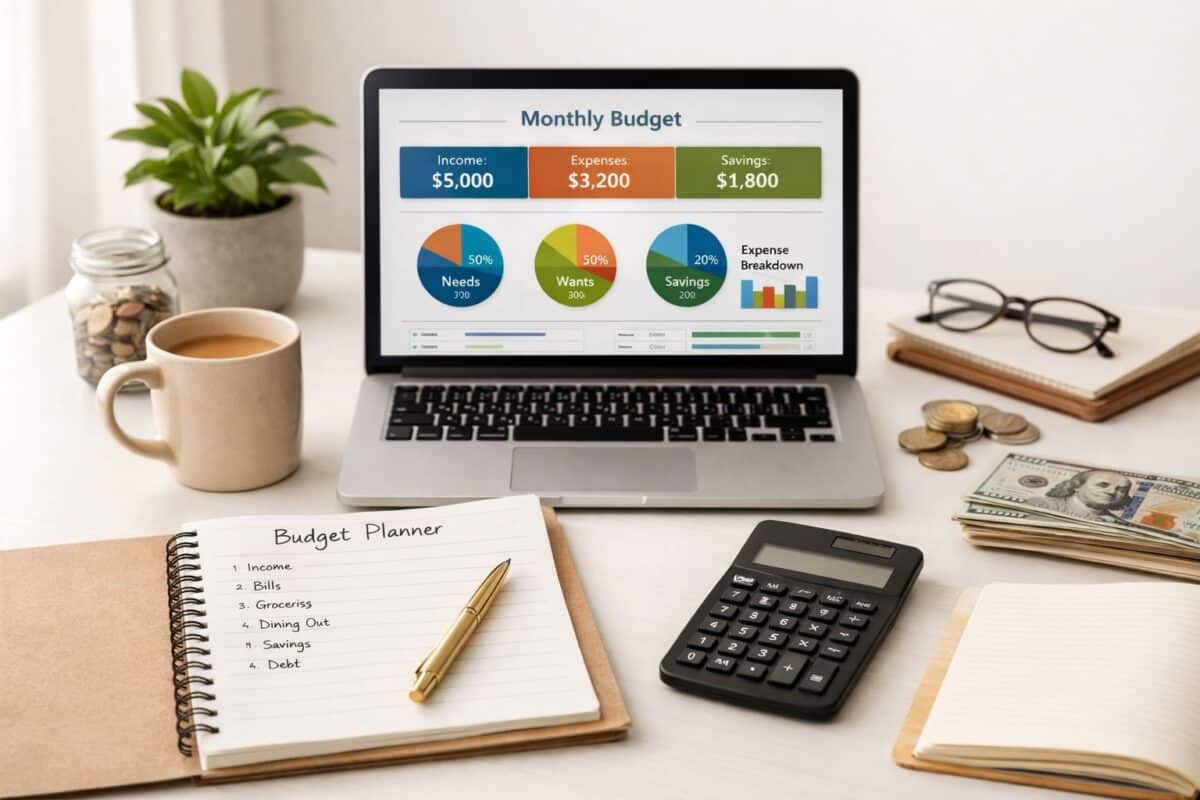
How Much Money Should I Keep in My Checking Account? (Free Calculator)
Not sure how much to keep in checking? Find a balance that covers real bills, protects you from timing mistakes, and keeps extra cash from sitting without a clear job.
Written by Scott Oosterhouse | Updated
Checking Account Balance Calculator
Use amounts that will actually affect this checking account before your next reliable deposit.
The result will separate money already spoken for from the balance you want to protect.
Your entries stay in this browser. Nothing is submitted to Every Dollar Grows. Saving is optional and uses storage on this device.
How Much to Keep in Checking: Find the Right Amount
The right amount is not whatever makes the app balance look reassuring. It is the amount required to safely operate your financial life until more dependable income reaches the account.
A useful checking balance must cover four things:
- Committed bills: payments due before the next reliable deposit.
- Normal spending: groceries, transportation, medicine, and other everyday needs.
- Unposted activity: checks, automatic withdrawals, and pending transactions.
- A protected floor: a cushion you do not treat as spendable money.
That is why two households earning the same amount may need very different checking balances. One may be paid weekly with bills spread across the month. The other may be paid monthly while most bills hit during the first week. Their monthly expenses could be identical, but their checking-account timing risk is not.
For a broader monthly view, use the free Every Dollar Grows Budget Tracker. The calculator above is deliberately narrower: it answers how much this checking account needs to carry right now.
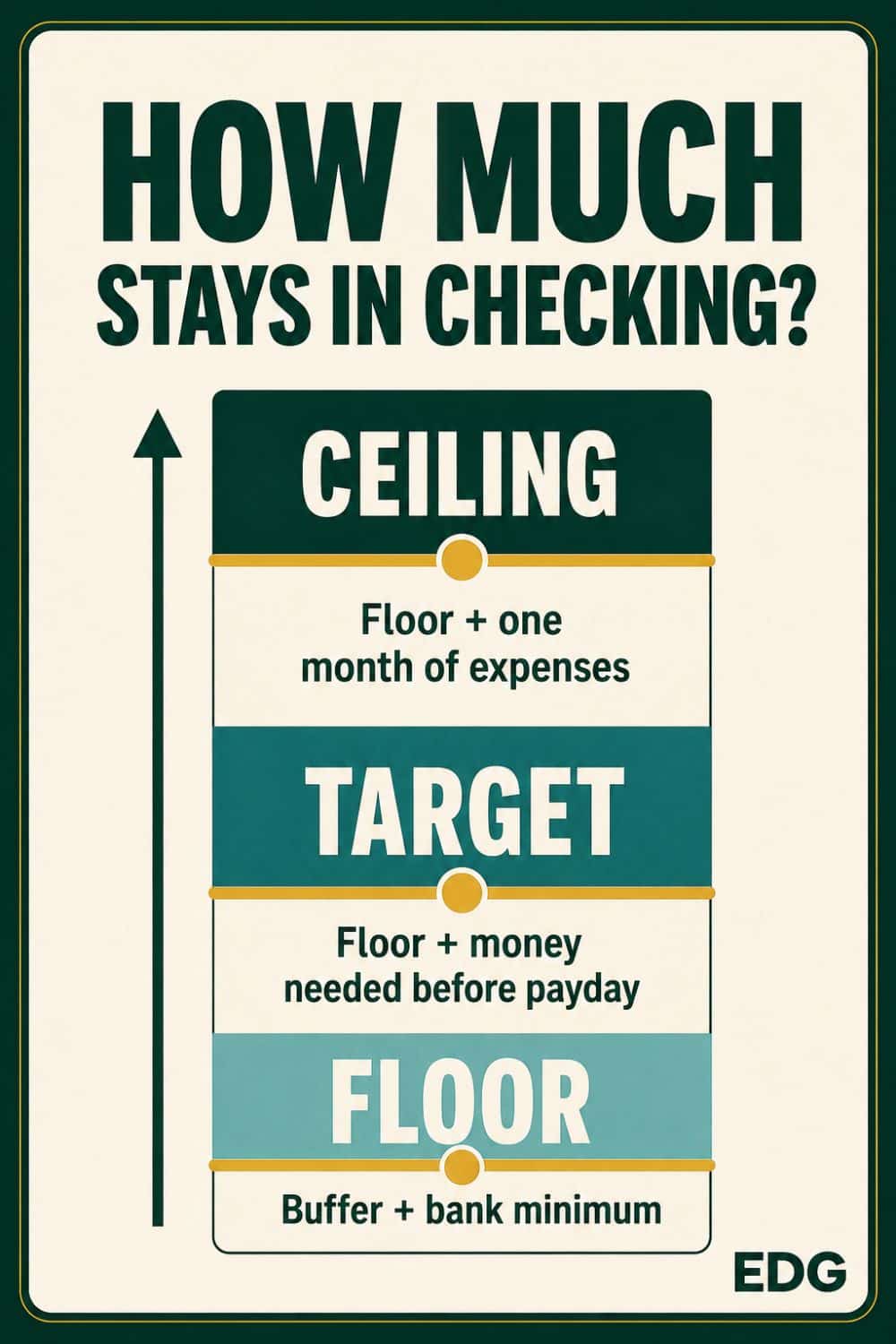
The EDG Floor, Target, and Ceiling Method
Most checking-account advice gives one number. That number is easy to remember, but it does not tell you which dollars are available, which dollars are already promised, or when cash should leave checking. The floor-target-ceiling method gives each level a different job.
1. Your checking floor
Your floor is the amount you do not intend to spend. It includes any balance required to avoid a bank fee plus your personal safety cushion.
A person starting with no buffer might build the floor in stages: $100, then $250, then $500. A larger household, someone with uneven pay, or anyone with several automatic withdrawals may prefer a higher floor. The point is not to choose an impressive number. The point is to stop ordinary timing problems from pushing the account below zero.
The Federal Reserve’s May 2026 household report found that 63% of adults said they could cover a hypothetical $400 emergency using cash or its equivalent. That statistic does not determine your checking target, but it shows why a modest operating floor and a separate emergency reserve both matter.
2. Your working target
Your target is the floor plus every dollar expected to leave before the next reliable deposit. This is the number the calculator produces.
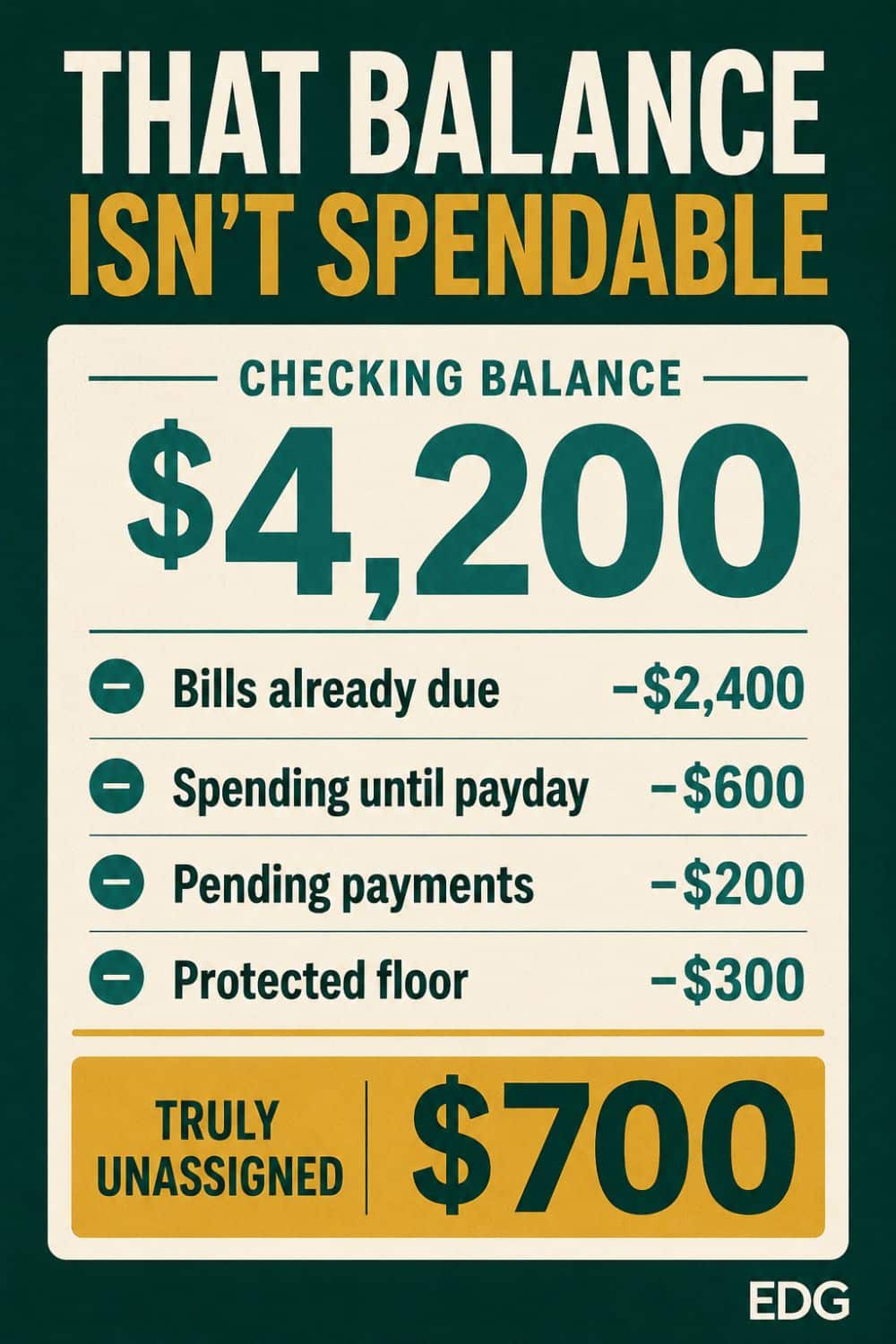
If the target is $2,700, seeing $2,700 in checking does not mean you have $2,700 available to spend. Most of it may already belong to the mortgage, utilities, groceries, insurance, or a savings transfer. Only the amount above the working target is currently unassigned.
3. Your checking ceiling
Your ceiling is the point where additional unassigned cash may be doing the wrong job. A practical starting ceiling is your protected floor plus roughly one normal month of expenses paid from checking.
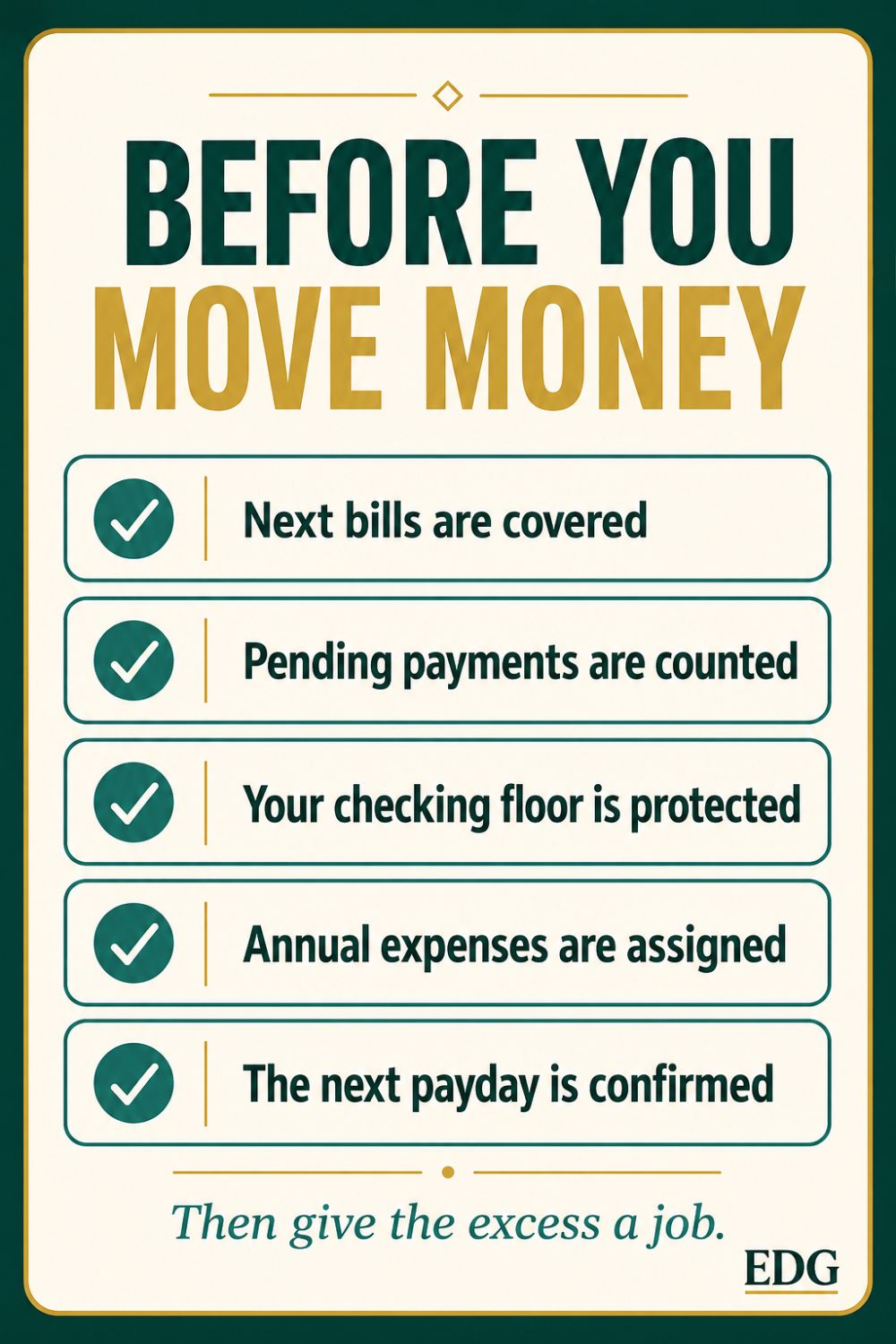
This is not an automatic transfer command. Before moving money, confirm that upcoming bills, annual expenses, outstanding checks, credit-card payments, and irregular costs have been included. Cash above the ceiling may still belong to a known short-term expense. If it does not, it may fit better in savings, a sinking fund, debt reduction, or another planned goal.
The core EDG rule: a high checking balance is not the same thing as extra money. Money becomes extra only after every near-term obligation and the checking floor are protected.
How to Read Your Calculator Result
The calculator gives you four numbers. Each answers a different question.
| Result | What it means | What to check next |
|---|---|---|
| Near-term outflows | Money expected to leave before the next dependable deposit. | Make sure pending checks and automatic payments are included. |
| Checking floor | Your bank minimum plus the safety cushion you want to protect. | Set a low-balance alert near this amount. |
| Working target | The balance needed today to cover the near term and preserve your floor. | Compare it with your actual available balance. |
| Above or below target | Your current balance minus the working target. | Verify the inputs before moving money or changing payments. |
If you are above target, that difference is only potentially available for another job. If you are below target, it does not automatically mean you will overdraft. It means the money currently in checking does not cover every entry plus the floor you selected.
Available balance is not always the full story. A check may not have cleared, a card authorization may change, or an automatic payment may be scheduled but not visible. The Consumer Financial Protection Bureau recommends tracking balances, understanding deposit holds, and using transaction or low-balance alerts to reduce checking-account mistakes.
Three Realistic Checking Balance Examples
These examples show why the answer depends more on timing than income.
Biweekly family budget
- Bills before payday: $1,850
- Everyday spending: $450
- Pending payments: $125
- Planned transfer: $150
- Protected floor: $300
Working target: $2,875
A $3,450 balance would place this household $575 above its current working target—after every entry is confirmed.
Weekly paycheck
- Bills before payday: $500
- Everyday spending: $200
- Pending payments: $60
- Planned transfer: $0
- Protected floor: $150
Working target: $910
A $950 available balance covers this cycle, but only $40 currently sits above the target.
Irregular income
- Bills before deposit: $2,200
- Everyday spending: $600
- Pending payments: $200
- Planned transfer: $0
- Protected floor: $500
Working target: $3,500
The larger income-smoothing reserve can stay in savings and feed checking according to a planned schedule.
How Much Money Is Too Much to Keep in Checking?
You may have too much in checking when the balance remains above your ceiling month after month and the excess is not assigned to a bill, near-term purchase, or deliberate cash reserve.
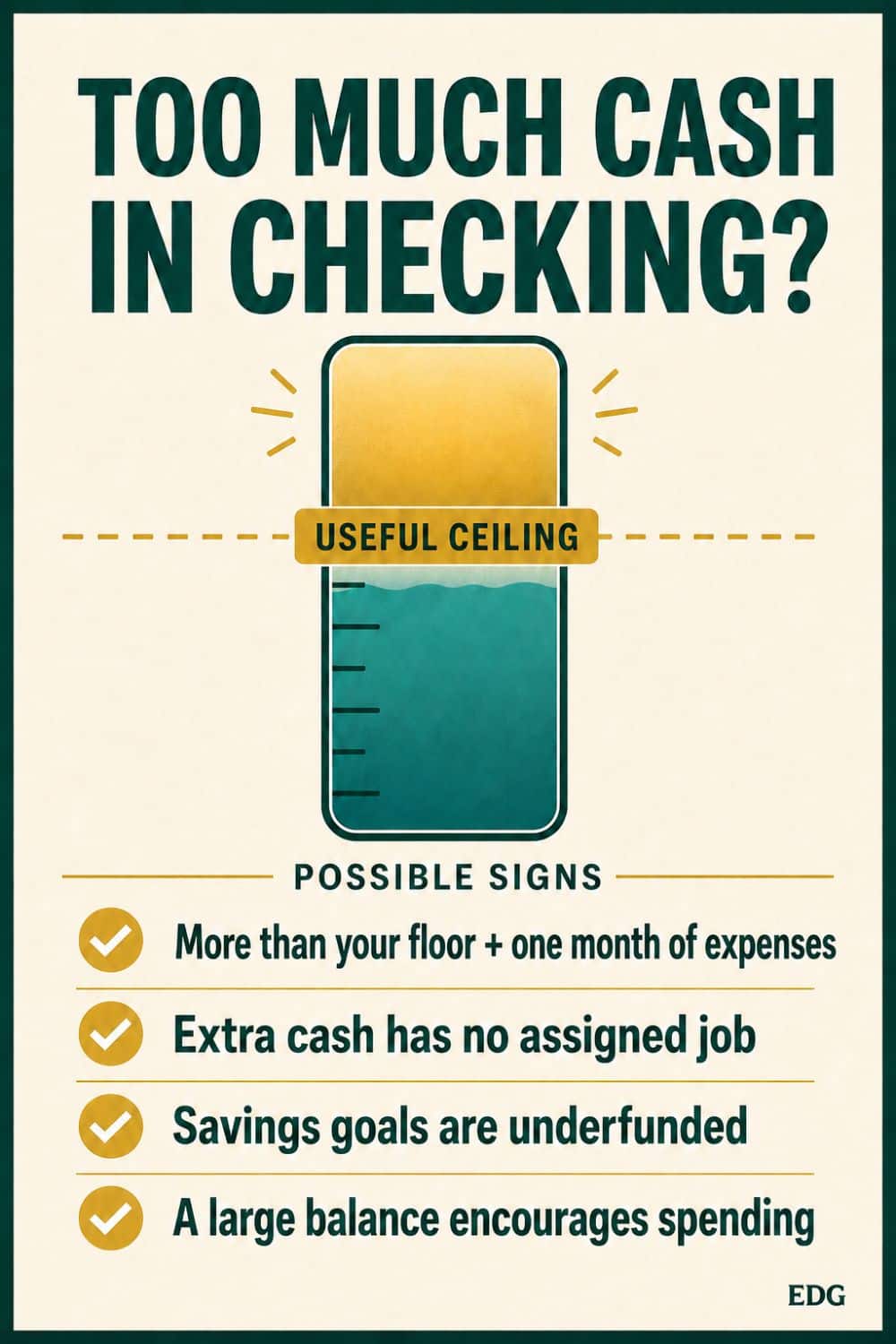
There is nothing inherently wrong with keeping a larger cushion if it helps you manage cash flow. The tradeoff is that checking should primarily operate your monthly money. Longer-term cash usually benefits from clearer separation and, when appropriate, a competitive savings yield.
If you are deciding where short-term cash belongs, read High-Yield Savings Accounts Explained. For a starter emergency reserve, use How to Build a $1,000 Emergency Fund.
Idle Cash Interest Calculator
Estimate the interest difference between leaving unassigned cash in checking and moving it to an interest-bearing savings account.
Illustration only. This estimate assumes the entered APYs remain unchanged and compounds annually. It does not include taxes, fees, rate changes, withdrawals, or additional deposits.
Checking vs. Savings: Give Each Account One Job
The easiest way to stop guessing is to separate operating cash from reserve cash.
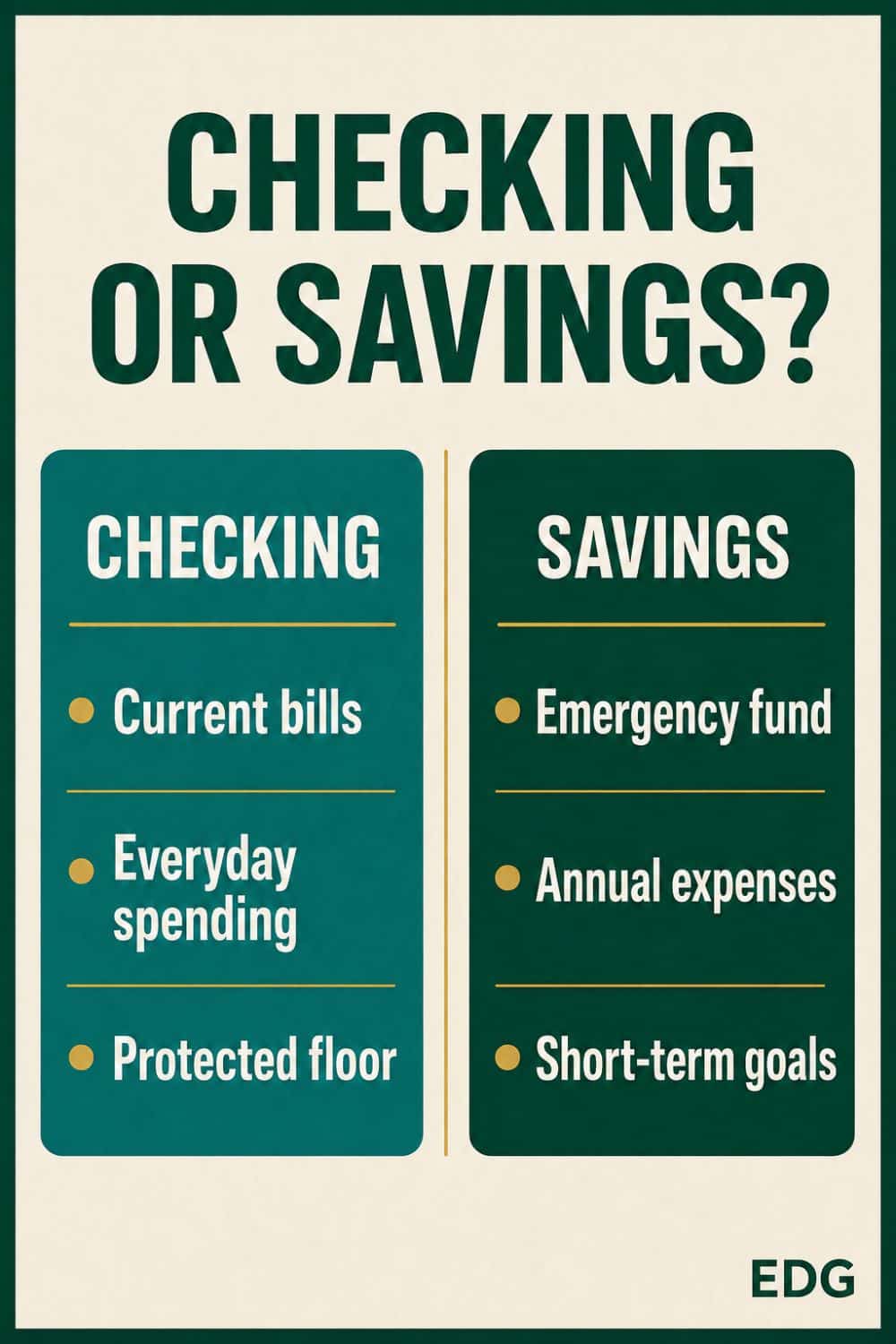
A savings account is not a substitute for enough money in checking to cover tomorrow’s withdrawal. Transfers can take time, and automatic payments may arrive before you expect them. Keep operating money where it can do its immediate job.
Money intended for long-term wealth building usually belongs in an appropriate investment account, where its time horizon and risk level can be considered separately from short-term cash.
Checking and savings deposits at an FDIC-insured bank are generally insured within applicable limits. The standard FDIC amount is $250,000 per depositor, per insured bank, for each account ownership category. Credit unions may use separate federal insurance through the NCUA.
When the Standard Checking Target Needs Adjusting
If your income changes from paycheck to paycheck
Build the monthly plan around a conservative income amount rather than your best month. Keep the working target in checking, then hold a separate income-smoothing reserve in savings. Transfer a planned amount into checking on a regular schedule. This makes irregular income behave more like a predictable paycheck.
If overtime is part of your normal pay
Separate dependable income from extra income. Base recurring bills on the amount you can reasonably expect. Give overtime a job—building the floor, funding irregular expenses, paying debt, saving, or investing—instead of quietly allowing fixed expenses to rise with a temporary paycheck.
If most bills hit at the beginning of the month
Your target may need to be much higher just before the first of the month and lower after those payments clear. A bill calendar is more useful than trying to maintain the exact same checking balance every day.
If you share a joint checking account
Agree on the floor and treat it as unavailable. Both people need visibility into pending purchases and automatic payments. A shared weekly review prevents two individually reasonable purchases from colliding with the same bill money.
If you are living paycheck to paycheck
Do not wait until you can create a perfect one-month cushion. Build the floor in small stages. The first $100 creates distance from zero. Then aim for $250 and $500. The Save $500 Starter Kit is designed for that first practical buffer.
If you are self-employed
Keep business operating money, household checking, and tax reserves separated. The household calculator should include only personal cash flow. A business tax reserve is not extra checking money and should not be treated as spendable household cash.
How to Maintain the Right Checking Balance
- Choose your floor. Add your bank’s required minimum to the personal cushion you want to protect.
- Map the next pay cycle. List every bill, necessary purchase, transfer, and unposted payment due before reliable income returns.
- Set a low-balance alert. Place the alert near your floor so you know when the account is entering protected territory.
- Review the account once a week. Look for new automatic payments, delayed transactions, duplicate charges, and spending drift.
- Sweep true excess intentionally. After confirming the next cycle, move unassigned cash to the goal it is meant to support.
The Consumer Financial Protection Bureau notes that many people use frequent balance checks, transaction tracking, and low-balance alerts to reduce overdraft risk. The system does not need to be complicated. It needs to show the difference between the balance on the screen and money that is truly free to use.
Common Checking Account Balance Mistakes
Treating the displayed balance as spendable
Some of that balance may already belong to payments that have not posted. Subtract outstanding checks, scheduled withdrawals, and card transactions before making a new spending decision.
Using the emergency fund as a checking cushion
A modest checking floor is useful. A full emergency fund usually benefits from separation so ordinary spending does not quietly consume it. Learn the difference in the EDG guide to building an emergency fund.
Moving money to savings too aggressively
Maximizing interest is not helpful if an automatic bill arrives first and creates a fee. Protect the working target before transferring excess.
Keeping years of cash in checking without a reason
Accessibility is useful, but unassigned cash can lose earning potential and blur your goals. Separate operating cash, emergency savings, and longer-term money.
Ignoring minimum-balance rules
Some accounts charge maintenance fees when a required balance or other condition is not met. Review the account agreement and use the bank’s actual rule in your floor calculation.
Setting the target once and never revisiting it
Insurance, groceries, utilities, debt payments, and family costs change. Recalculate after a major bill change and review the floor at least a few times each year.
What to Do If Your Checking Account Keeps Running Low
A low balance is a symptom, not a diagnosis. The cause may be bill timing, irregular income, spending that is not being tracked, a fixed expense that has become too heavy, or several small categories pulling at the account together.
Start with the free monthly budget planner if you need to organize income and expenses. For the broader system behind those numbers, use the EDG budgeting guide. If you already have a budget but still cannot see the main pressure point, the Budget Review System is the stronger next step.
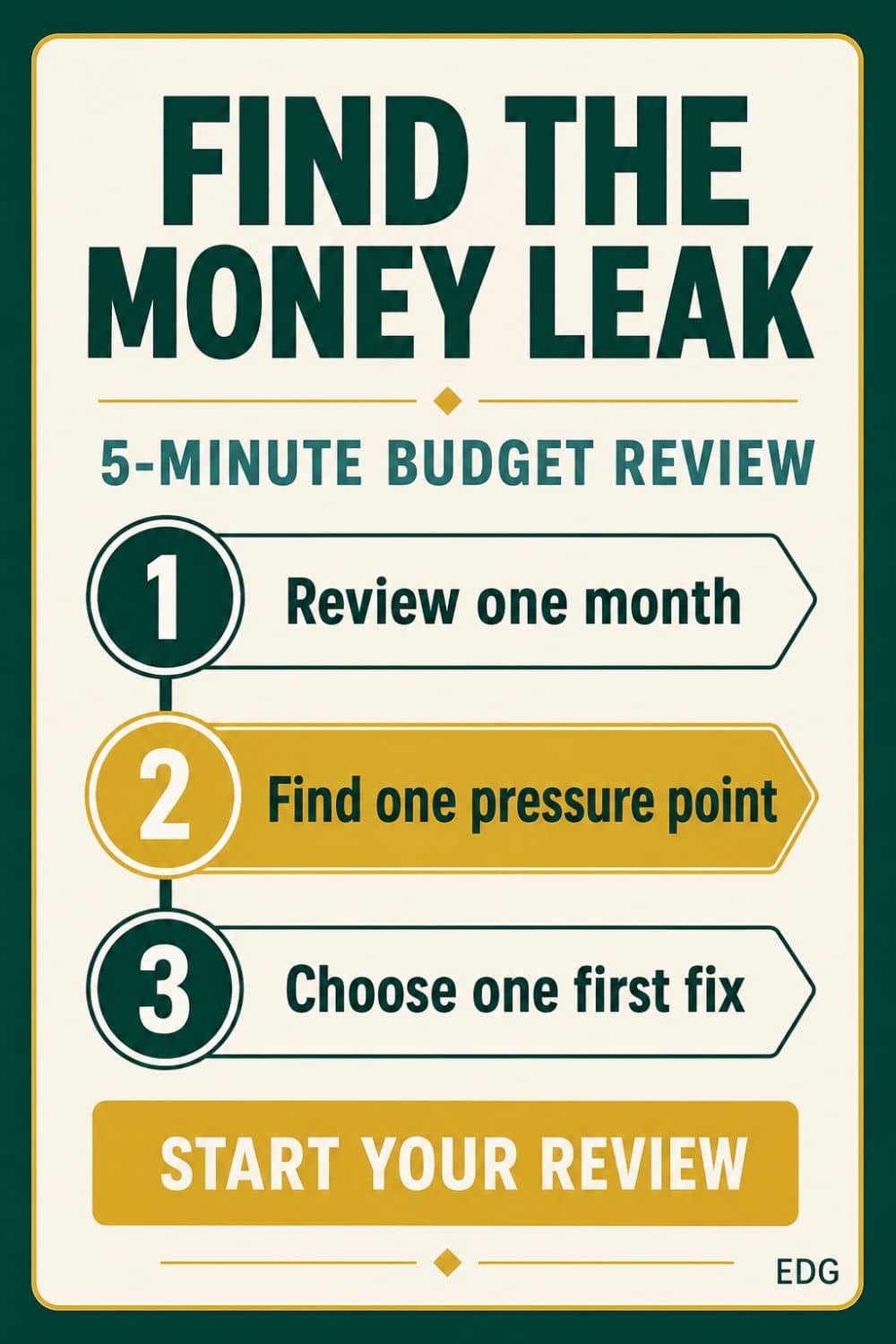
Review one month. Find one pressure point. Choose one clear first fix.
Stop Guessing Where the Money Went
The Every Dollar Grows Budget Review System helps you review one month of spending, identify the biggest pressure point, and build a clear first action instead of trying to fix everything at once.
Frequently Asked Questions
How much money should I keep in my checking account?
Keep enough to cover bills, necessary spending, pending payments, and planned transfers until your next reliable deposit, plus a protected safety buffer and any bank minimum. For many steady-income households, the practical ceiling is around one normal month of checking-funded expenses, but bill timing matters more than a generic average.
Should I keep one or two months of expenses in checking?
One month of checking-funded expenses plus a safety floor is a reasonable upper starting point for many households. Keeping two months in checking may be useful when income or bills are unusually unpredictable, but the second month can often remain in an accessible savings account and be transferred according to a plan.
Is $10,000 too much money to keep in checking?
It depends on your expenses and upcoming obligations. If $10,000 covers near-term bills, a large household’s normal cash flow, or an assigned purchase, it may be appropriate. If much of it remains unassigned above your floor and monthly checking needs, some may fit better in savings or another goal.
How much should I keep in checking after payday?
After payday, your balance should cover every payment and necessary purchase due before the following reliable deposit, all unposted transactions, and your checking floor. Use the calculator on this page with the upcoming pay cycle—not an average month—to find that number.
What is a good checking account buffer?
A good buffer is large enough to absorb a normal timing mistake without causing an overdraft. Someone starting from zero might build from $100 to $250 and then $500. Larger households or people with irregular income and several automatic withdrawals may choose more.
Should my emergency fund stay in checking?
Usually, only a smaller operating cushion needs to remain in checking. Keeping the larger emergency fund in a separate accessible savings account can reduce accidental spending and may earn more interest. Make sure you understand transfer timing and maintain enough checking cash for immediate obligations.
What is the difference between current balance and available balance?
The current or ledger balance generally reflects posted activity. The available balance attempts to show what can be used now after certain holds or pending transactions. Neither view necessarily includes every outstanding check or future automatic payment, so keep your own record of money already committed.
Is money in a checking account insured?
Checking deposits at an FDIC-insured bank are generally covered within applicable limits. The standard FDIC amount is $250,000 per depositor, per insured bank, for each ownership category. Federally insured credit unions generally use NCUA coverage. Confirm the institution and account coverage directly.
How often should I recalculate my checking target?
Review it whenever income, housing, insurance, debt payments, childcare, or other major bills change. A quick review every few months also helps catch gradual spending changes and new automatic payments.
Sources and Further Reading
- Consumer Financial Protection Bureau: Consumer Experiences With Overdraft Programs
- Consumer Financial Protection Bureau: Managing Your Checking Account
- Federal Deposit Insurance Corporation: Overdraft and Account Fees
- Federal Deposit Insurance Corporation: Understanding Deposit Insurance
- National Credit Union Administration: Share Insurance and You
- Federal Reserve: Economic Well-Being of U.S. Households in 2025
Educational note: This page provides general financial education and an illustrative calculator. It does not provide individualized financial, banking, tax, legal, or investment advice. Account terms, deposit availability, fees, insurance coverage, and transfer times vary. Verify details with your bank or credit union before moving money or relying on a calculated balance.