How Much Should You Have Invested by Age? A Realistic Guide to Saving and Building Wealth
If you clicked because you want a fast answer, here it is: the “right” amount to have invested by a certain age is not one magic number. It depends on when you started, how steadily you invest, whether you have high-interest debt, how much you earn, and how aggressive your long-term goals are. But that does not mean you need to stay confused.
Quick note: In this post, “invested” means money in retirement accounts and brokerage accounts built for long-term growth, not your emergency fund, home equity, or cash sitting in checking.
If you feel behind, do not click away. You do not need to beat strangers on the internet. You need to stop drifting, build a real plan, and start compounding from where you are.
Quick Summary
What this post helps you do
Figure out whether your current invested amount is roughly on track for your age and income, understand what really moves the needle, and choose a realistic next step.
What counts as “invested”
Usually your 401(k), 403(b), IRA, Roth IRA, HSA invested for long-term growth, and taxable brokerage accounts. Your emergency fund is important, but it is not the same thing as your invested portfolio.
The core idea
Investing is the process of turning earned income into future freedom. The goal is not to chase hot stocks. The goal is to build assets that can grow while you sleep and support you later.
How much should you have invested by age? A realistic investing guide for building wealth from your 20s to your 60s.
- The quick answer most people want first
- A realistic benchmark table by age
- How to read these numbers without panicking
- What to focus on in your 20s, 30s, 40s, 50s, and 60s
- Age Benchmark Calculator
- How much to invest each month to build wealth
- Monthly Investing Growth Estimator
- What to invest in once you know your target
- How to catch up if you started late
- Common mistakes that slow people down
- Frequently asked questions
The Quick Answer Most People Want First
If you want a straightforward framework, here it is: by age 30, many people should aim to have roughly half to one times their annual income invested. By age 40, a more serious checkpoint might look closer to two to three times annual income. By age 50, many households want to be pushing toward four to six times annual income or more, depending on retirement goals, pension benefits, lifestyle expectations, and when they started.
That said, those numbers are guideposts, not handcuffs. Someone who started investing at 22, avoided consumer debt, and consistently bought broad index funds may be far ahead of someone with a higher income who did not start until 39. Another person may have a lower invested balance because they spent years aggressively paying off debt, supporting kids, or building a business. The benchmark only matters if it helps you make a better decision today.
So instead of treating this article like a verdict, treat it like a financial dashboard. Your goal is not to feel ashamed or superior. Your goal is to see where you are, understand why, and move forward with a smarter system.
It is: “Given my age, income, and current balance, what should I do next to improve my trajectory?”
A Realistic Benchmark Table by Age
Below is a flexible checkpoint table you can use as a starting point. These are not promises, and they are not personalized retirement plans. They are a practical way to think about progress if you want to know whether your invested balance is roughly in the neighborhood of where it should be.
| Age | Reasonable Investing Checkpoint | Main Priority at This Stage | What Matters Most |
|---|---|---|---|
| 20–24 | Start the habit. Even a small balance matters more than waiting. | Open accounts, learn the basics, begin contributing consistently. | Starting early and building the behavior. |
| 25–29 | About 0.25x to 0.75x annual income invested | Move from dabbling to steady automatic investing. | Consistency, not flashy picks. |
| 30–34 | About 0.5x to 1.5x annual income invested | Increase savings rate as income rises. | Avoid lifestyle creep. |
| 35–39 | About 1.5x to 2.5x annual income invested | Get serious about retirement accounts and long-term allocation. | Keeping contributions high during busy years. |
| 40–44 | About 2.5x to 3.5x annual income invested | Maximize prime earning years. | Steady investing through midlife expenses. |
| 45–49 | About 3.5x to 5x annual income invested | Tighten your plan and reduce drift. | Higher contribution rate and discipline. |
| 50–54 | About 5x to 6.5x annual income invested | Use strong earning years to accelerate. | Catch-up mindset without panic. |
| 55–59 | About 6.5x to 8x annual income invested | Refine retirement timeline and simplify accounts. | Protecting consistency and keeping fees low. |
| 60–64 | About 8x to 10x annual income invested | Prepare for withdrawals and income planning. | Allocation, taxes, and transition planning. |
| 65+ | About 10x to 12x annual income invested or a portfolio aligned with your spending goal | Turn the portfolio into usable retirement income. | Withdrawal strategy and lifestyle fit. |
There is a reason these are shown as ranges instead of exact numbers. Real life is not linear. People switch careers, have babies, buy homes, move, pay off debt, support parents, take income hits, recover from mistakes, and sometimes restart from scratch. That is normal.
If you are at the low end of your range, that does not mean failure. If you are above the range, that does not mean you can coast forever. The point is to understand the direction of your plan.
How to Read These Numbers Without Panicking
The biggest danger with age-based investing posts is that people read one chart, feel behind, and leave discouraged. That is exactly what you do not want to do.
Here is the healthier way to read this:
- Use the benchmark as a checkpoint, not a judgment. It is a snapshot, not your identity.
- Look at your savings rate, not just your current total. A person contributing aggressively right now may be in better shape than someone with a bigger balance who barely saves anymore.
- Separate cash stability from investing growth. If you do not yet have a starter emergency fund, your first priority may be building some margin. See how to build a $1,000 emergency fund and high-yield savings accounts.
- Do not ignore debt. If high-interest debt is draining your cash flow, that has to be addressed alongside investing. See this debt payoff plan that works.
- Do not compare your chapter 2 to someone else’s chapter 12. Your best move is almost always the next right move, not emotional comparison.
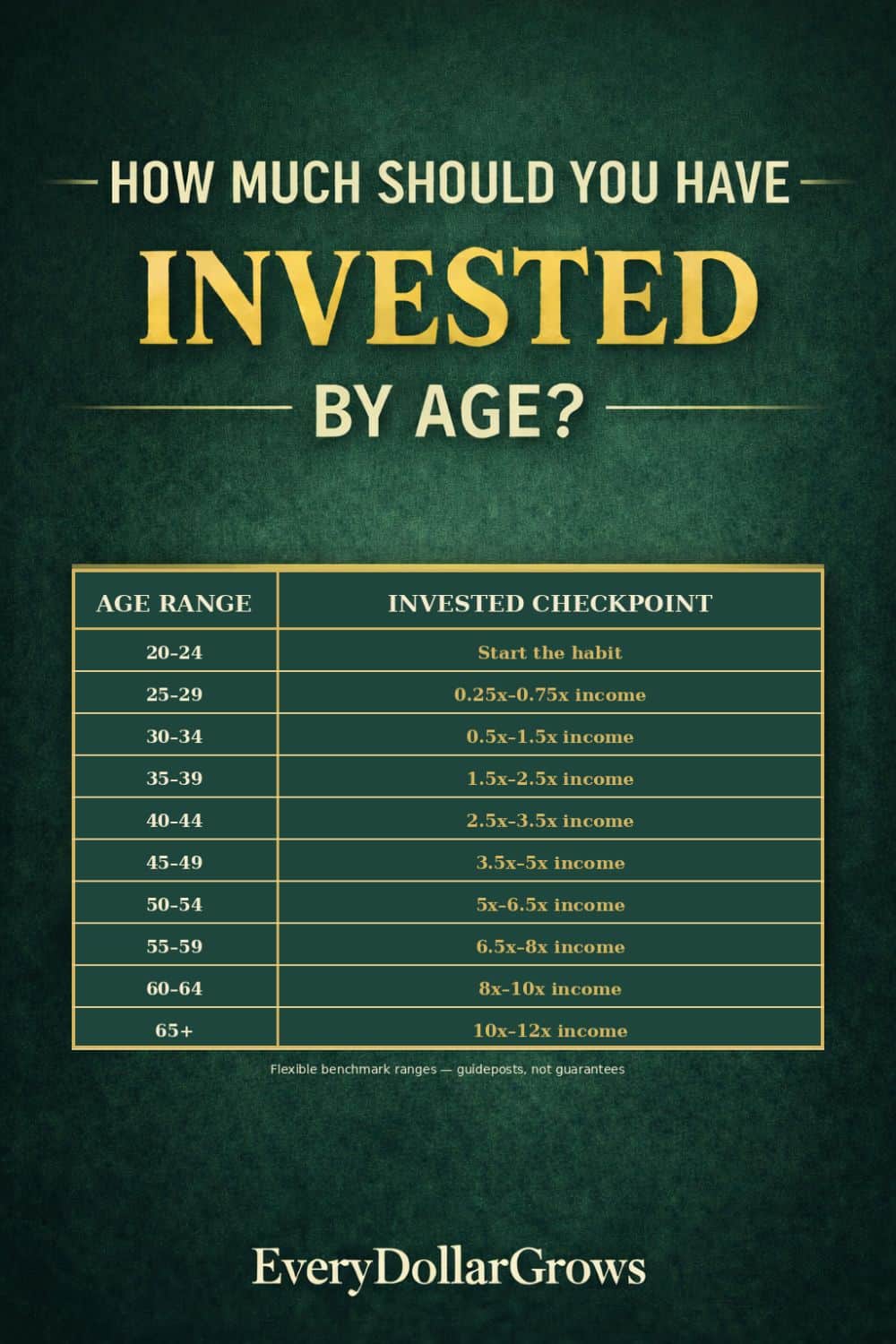
A realistic benchmark chart showing how much you may want invested by different age ranges.
What to Focus on in Your 20s, 30s, 40s, 50s, and 60s
In Your 20s: Build the Habit, Not the Perfect Portfolio
Your 20s are less about having a huge balance and more about learning how to become the kind of person who invests no matter what. If you can automate even modest amounts in your 20s, you create a financial behavior that can compound for decades.
This is also the decade when people often overcomplicate investing. They think they need to understand every chart, every fund, every economic headline, and every market opinion before they start. They do not. Most beginners need a simple setup, broad diversification, and a repeatable habit.
If you are in your 20s, the win is not “be rich immediately.” The win is:
- open the right accounts,
- avoid letting cash sit idle forever,
- learn the basics of index funds and ETFs,
- start automatic investing,
- and protect your cash flow from lifestyle inflation.
A person investing $150 or $250 a month in their 20s is not doing something small. They are building a long runway for compound growth. That is why this decade matters so much.
Related reading: index funds vs. stocks for beginners, how to choose ETFs and mutual funds, and financial independence checklist for young adults.
In Your 30s: Raise the Contribution Rate
Your 30s are often where adult life gets crowded. Mortgage or rent costs rise. Kids may enter the picture. Time feels tighter. Social pressure grows. This is also the decade when a lot of people earn more than they did in their 20s but still feel cash-strapped because spending rose right along with income.
That is why your 30s are such an important decade for investing. The focus should shift from simply “starting” to intentionally raising your savings rate. If your income goes up and your investing rate does not, you can drift for years without realizing it.
A strong target in your 30s is to move toward saving and investing a meaningful percentage of income every month, especially through workplace plans and IRAs. This is where your financial system matters. If money disappears before it gets invested, the problem is not motivation. The problem is the system.
That is exactly why budget structure matters. If you need help tightening cash flow first, see how to make a budget for beginners, this free budget tracker, and Money Reset OS.
In Your 40s: Turn Prime Earning Years Into Prime Investing Years
Your 40s are often where people finally feel more established professionally, but they can also be squeezed from every direction. Higher bills, kids’ activities, aging parents, house repairs, insurance costs, and burnout can all fight against consistent investing.
This is why your 40s are not the time to drift. They are the time to tighten the machine. If you are earning more, your investing should reflect it. Your portfolio does not need to look impressive on social media. It needs to be fed regularly and allocated intelligently.
If you are in your 40s and feel behind, the answer is not panic-trading or swinging for home runs. It is usually some combination of:
- raising your automatic contribution amount,
- using tax-advantaged accounts more intentionally,
- cutting expensive financial drag,
- keeping your portfolio simple,
- and sticking with the plan long enough for it to work.
Many people in their 40s can make dramatic progress if they stop underinvesting strong income years.
In Your 50s: Accelerate Without Turning Reckless
Your 50s are an important decade because the runway is shorter, but it is still long enough to matter. This is where people can make one of two mistakes: either they get too passive because they feel tired, or they get too aggressive because they feel late.
Both can be expensive. The smarter move is to become more intentional. Tighten your contribution strategy. Know where your accounts are. Understand what you own. Reduce the amount of chaos in your money system. Make sure your portfolio aligns with your real time horizon and not just your emotions.
This is also the decade when many people start paying more attention to contribution rules, catch-up options, and how much of their income is really reaching long-term investments. Current limits can change over time, so use the IRS contribution pages linked later in this article as your reference point rather than relying on outdated screenshots or random social posts.
In Your 60s: Shift From Accumulation to Readiness
By your 60s, the conversation changes. The question is no longer only “How big can I grow this?” It also becomes “How do I turn this into usable retirement income without making avoidable mistakes?”
That means portfolio size still matters, but so does:
- where your money sits,
- how it is allocated,
- which accounts you draw from first,
- how much flexibility you have in spending,
- and how much margin you built before retirement began.
If you are still working in your 60s, these years can meaningfully improve your retirement picture. If you are already transitioning out of full-time work, the focus becomes readiness, simplicity, and protecting the plan.
Age Benchmark Calculator
This calculator gives you a quick benchmark range based on your age, annual income, and current invested balance. It is not a retirement plan. It is a simple checkpoint to show where you roughly stand today.
This uses the flexible age-based ranges shown in this article. It is a practical guide, not personalized investment advice.
Enter your age, income, and current invested amount to see your rough checkpoint range and the gap between where you are and where you may want to head next.
How Much Should You Invest Each Month to Build Wealth?
Once you know the rough balance you want to build over time, the next question becomes more useful: How much should I be investing every month?
This is where age-based charts become practical. A benchmark is interesting. A monthly contribution plan is actionable.
If two people both want to build a seven-figure portfolio by traditional retirement age, the person who starts earlier can often get there with dramatically lower monthly contributions. That is the power of time. Compounding does not just reward high earners. It rewards early, repeated action.
| Starting Age | Years Until 65 | Approx. Monthly Amount Needed for $500,000 by 65* | Approx. Monthly Amount Needed for $1,000,000 by 65* |
|---|---|---|---|
| 25 | 40 | About $143/month | About $286/month |
| 30 | 35 | About $218/month | About $436/month |
| 35 | 30 | About $335/month | About $671/month |
| 40 | 25 | About $526/month | About $1,052/month |
| 45 | 20 | About $849/month | About $1,698/month |
| 50 | 15 | About $1,445/month | About $2,890/month |
*Illustrative examples assuming steady monthly investing and an 8% nominal annual return before inflation. Real returns vary, markets are not linear, and your actual results will differ.
These examples are not meant to discourage anyone who started later. They are meant to show why starting now matters. Waiting has a cost. Even five years can change the monthly burden dramatically.
That is also why the early years matter so much. Someone investing modestly in their 20s is not “behind because the number looks small.” They may be building the exact habit that gives them the strongest long-term advantage.
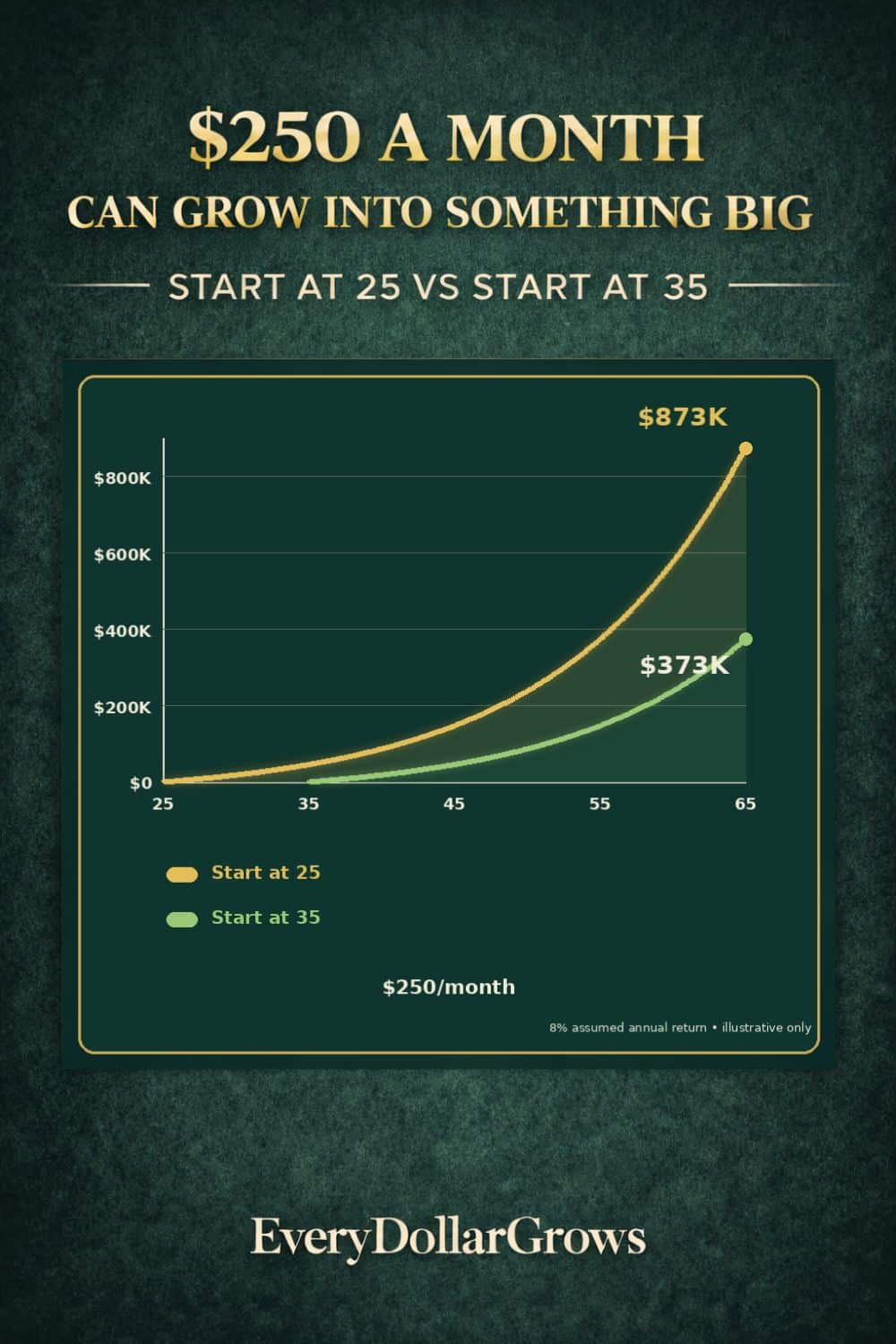
Starting at 25 instead of 35 can dramatically increase long-term growth, even with the same monthly investment.
Monthly Investing Growth Estimator
This calculator estimates how much your portfolio could grow based on your current age, retirement age, current invested amount, monthly contribution, and assumed annual return. It also shows a simple “wait 5 years” comparison so you can immediately see the cost of delay.
Educational only. Market returns are never guaranteed, and this tool does not account for taxes, fees, inflation, or changing contributions over time.
Use this calculator to see how today’s consistency may change your future balance and how much waiting can cost.
Know Your Number. Now Build the Portfolio.
Knowing how much to invest is only half the battle. The next question is usually what should you actually invest in? If you want a beginner-friendly system that helps you move from confusion to action, start with my investing tools page and portfolio-building resources.
What to Invest In Once You Know Your Target
A lot of people freeze right here. They finally understand that they should be investing, but they still do not know what to buy. That is where simple investing usually wins.
For many beginners, the path is not about hunting for the next winning stock. It is about building a diversified long-term portfolio using broad funds and holding them consistently. That is why index funds, diversified ETFs, and simple asset allocation strategies are so often recommended for ordinary investors.
When you are ready to turn the investing concepts into a simple allocation, use the Beginner Portfolio Builder.
Here is the basic progression:
1) Know your account order
Many people start by capturing any employer match available in a workplace retirement plan, then evaluating IRAs, Roth IRAs, HSAs, and additional workplace contributions depending on their situation and income.
2) Keep the portfolio simple
Simple usually beats clever. A diversified portfolio you understand and stick with is more powerful than a complex one you constantly second-guess.
3) Learn basic allocation
Your mix of stocks, bonds, and cash should reflect your time horizon and risk tolerance. A younger investor usually has more time to ride out volatility than someone close to retirement.
4) Avoid performance chasing
Jumping in and out of funds because of headlines or short-term excitement can wreck long-term progress.
If you want to go deeper, start here:
- Index funds vs. stocks for beginners
- How to choose ETFs and mutual funds
- Fidelity mutual funds and ETFs
- Vanguard mutual funds and ETFs
- Unlock your wealth potential with smart investing
- Investing mindset
For authoritative outside references, the SEC’s Investor.gov pages on asset allocation and diversification and the compound interest calculator are both useful. If you are checking current account contribution rules, use the IRS pages for IRA contribution limits and 401(k) and profit-sharing plan contribution limits.
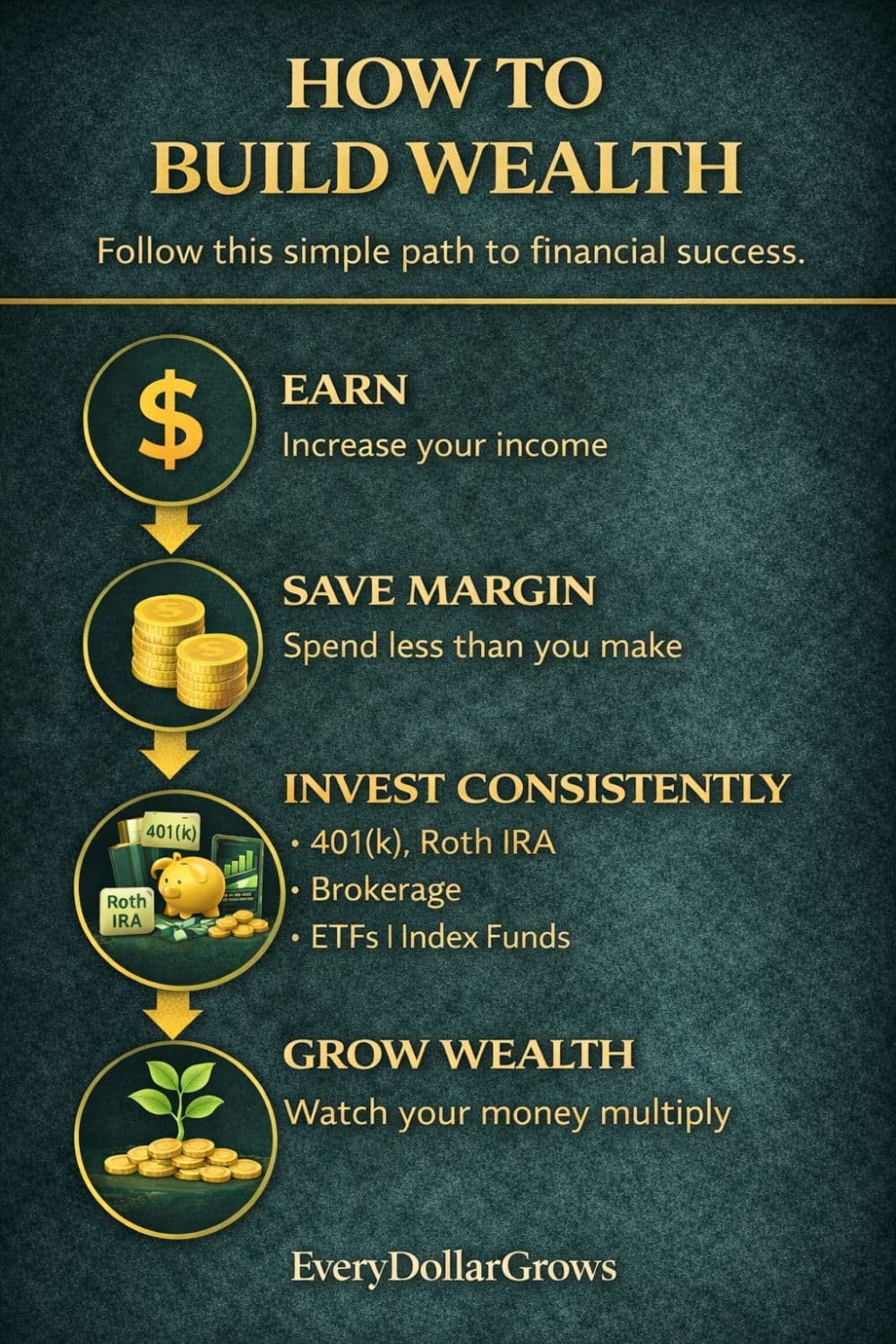
A simple wealth-building roadmap: earn more, save margin, invest consistently, and let time grow your money.
What Actually Counts Toward Your “Invested by Age” Number?
This is an important clarification because people often mix everything together and then feel confused.
When most people ask how much they should have invested by age, they are usually talking about assets designed to grow for the future. That often includes:
- 401(k) or similar workplace retirement plans
- Traditional IRA balances
- Roth IRA balances
- Taxable brokerage accounts invested for long-term growth
- Invested HSA assets if you are using the account as a long-term tool
What usually does not count in the same way:
- Your emergency fund
- Cash sitting in checking because you are afraid to move it
- Home equity used as a vague emotional “I’m doing okay” number
- Cars, furniture, or random stuff that loses value
That does not mean those things are meaningless. It just means they serve different jobs. Your emergency fund is for stability. Your invested accounts are for growth.
If You Are Behind, Here Is How to Catch Up Without Losing Your Mind
Feeling behind can either make you smarter or more impulsive. You want it to make you smarter.
If your invested balance is lower than you hoped, here is the right mindset: you do not need a miracle. You need a plan that is clear enough to follow and strong enough to sustain.
Step 1: Stop guessing where your money goes
You cannot increase investing consistently if your monthly cash flow is foggy. Start with the basics: income, fixed bills, variable spending, debt payments, and real leftover cash. Use the free budget tracker or this beginner budget guide if needed.
Step 2: Create cash margin before trying to be impressive
Some people try to invest aggressively while still living paycheck to paycheck. That usually creates stress and inconsistency. Build breathing room. A starter emergency fund and a tighter money system give your investing habit a better chance to survive.
Step 3: Raise your contribution rate intentionally
Do not wait for “extra money” to appear. Decide on a number. Automate it. Increase it as income rises. Even small increases matter when they happen repeatedly over time.
Step 4: Use tax-advantaged accounts wisely
If you have access to a workplace plan, an IRA, a Roth IRA, or an HSA, understand how those accounts fit into your bigger strategy. Account location matters. Contribution timing matters. Simplicity matters.
Step 5: Cut what keeps sabotaging your future self
This does not mean living like a robot. It means identifying the money leaks that stop long-term progress. Related reading: budgeting mistakes, emotional spending, and how to save money without feeling deprived.
Step 6: Keep your investing strategy boring enough to stick with
The more complicated you make it, the easier it becomes to stop. For most people, boring and consistent wins.
Step 7: Think in decades, not moods
Investing progress is often quiet before it becomes obvious. That is normal. The first stage feels slow. The middle stage feels meaningful. The later stage looks “lucky” to people who did not see the years of discipline underneath it.
If your cash flow is too messy to invest consistently, fix the system first
A lot of people do not have an investing problem first. They have a money-flow problem first. If you need a better way to organize paychecks, bills, leftover cash, and priorities before increasing investing, start with Money Reset OS.
Common Mistakes That Slow Down Long-Term Investing Progress
You do not need to make every financial mistake yourself. Here are some of the most common ones that keep people from reaching stronger age-based investing numbers:
- Waiting until you feel fully confident. Confidence often comes after action, not before it.
- Treating investing like entertainment. News, drama, and hot takes can make finance feel exciting, but boring systems usually build more wealth.
- Ignoring contribution increases. If your income went up and your investing stayed flat, you probably slowed your own progress.
- Confusing saving with investing. You need both, but they do different jobs.
- Failing to connect budgeting and investing. Your investment account is downstream of your money habits.
- Thinking it is too late. Late is harder than early, but late is still better than never.
There is a mindset side to wealth building that people underestimate. See money mindset that builds wealth and money mindset habits if you want to strengthen the behavior side of the equation, not just the numbers.
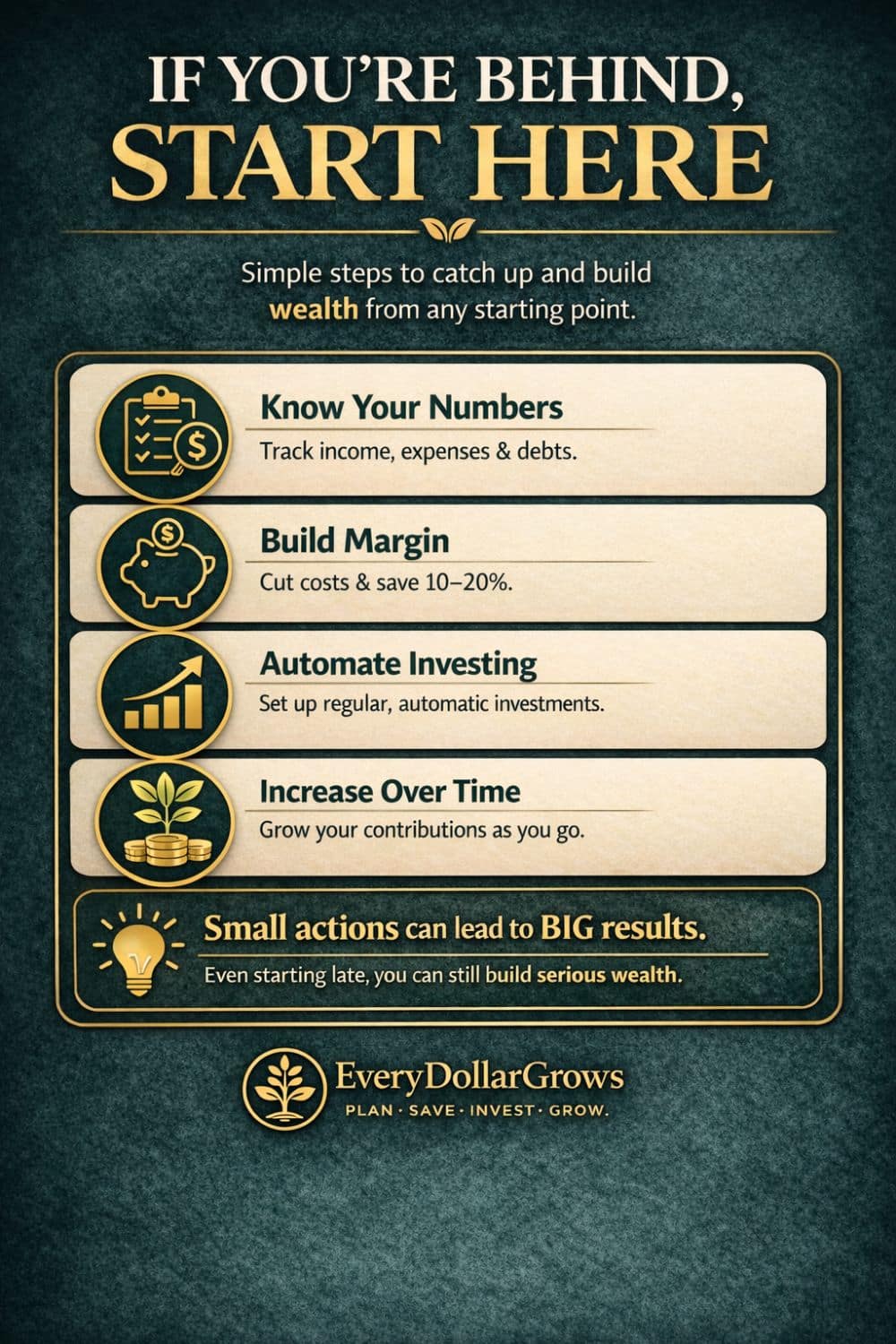
A simple wealth-building roadmap for catching up financially: know your numbers, build margin, automate investing, and increase contributions over time.
The Goal of Investing, in Plain English
At the deepest level, the goal of investing is not just to have a big account screenshot. It is to convert your working years into lasting assets. It is to give your money a job beyond paying next month’s bills. It is to create options, flexibility, resilience, and eventually freedom.
That freedom may mean retiring with dignity. It may mean reducing stress in midlife. It may mean having more margin, more generosity, more stability, or more ability to say no to things you do not want. That is why investing matters.
And that is why the “how much should I have invested by age?” question is valuable when it leads you to action. Not panic. Not comparison. Not shame. Action.
Frequently Asked Questions
How much should I have invested by age 30?
A realistic checkpoint for many people is somewhere around half to one and a half times annual income invested by the early 30s, depending on when they started, their income level, and whether they prioritized debt payoff or emergency savings first. More important than the exact number is whether you are now investing consistently and increasing the rate over time.
How much should I have invested by age 40?
Many investors want to be somewhere in the range of roughly two to three times annual income invested by their 40s, though individual circumstances matter a lot. If you are below that, the best response is usually not panic. It is raising your savings rate, tightening your cash flow, and simplifying your investing plan.
How much should I invest each month?
The best monthly amount is the amount you can automate and sustain while still handling essential priorities like bills, emergency savings, and high-interest debt. If you can only start with a smaller number, start there and build upward. Progress compounds.
Is it too late to start investing in my 40s or 50s?
No. Starting later does mean you have less time, but it does not mean the effort is pointless. Strong income, disciplined contributions, and simple investing can still produce meaningful results. The sooner you start, the more options you create.
Should I save before I invest?
You usually need both, but they serve different jobs. A basic emergency fund creates stability. Investing creates long-term growth. If your finances are fragile, build some cash buffer while beginning or planning your investing habit, rather than treating them like enemies.
What should I invest in as a beginner?
Many beginners do best with simple, diversified investments rather than trying to pick winners. Broad index funds, ETFs, and straightforward asset allocation strategies are common starting points. For more help, visit Digital Investing Tools and this ETF and mutual fund guide.