
Investing Education · Every Dollar Grows
Roth vs. Traditional Calculator: 2026 Tax Comparison
Use the Roth vs. Traditional Calculator to compare taxes now versus retirement, including current tax cost, future withdrawal taxes, contribution limits, qualified-withdrawal rules, and required minimum distributions.
Quick Answer
The Roth vs. Traditional Calculator compares the tax timing of Roth and traditional retirement contributions under different current and future tax-rate assumptions.
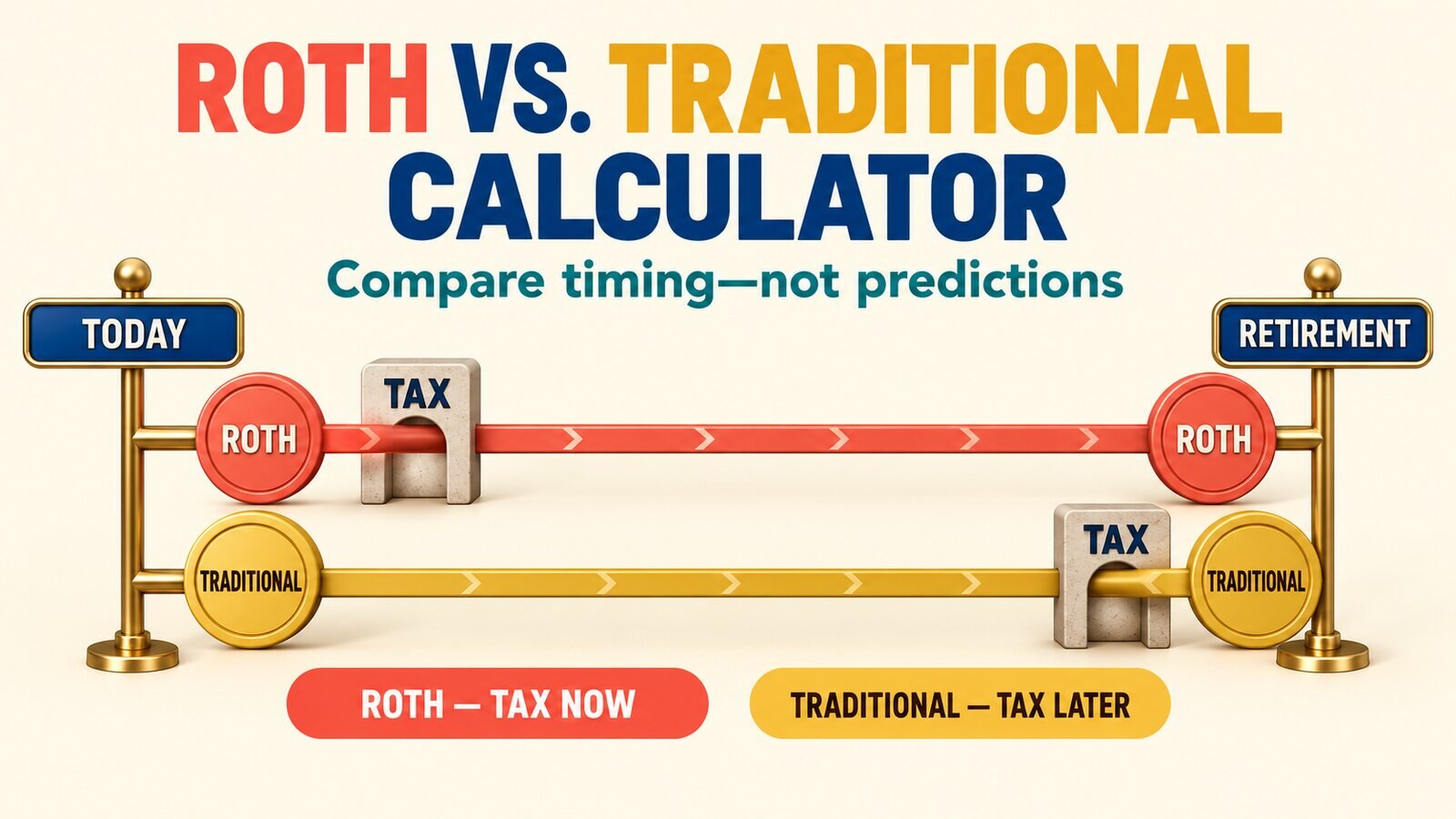
Roth vs. traditional is primarily a question of when you pay income tax.
With a traditional pre-tax workplace contribution, you generally receive the income-tax benefit now and pay ordinary income tax when the money is withdrawn.
With a Roth contribution, you generally pay income tax now in exchange for potentially tax-free qualified withdrawals later.
If your future marginal tax rate is lower than your current rate, traditional treatment can gain an advantage. If your future rate is higher, Roth can gain an advantage. When the rates are similar, other factors such as required distributions, tax diversification, state taxes, eligibility, and behavior become more important.
Roth vs. Traditional: The Core Tax Difference

Traditional
Eligible pre-tax contributions can reduce current taxable income.
The contribution and investment earnings generally grow tax-deferred, and taxable withdrawals are generally included in income later.
Roth
Roth contributions are made with income that is taxed currently.
Qualified withdrawals can later be received free of federal income tax, including qualifying investment earnings.
The investment itself does not have to be different.
A traditional 401(k) and a Roth 401(k) could hold the same mutual fund, earn the same investment return, and still produce different after-tax results because the tax is paid at a different point in time.
How the Roth vs. Traditional Calculator Makes an Apples-to-Apples Comparison
This is where many online comparisons go wrong.
Assume you contribute $7,500 to a traditional account and $7,500 to a Roth account.
The account contribution is equal, but the current cash-flow cost is not necessarily equal.
A deductible or pre-tax traditional contribution can create a current income-tax benefit. The Roth contribution does not.
There are therefore two useful comparison methods.
Same Account Contribution
Put the same dollar amount into the Roth and traditional account.
This is simple, but recognize that the Roth contribution generally requires more current after-tax resources.
Same Current Economic Cost
Account for the current traditional tax savings and assume those savings are also saved or invested.
This produces a more complete comparison when evaluating the true household cost of each choice.
The Tax Savings Matter Only If You Keep Them
If a traditional contribution saves money on today's tax bill but the household simply spends that extra cash, the theoretical advantage from investing those tax savings disappears.
Free interactive calculator
Roth vs. Traditional Calculator: Compare the Tax Timing
The Roth vs. Traditional Calculator compares the future after-tax value of the same account contribution under simplified current and future marginal tax-rate assumptions.
Enter your assumptions and select Calculate.
Simplified educational comparison. It does not calculate actual tax liability, IRA deductibility, Roth IRA income eligibility, state taxes, Social Security taxation, Medicare premiums, required minimum distributions, early-withdrawal rules, employer matching, or future tax-law changes.
How to Use the Roth vs. Traditional Calculator Responsibly
Use It To
See how changing today's marginal tax rate and the future withdrawal tax rate changes the simplified Roth-versus-traditional result.
Read the Result As
A tax-rate sensitivity test, not a prediction of your future tax return.
Do Not Treat It As
Proof that Roth or traditional contributions are universally better for every household.
Current Tax Rate vs. Future Tax Rate Drives Much of the Math
In a simplified model, the relative tax rates are powerful.
| Tax-rate relationship | Simplified tendency |
|---|---|
| Future marginal rate lower than current rate | Traditional tends to become more attractive |
| Future marginal rate higher than current rate | Roth tends to become more attractive |
| Current and future rates similar | Other planning factors become more important |
But your tax return does not have one universal tax rate.
Retirement withdrawals can interact with:
- ordinary income-tax brackets,
- Social Security taxation,
- capital gains,
- deductions,
- credits,
- Medicare income-related premiums,
- state income taxes,
- and required minimum distributions.
Treat the calculator's future rate as a scenario to test, not a forecast you can know with certainty decades in advance.
Roth vs. Traditional Contribution Limits for 2026
Contribution limits depend on the type of account.
| Account | 2026 basic limit | Important rule |
|---|---|---|
| Traditional IRA + Roth IRA | $7,500 combined | $1,100 additional IRA catch-up contribution if age 50 or older |
| Traditional 401(k) + Roth 401(k) | $24,500 combined employee deferral | Roth and traditional employee deferrals share the same annual employee limit |
| 401(k) age 50+ catch-up | $8,000 | Applies if eligible and the plan permits catch-up contributions |
| 401(k) age 60–63 catch-up | $11,250 | Higher catch-up applies for eligible participants attaining ages 60–63 during 2026 |
A person cannot contribute $7,500 to a traditional IRA and another $7,500 to a Roth IRA for 2026. The IRA contribution limit is shared.
The same concept applies to employee elective deferrals between Roth and traditional contributions inside a 401(k).
Roth IRA and Roth 401(k) Are Not the Same Account
The word Roth describes tax treatment, but a Roth IRA and Roth 401(k) have different rules.
| Feature | Roth IRA | Roth 401(k) |
|---|---|---|
| 2026 contribution limit | $7,500 combined with traditional IRA | $24,500 combined with traditional 401(k) employee deferrals |
| Income restriction | Direct Roth IRA contributions can be reduced or prohibited at higher income | No Roth-IRA-style income limit for making designated Roth contributions |
| Employer required | No | Yes — the workplace plan must offer the Roth feature |
| Lifetime RMD for original owner | No | No under current law |
2026 Roth IRA Income Phaseouts
For 2026, direct Roth IRA contribution eligibility begins phasing out at modified AGI of:
- $153,000 for single and head-of-household filers,
- and $242,000 for married couples filing jointly.
The contribution is fully phased out at:
- $168,000 for single and head-of-household filers,
- and $252,000 for married couples filing jointly.
Married-filing-separately rules can be significantly more restrictive.
A Traditional IRA Contribution Is Not Automatically Deductible
This distinction matters when using the Roth vs. Traditional Calculator.
A traditional IRA contribution can be made even when the contribution is not deductible, assuming the other contribution requirements are met.
If you or your spouse participates in a retirement plan at work, the deduction can phase out as income rises.
For 2026, when the IRA contributor is covered by a workplace retirement plan, the traditional IRA deduction phases out between:
- $81,000 and $91,000 for single or head-of-household filers,
- and $129,000 and $149,000 for married couples filing jointly.
If the contributor is not covered by a workplace plan but is married to someone who is, the 2026 joint-return phaseout range is $242,000 to $252,000.
Why This Matters to the Calculator
The traditional side of a simple calculator often assumes that the contribution produces a current tax benefit.
If your traditional IRA contribution is nondeductible, that assumption does not fit your actual situation.
Qualified Roth Withdrawal Rules Matter
Roth does not mean every withdrawal is automatically tax-free.
Tax-free treatment of earnings depends on satisfying the applicable qualified-distribution rules.
Roth 401(k) and Similar Designated Roth Accounts
A qualified distribution generally requires:
- a five-taxable-year participation period,
- plus a qualifying event such as reaching age 59½, disability, or death.
Roth IRA
Roth IRA qualified-distribution rules also include a five-year requirement and qualifying conditions. Roth IRA distribution-ordering rules differ from workplace Roth accounts, so the two should not be treated as identical.
Confirm the rules for the exact account before making an early withdrawal.

Roth and Traditional Accounts Have Different RMD Effects
Required minimum distributions can affect retirement tax planning.
Under current federal rules, traditional IRAs and many pre-tax retirement-plan balances generally become subject to required minimum distributions.
The current applicable RMD age is generally 73 for many retirees, with the statutory age scheduled to rise to 75 for later cohorts.
Roth IRAs do not require lifetime RMDs for the original owner.
Designated Roth accounts in 401(k) and 403(b) plans also no longer require lifetime RMDs for the original owner under current law.
Beneficiary distribution rules are separate and can still apply after the owner's death.
Why RMDs Matter
Large required taxable withdrawals later in retirement can increase taxable income even when the retiree does not need all of the money for spending.
That can make Roth assets useful as one component of a broader tax-diversified retirement plan.
Traditional Wins More Often on Paper When the Tax Savings Are Invested
A traditional contribution can reduce current taxable income.
Suppose a fully pre-tax or deductible $7,500 contribution falls within a 22% marginal federal tax bracket.
A simplified estimate of the current federal tax reduction is:
$7,500 × 22% = $1,650
If that $1,650 is invested, the traditional strategy has an additional asset that should be included in a fair comparison.
If that $1,650 is spent instead, the retirement outcome can be very different.
The Behavior Test
Ask yourself: if I choose traditional contributions, will the resulting tax savings actually increase my savings or investment rate?
If the answer is no, Roth's higher current tax cost can sometimes act as a form of forced tax prepayment.
State Taxes Can Change the Roth vs. Traditional Result
The Roth vs. Traditional Calculator models a simplified tax rate, but state taxes can materially change the comparison.
Consider a worker who contributes while living in a state with an income tax but later retires in a state with lower or no state income tax.
Traditional contributions may receive a state tax benefit today while future withdrawals face a lower state tax burden.
The reverse can also occur.
State tax rules also vary in how they treat:
- retirement contributions,
- pension and retirement-plan withdrawals,
- Social Security,
- and IRA distributions.
For a major retirement contribution decision, test both federal and state assumptions.
Real-World Roth vs. Traditional Examples
| Situation | Why it matters |
|---|---|
| Early-career worker in a relatively low tax bracket | Paying tax now through Roth contributions may be attractive if substantially higher income and tax rates are expected later |
| High-income worker near peak earnings | A current traditional tax deduction or pre-tax contribution can be more valuable if retirement withdrawals are expected in lower brackets |
| Worker expecting a pension plus large retirement balances | Future taxable income may remain relatively high, increasing the value of having some Roth assets |
| Household planning to retire before claiming Social Security | Low-income years between retirement and later benefits can create opportunities for traditional withdrawals or Roth conversions |
| Household unsure about future tax rates | Holding both Roth and traditional assets can diversify future tax exposure |
You Do Not Have to Choose 100% Roth or 100% Traditional
Many workplace retirement plans allow employees to divide elective contributions between traditional pre-tax and designated Roth contributions.
The combined employee contribution still must remain within the applicable annual limit.
Splitting contributions can create tax diversification.
At retirement, having both taxable traditional assets and qualified tax-free Roth assets can give the household more control over where spending money comes from.
That flexibility can become useful when managing:
- tax brackets,
- capital gains,
- Social Security taxation,
- Medicare income thresholds,
- charitable giving,
- and large one-time expenses.
A close Roth vs. Traditional Calculator result does not require choosing one side exclusively.
Roth vs. Traditional Calculator Decision Checklist
- Identify whether you are comparing an IRA or a workplace retirement plan.
- Confirm that the traditional contribution actually receives the assumed current tax benefit.
- Verify Roth IRA income eligibility if using a Roth IRA.
- Check the current contribution limit for the account.
- Estimate your current marginal federal tax rate.
- Run several future tax-rate scenarios rather than one forecast.
- Include state taxes when material.
- Decide whether traditional tax savings would actually be invested.
- Consider future pensions, Social Security, and required distributions.
- Review Roth qualified-withdrawal rules.
- Consider whether having both Roth and traditional assets improves flexibility.
- Revisit the decision after major income, tax-law, job, or retirement-plan changes.
Use Roth vs. Traditional Contributions for the broader decision framework, 401(k) for Beginners for workplace-plan basics, and Retirement Withdrawal Strategy for the other side of the tax-planning equation.
Helpful Primary Sources
Roth vs. Traditional Calculator FAQs
Is Roth always better if I am young?
No. Age alone does not determine the answer. Current and future tax rates, income, retirement plans, pensions, contribution limits, and how long the money will remain invested can all affect the decision.
Is traditional always better if my current tax rate is high?
Not automatically. A high current marginal tax rate can make the traditional tax benefit valuable, but future taxable income, required distributions, pensions, state taxes, and tax diversification can still matter.
What is the IRA contribution limit for 2026?
The combined traditional and Roth IRA contribution limit is $7,500 for 2026, plus a $1,100 catch-up contribution for eligible people age 50 or older.
What is the 401(k) contribution limit for 2026?
The employee elective-deferral limit is $24,500 for 2026. Traditional and Roth employee deferrals share that limit. Eligible catch-up contributions can increase the amount for older participants.
Is there an income limit for Roth 401(k) contributions?
No Roth-IRA-style income limit applies to designated Roth contributions in an eligible workplace plan. The plan must offer the Roth feature, and normal plan contribution limits still apply.
Is there an income limit for Roth IRA contributions?
Yes. For 2026, direct Roth IRA contributions phase out between $153,000 and $168,000 of modified AGI for single and head-of-household filers and between $242,000 and $252,000 for married couples filing jointly.
Are traditional IRA contributions always deductible?
No. Deductibility can be limited by income when you or your spouse participates in a workplace retirement plan. A nondeductible traditional IRA contribution has different tax consequences from the simplified deductible-traditional assumption used in many calculators.
Do Roth 401(k) accounts have required minimum distributions?
Not for the original account owner under current federal law. Roth IRAs and designated Roth accounts in 401(k) and 403(b) plans are not subject to lifetime RMDs for the owner. Beneficiary rules are different.
Can I contribute to both Roth and traditional 401(k) accounts?
Yes, if your plan offers both. You can divide employee elective deferrals between Roth and traditional contributions, but the combined amount remains subject to the annual employee contribution limit.
Keep learning