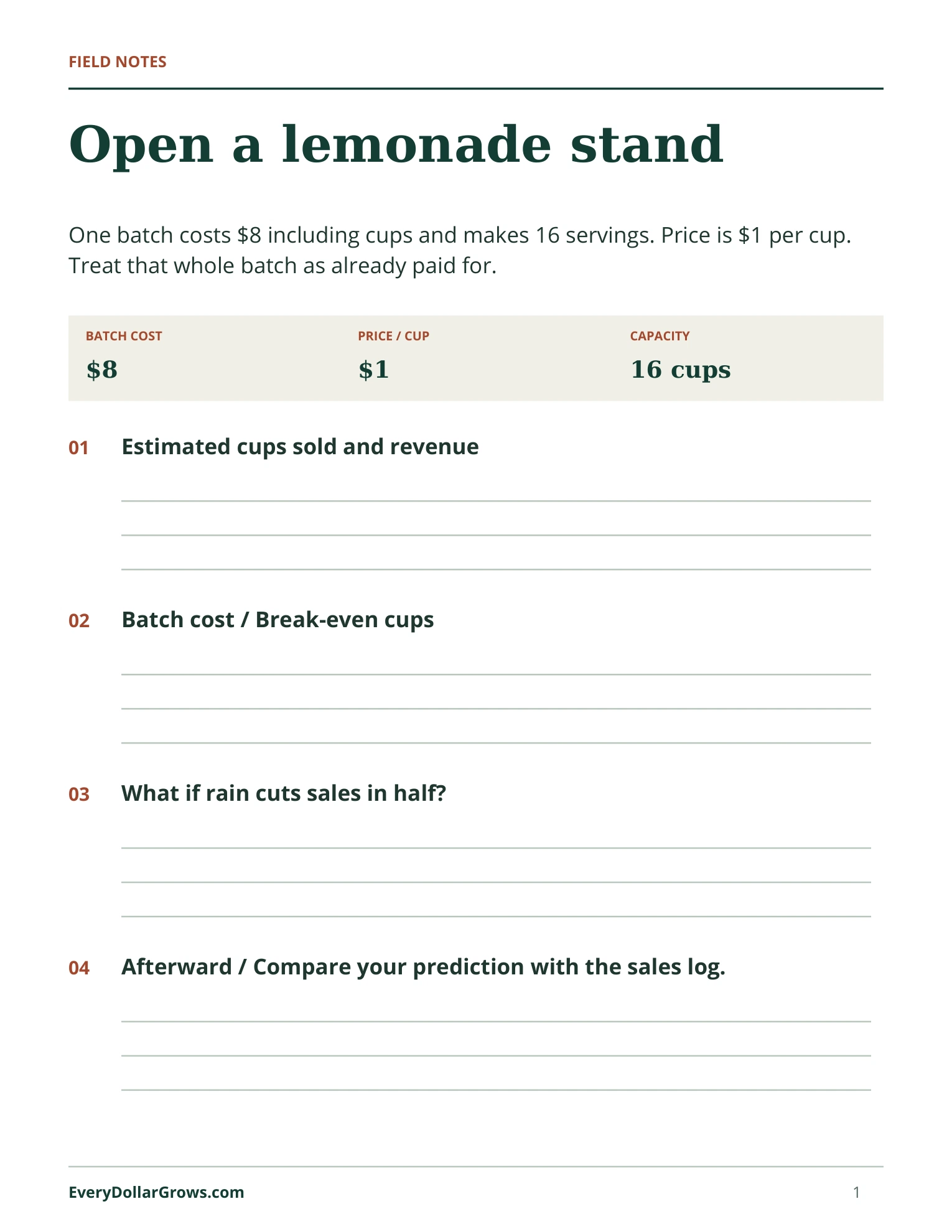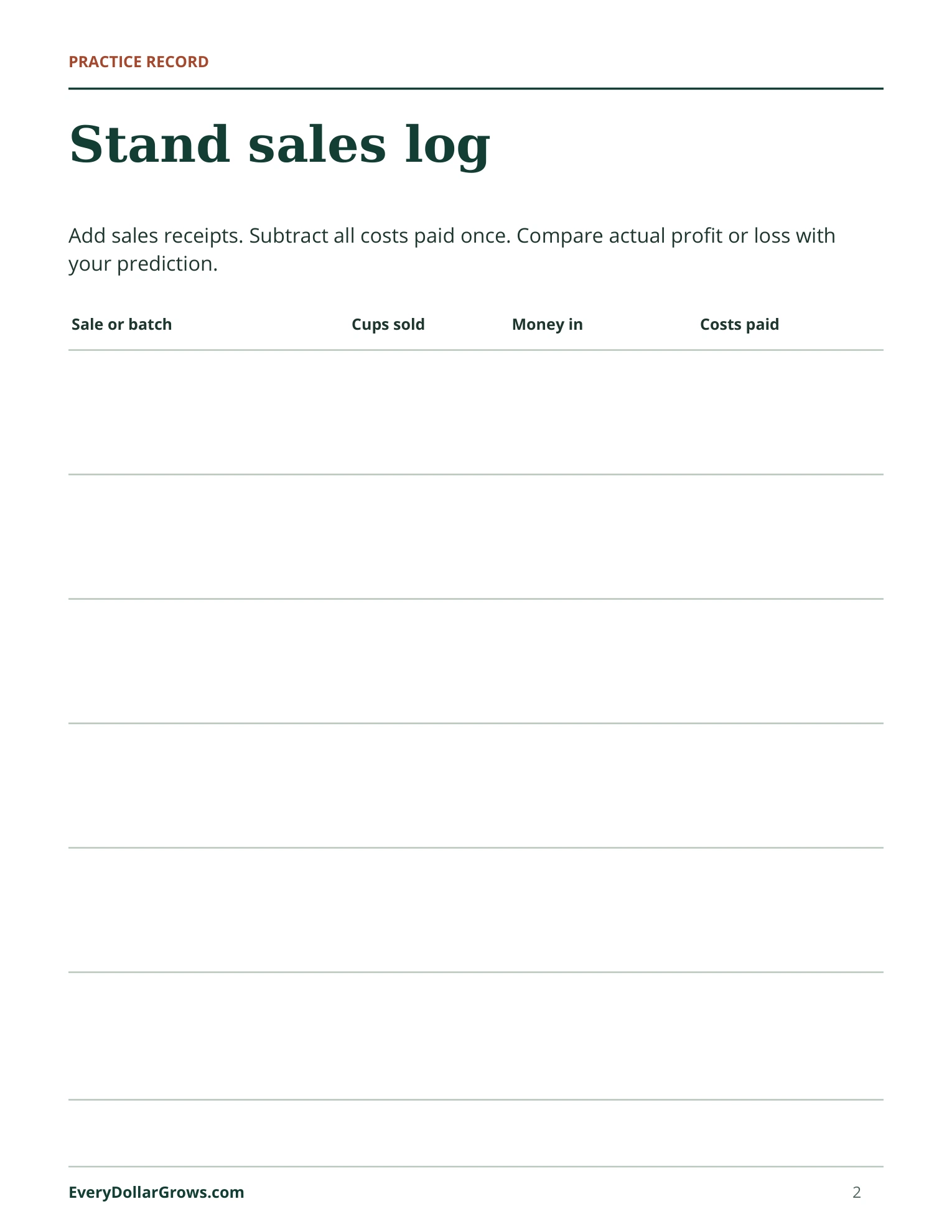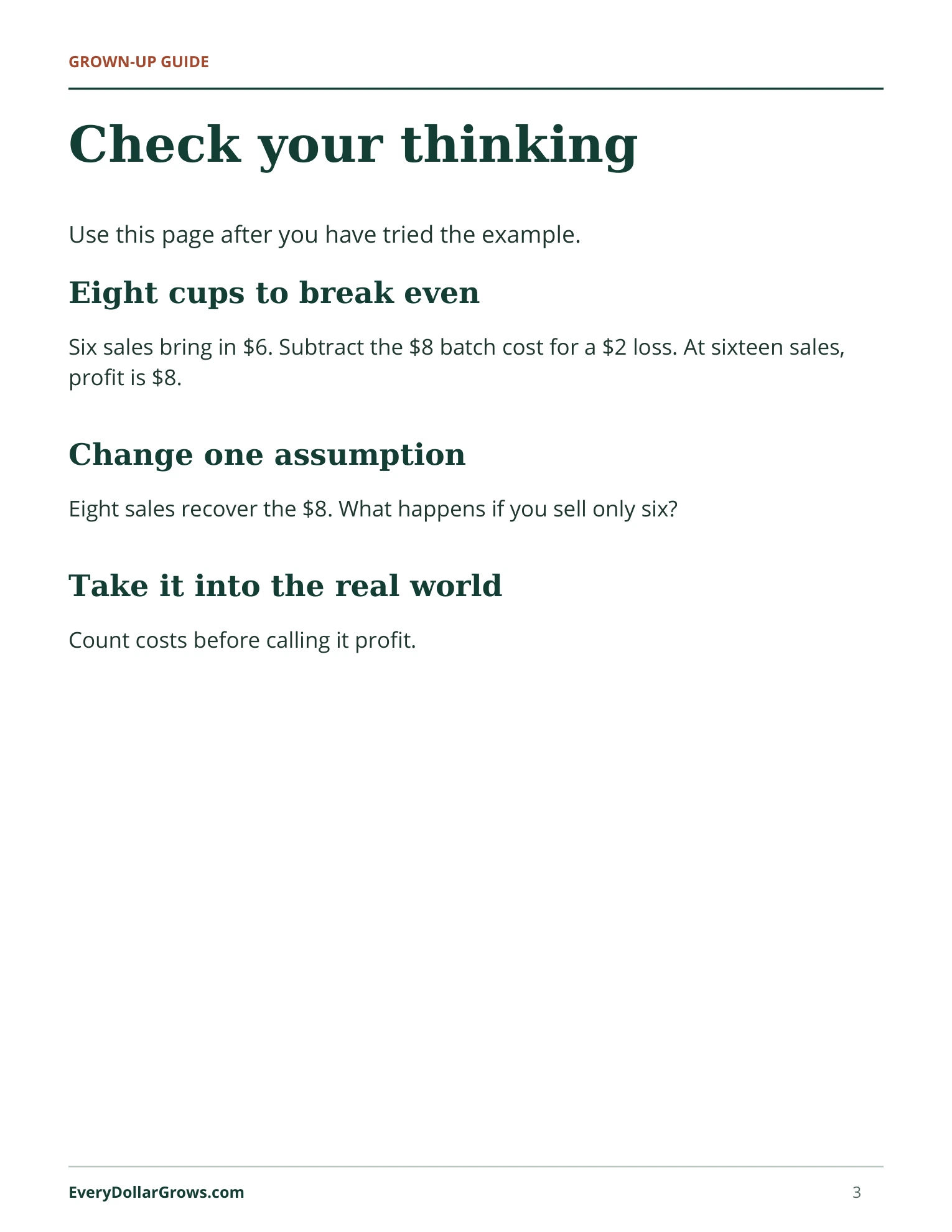
Lemonade Stand Budget Worksheet & Free Printable Game
Plan a real lemonade stand, calculate expenses and profit, print your own budget worksheet, and learn money skills with Lemonade Lane and its Neighborhood Rivals expansion.

How to Use the Lemonade Stand Budget Worksheet
Running a lemonade stand can teach children how a business works. They make a plan, buy supplies, choose a selling price, and adjust when sales differ from their forecast.
Plan a real stand or practice the same principles with the printable game.
Plan a Real Stand
Estimate ingredients, supplies, selling prices, expected customers, and profit using the interactive calculator.
Practice With a Game
Play Lemonade Lane, a short business simulation, or its 30-day Neighborhood Rivals expansion.
Three Numbers Every Young Entrepreneur Needs
Revenue
The total money paid by customers.
Cups sold × Selling priceExpenses
The cost of running the stand.
Add all business costsProfit
What remains after expenses.
Revenue − ExpensesSales Aren’t All Profit
When you sell lemonade, you collect revenue. But the business must first cover its ingredients, cups, and any other expenses. Only the money remaining is profit.
How can two lemonade stands collect the same amount in sales but earn different profits?

Build Your Lemonade Stand Budget
Enter the amounts you expect to spend and the number of cups you hope to sell. The calculator estimates total costs, revenue, profit, and the number of cups needed to break even.
All default costs are illustrative. Replace them with your actual prices.
1. Ingredients and Cups
2. Other Costs and Price
3. Sales Forecast
The forecast counts the cost of all planned supplies, including unsold servings and equipment purchased for this event. Actual cash needed at the store may be higher when ingredients are sold in larger packages.
This sheet starts completely blank. Type into it or print and fill it in by hand. The calculator’s separate Print button above still prints its calculated results.
1. Plan Your Lemonade
2. Estimate Your Expenses
| Expense | Quantity or notes | Estimated cost |
|---|---|---|
| Lemons or drink mix | ||
| Sugar or sweetener | ||
| Water and ice | ||
| Cups | ||
| Napkins and supplies | ||
| Signs and equipment | ||
| Other expenses | ||
| Total expenses |
3. Plan Your Sales and Profit
4. What Would I Change Next Time?
Revenue = cups sold × selling price. Profit = revenue − expenses.
What Should Go in a Lemonade Stand Budget?
Include more than drink mix. Plan for ingredients, cups, equipment, and other expenses. Work out ingredient costs from the portions used, while remembering that you may have to buy larger packages up front.
| Expense | How to estimate it |
|---|---|
| Drink mix or lemons | Cost of ingredients used per batch |
| Sugar | Cost of the amount used in the recipe |
| Water and ice | Water, ice, and cooling supplies |
| Disposable cups | Package cost divided by the number of cups |
| Signs and equipment | Items purchased for the stand |
| Other expenses | Napkins, cleaning supplies, and extras |
An adult should help with food safety, permissions, and any local requirements before running a real stand.
How Many Cups Must You Sell to Break Even?
Break-even is the point where money collected equals the total cost of your business plan. Change the selling price in the calculator and observe how your break-even quantity changes.
Is your stand preparing enough cups to cover the expenses at the price you’ve chosen?

Practice With the Lemonade Lane Game
Before operating a real stand, children can practice with a printable game. Lemonade Lane uses simplified fictional numbers so kids can focus on choosing batches, setting a price, and responding to uncertain customer demand.
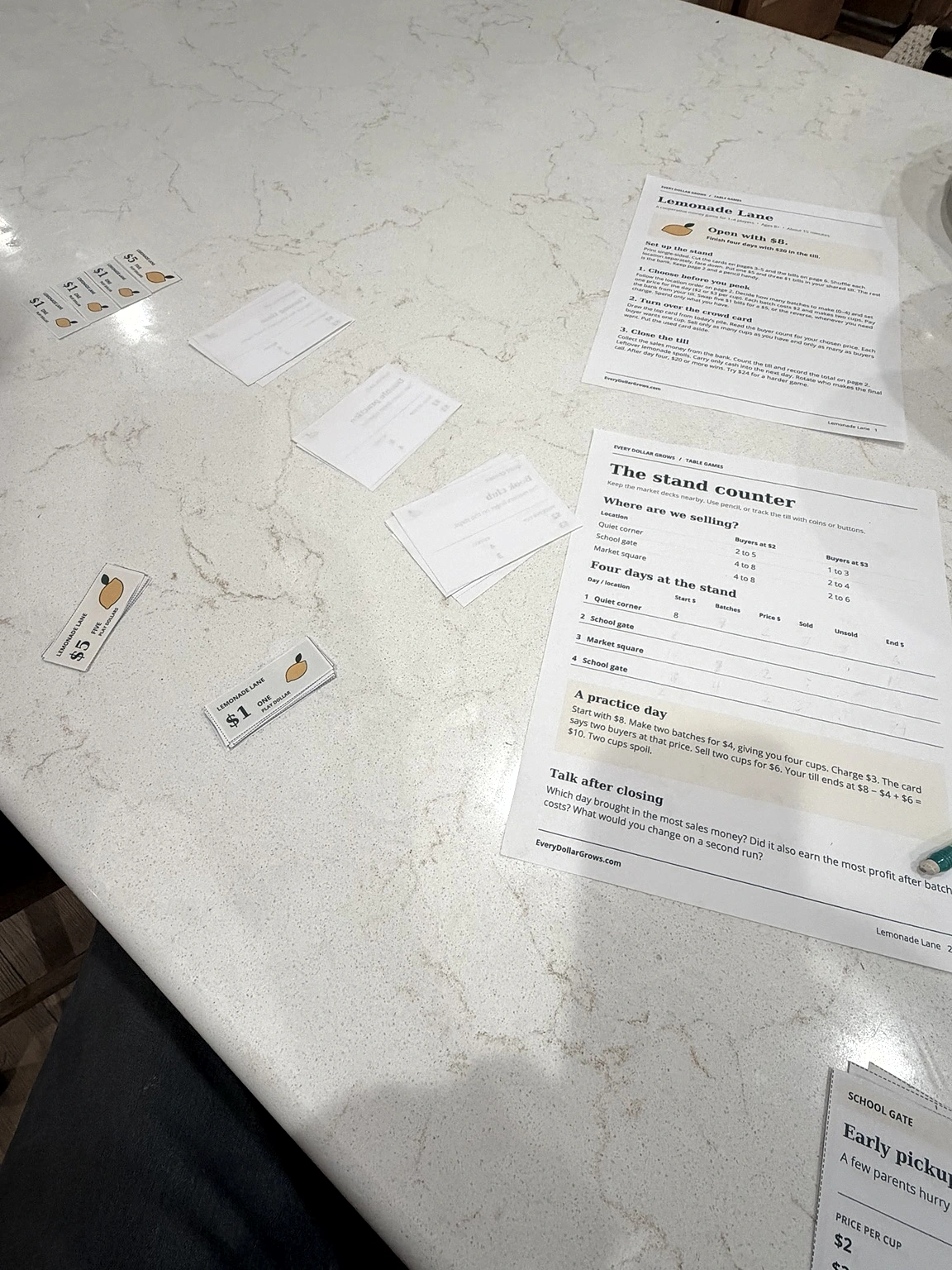
Try a Lemonade Lane Business Day
The printable game uses simpler numbers than a real stand. Each batch costs $2 and makes two cups. You choose a price of $2 or $3 per cup.
In the actual game, you must have enough money in your till to pay for the batches before drawing the crowd card. These are fictional game costs, not real-world lemonade prices.
Lemonade Lane
A cooperative money game for 1–4 players, ages 8+, lasting about 15 minutes. Start with $8 in fictional shared game cash, make smart decisions over four days, and finish with at least $20 in the till to win.

How to Play
- Prepare the game. Print the six pages, cut out the crowd cards and play money, and set aside the game’s $8 opening cash.
- Choose before you peek. Decide how many batches to make, from zero to four, and choose $2 or $3 per cup.
- Pay for production. Each fictional game batch costs $2 and makes two cups.
- Draw a crowd card. The card tells you how many customers want lemonade at your price.
- Close the till. Collect game money, record closing cash, and carry it into the next day. Unsold lemonade spoils.
- Check your result. Finish day four with $20 to win, or try $24 for a harder challenge.
Children must spend cash before earning it, estimate demand before seeing the crowd card, and distinguish revenue from money remaining after costs.
Look Inside the Printable Game
These are small thumbnails of the six actual game pages, not large images stacked down the article. Select any to enlarge; use the PDF to print at the correct size.
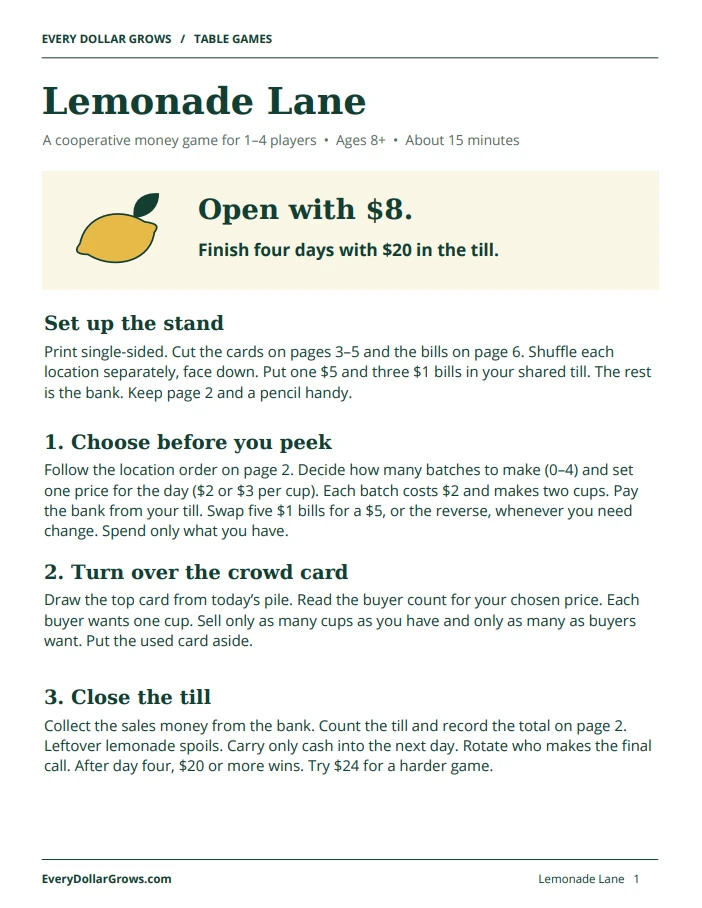
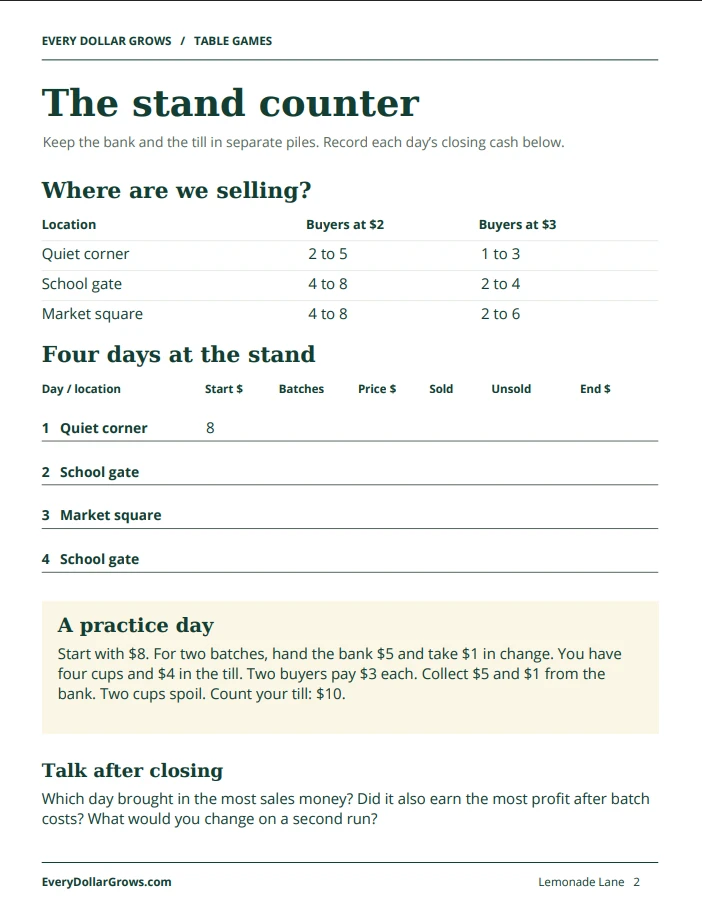
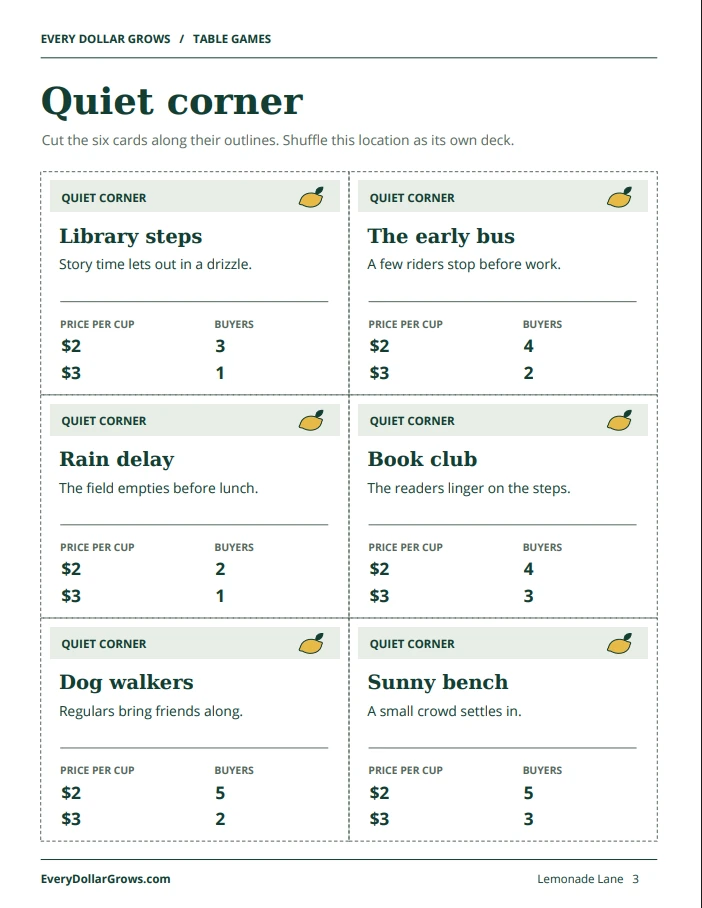
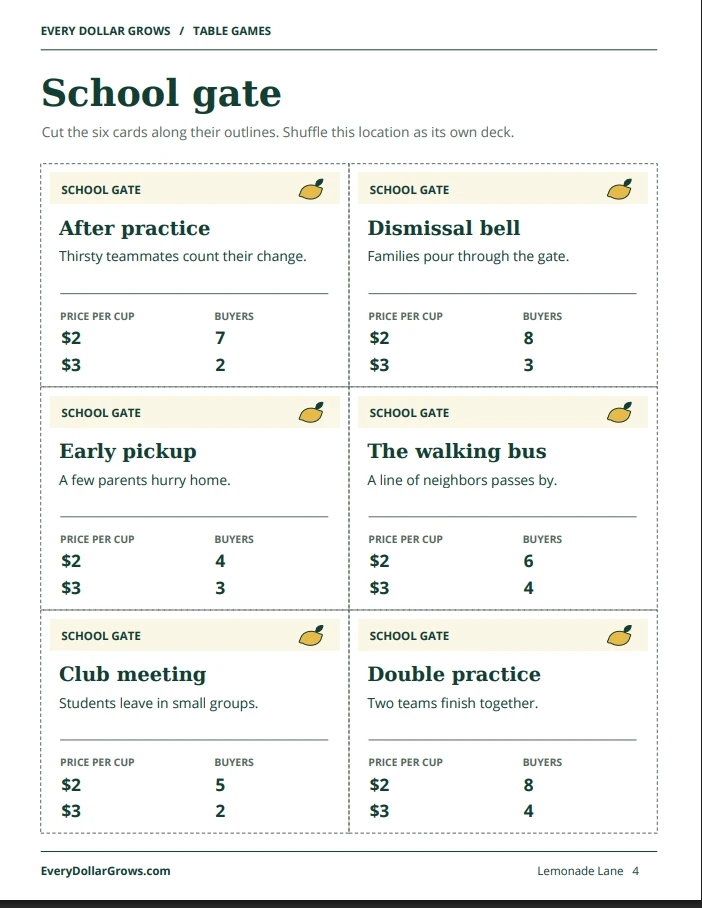
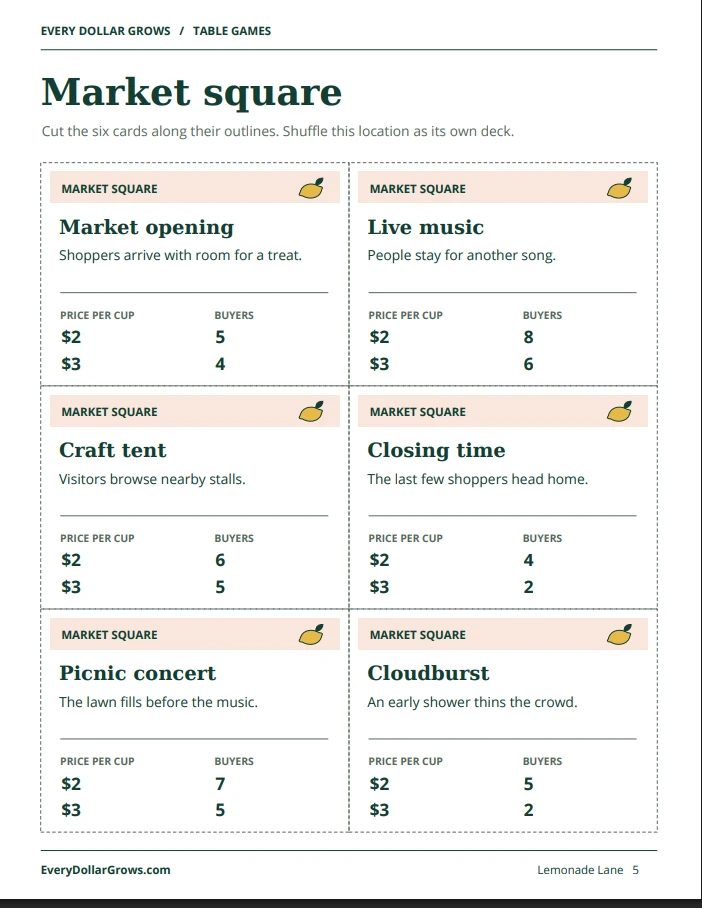
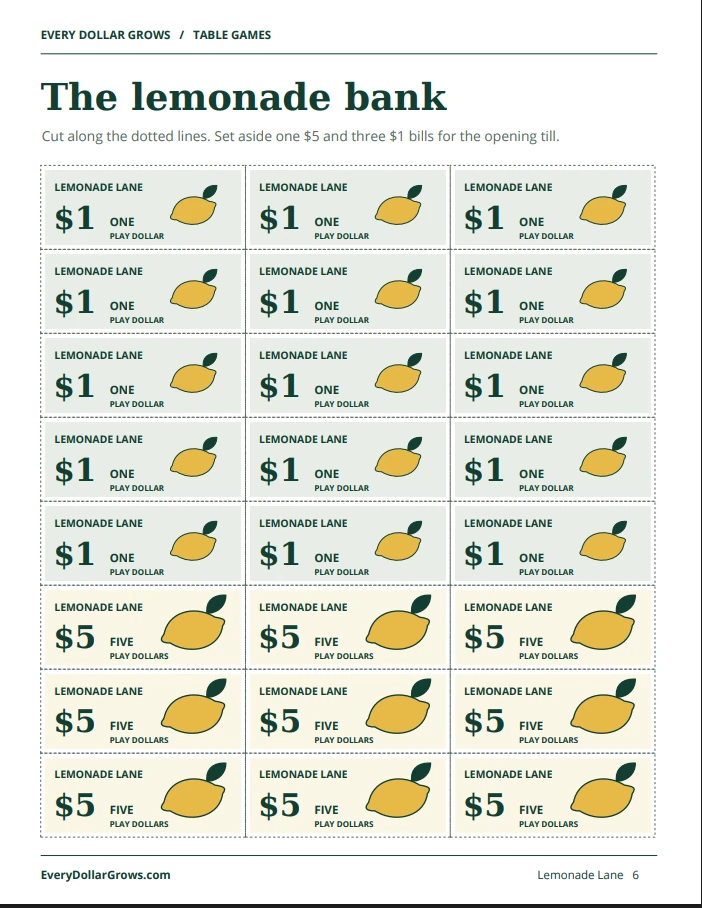
Neighborhood Rivals — 30-Day Edition
Two to four players each operate an independent lemonade stand. Everyone starts with $8 in fictional game cash and manages their own batches, pricing, and daily ledger. After 30 days, the player with the most cash wins; pause after any day and resume later.
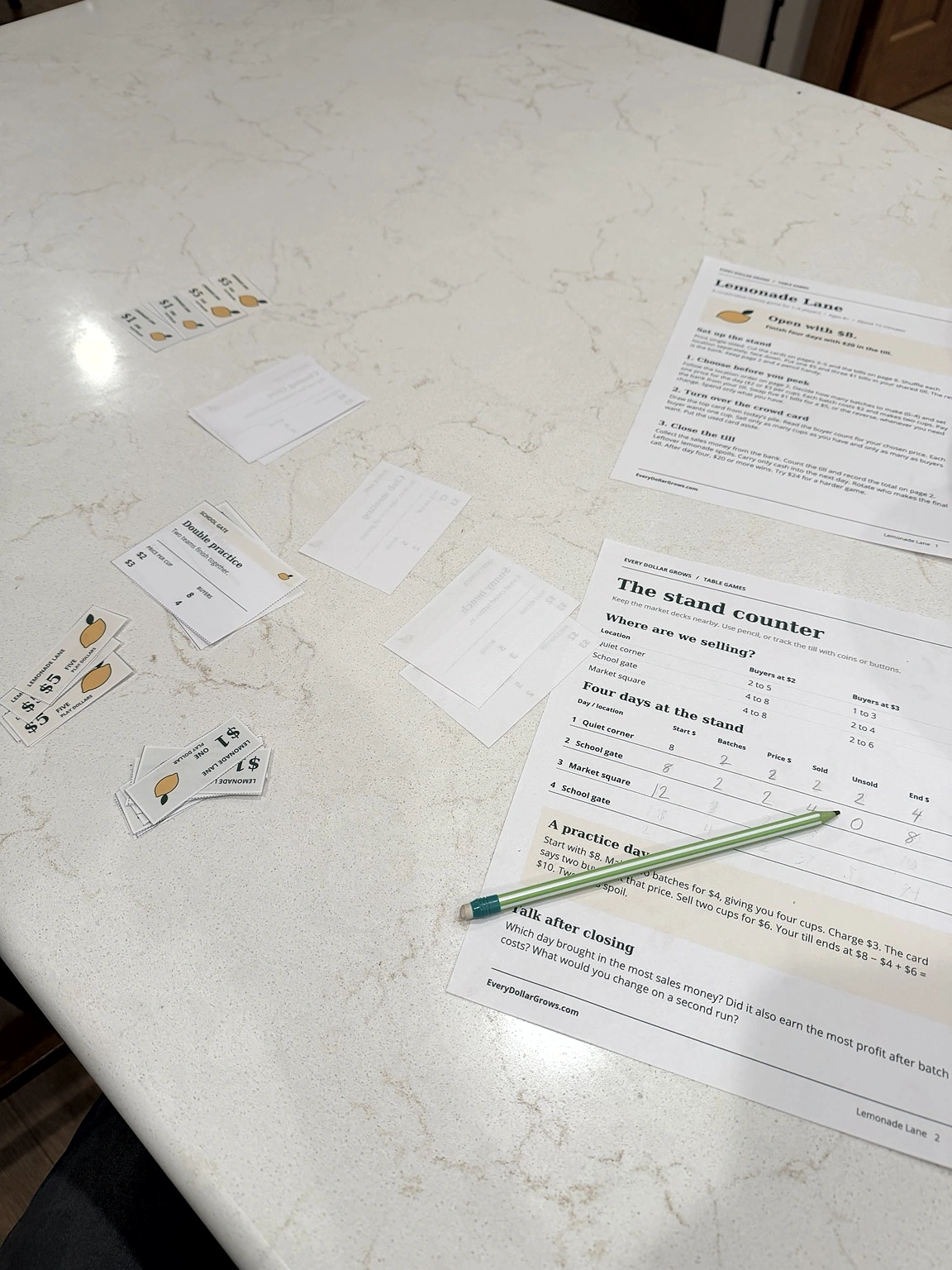
Choose a Selling Location
The board includes Quiet Corner, School Gate, and Market Square.

Separate Businesses
Every player makes independent decisions.
30-Day Challenge
Track long-term cash results.
Delivery Shift
Skip sales for a day and collect $2 in game money when short on cash.
Make Your Lemonade Lane Game Last Longer
Ordinary printer paper works and may already be on hand. The following photographed products are optional upgrades for families who want sturdier cards or reusable ledgers.
Affiliate disclosure: As an Amazon Associate, Every Dollar Grows earns from qualifying purchases. Prices and availability are determined by Amazon.

Koala Waterproof Inkjet Paper — 30 Sheets
Non-adhesive, matte, tear-resistant printable paper designed for inkjet printers. A premium durability upgrade for game cards and play money.
Check printer thickness compatibility and test ink adhesion on one sheet first. Waterproof doesn’t mean dry-erase.
View Koala Paper on Amazon
Astrobrights/Neenah White Cardstock — 75 Sheets
65 lb cardstock makes cards and play money sturdier while staying less expensive than waterproof synthetic paper.
Check your inkjet printer’s supported paper weight before purchasing.
View Cardstock on Amazon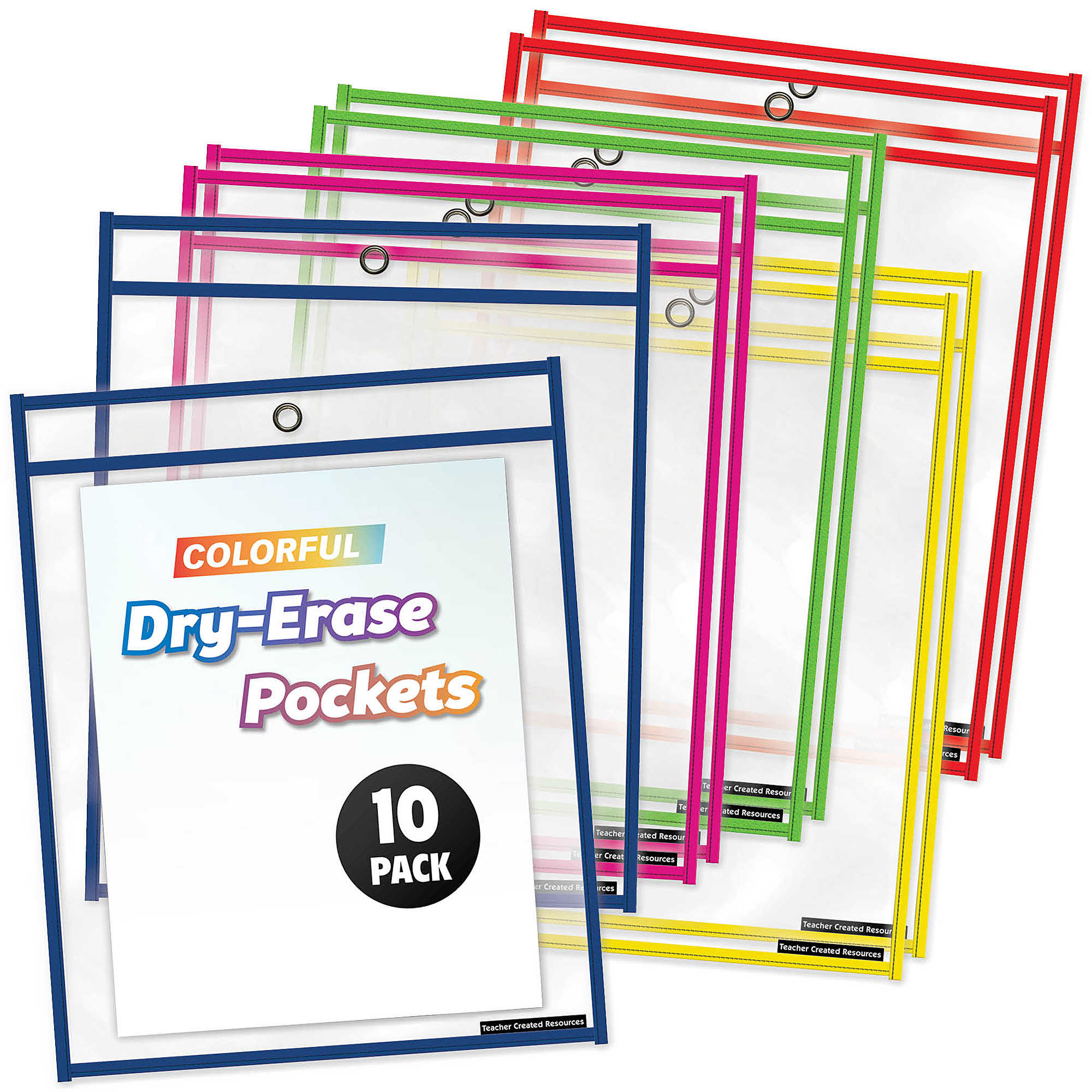
Reusable Dry-Erase Pockets — 10-Pack
Place the printed daily ledger in a clear pocket, write on the pocket’s surface, and erase it for the next game.
Works with standard letter-size sheets.
Find These Pockets on Amazon
EXPO Fine-Tip Dry-Erase Markers — 4-Pack
Fine-tip markers make it easier to write numbers in the game’s small daily-ledger boxes.
Use only on dry-erase-compatible surfaces, not directly on cardstock or waterproof paper.
Find EXPO Markers on AmazonRegular printer paper and a pencil are enough. For frequent play, consider cardstock for the cards and a dry-erase pocket for the tracking sheet.
Questions to Ask After Playing
Did a Higher Price Help?
Compare the number of buyers at $2 and $3 in the game.
Did You Prepare Too Much?
Unsold lemonade spoils, but batches already cost money.
Which Day Earned the Most?
Compare revenue against production costs, not just sales.
What Would You Change?
Choose one business decision to improve and explain why.
Frequently Asked Questions
Are the games free?
Yes. The original game and Neighborhood Rivals expansion are free printable PDFs. Paper, ink, and optional upgrades have costs.
Why is the real calculator prefilled but the blank sheet isn’t?
The calculator retains editable example values so it shows how calculations work. The separate one-page fill-in worksheet contains no preset numbers.
Is $8 the real cost to make lemonade?
No. $8 is the fictional game opening till, not the cost of a lemonade batch. The simplified game batch cost is also fictional.
Can the expansion be paused?
Yes. Save the game sheets and continue after any day.
Keep Teaching Kids About Money
Explore more practical lessons, printables, and money games.
EveryDollarGrows.com | Plan it. Sell it. Count your profit.
Stand:
Date:
1. My Shopping Budget
| Item | Calculation | Cost |
|---|---|---|
| Drink mix | ||
| Sugar | ||
| Water and ice | ||
| Disposable cups | ||
| Signs and equipment | One-time expense | |
| Other expenses | Additional supplies | |
| TOTAL PLANNED EXPENSES | ||
2. My Sales Plan
| Batches to prepare | |
| Cups per batch | |
| Total cups prepared | |
| Selling price per cup | |
| Expected cups sold | |
| Expected revenue | |
| Expected profit or loss | |
| Break-even cups |
3. After the Sale
| Actual cups sold | ________________________ |
| Actual revenue | $_______________________ |
| Actual expenses | $_______________________ |
| Actual profit or loss | $_______________________ |
Profit = Revenue − Expenses.
What would I change next time?
Costs are estimates until verified. Ask an adult for help with shopping, food safety, and permissions.
View the activity pages