Fund Research · Every Dollar Grows
ETF and Mutual Fund Companies: Compare Major Providers
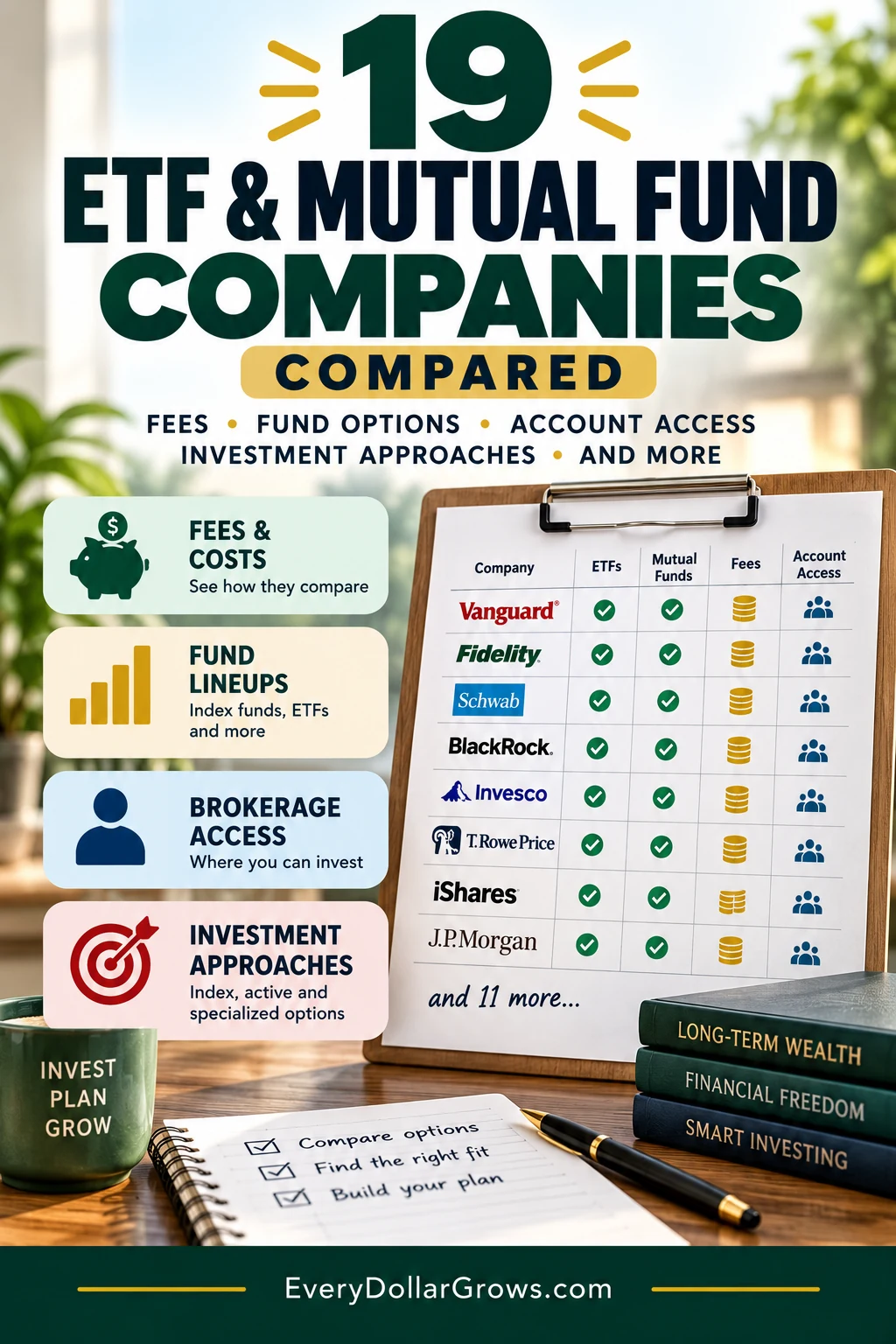
Compare major ETF and mutual fund companies by portfolio role, fund format, investment approach, costs, share classes, brokerage access, and the actual exposure you are trying to buy.

Quick answer
ETF and mutual fund companies create and manage investment funds, while brokerages provide the accounts through which investors buy and hold them. Some firms do both. The most useful comparison is not “Which company is best?” but “Which specific fund best matches the portfolio role I am trying to fill, at a cost and structure I understand?”
ETF and Mutual Fund Companies: Search 19 Provider Guides
Search by company, ticker, strategy, or research topic. You can also narrow the directory by fund format or the type of research question you are trying to answer.
19 provider guides
| Provider guide | Formats | Research focus | Good first comparison |
|---|---|---|---|
| Vanguard | ETFs | Broad-market ETFs, portfolio roles, and mutual fund alternatives | VTI vs VOO vs VT: what does your stock allocation actually cover? |
| Charles Schwab | ETFs + mutual funds | Separate Schwab-created funds from investments purchased through a Schwab brokerage account | SCHB vs SWTSX: similar goal, different trading format |
| Fidelity | ETFs + mutual funds | Index mutual funds, ZERO funds, Fidelity ETFs, and account portability | FXAIX vs FSKAX: large U.S. companies or the broader U.S. market? |
| iShares / BlackRock | ETFs | Core index building blocks alongside a very large specialty ETF lineup | Separate broad-market core exposure from narrow strategy exposure |
| State Street / SPDR | ETFs | S&P 500 exposure, broad portfolio funds, and sector ETFs | SPY vs SPYM: compare the vehicle even when the benchmark is similar |
| Invesco | ETFs + mutual funds | Nasdaq exposure, equal weighting, factor strategies, and specialty funds | Nasdaq-100 exposure is not the same thing as the total U.S. market |
| J.P. Morgan | ETFs + mutual funds | Active management, income-oriented strategies, options, and distribution mechanics | When a fund targets income, identify where the distribution actually comes from |
| Capital Group / American Funds | ETFs + mutual funds | Share classes, sales charges, active mutual funds, and newer ETF access | The same underlying portfolio can have materially different investor costs |
| T. Rowe Price | ETFs + mutual funds | Active fund selection and target-date retirement glide paths | Target-date funds: compare the glide path, holdings, and costs—not just the year |
| Dimensional | ETFs + mutual funds | Systematic investing, factor tilts, implementation rules, and access | Systematic investing is not automatically the same thing as traditional indexing |
| PIMCO | ETFs + mutual funds | Bond management, duration, credit quality, income, and active fixed income | Higher bond income and greater capital stability are not the same objective |
| Franklin Templeton | ETFs + mutual funds | Multiple investment teams, active strategies, share classes, and fund structure | Identify the specific strategy and share class instead of relying on the family name |
| Avantis / American Century | ETFs + mutual funds | Broad exposure combined with deliberate value and smaller-company tilts | A broadly diversified portfolio can still be actively managed |
| WisdomTree | ETFs | Dividend, factor, currency, and capital-efficient strategies | Dividend and quality screens are portfolio-design decisions, not neutral labels |
| VanEck | ETFs + mutual funds | Sector, commodity, thematic, and specialized market exposure | A gold-mining equity fund is not the same exposure as physical gold |
| First Trust | ETFs + mutual funds | Rules-based selection, active strategies, income products, and target-outcome structures | Rules-based security selection is not the same as owning the entire market |
| Janus Henderson | ETFs + mutual funds | Active equities and specialized fixed-income strategies | JAAA and JBBB may both involve CLO exposure but represent different credit profiles |
| Nuveen | ETFs + mutual funds | Municipal income, fund structures, share classes, and closed-end fund differences | Tax treatment alone does not determine whether a municipal fund fits the investor |
| PGIM | ETFs + mutual funds | Active bond management, short-duration strategies, and buffered equity products | Compare the source of risk rather than assuming every income fund solves the same problem |
No provider guides match those filters. Try a broader phrase or reset the directory.
How to use this table: Pick the portfolio role first, then use the provider guide to compare specific funds. These examples are research starting points, not rankings.
ETF and Mutual Fund Companies: Issuer vs Brokerage vs Account
Three separate decisions are often blended together even though they answer different questions.
A Schwab brokerage account, for example, does not mean every investment inside the account must be issued by Schwab.
Likewise, buying a Vanguard ETF through another brokerage does not turn the account itself into a Vanguard account.
For account structure, see Taxable Brokerage Account Explained.
How to Compare ETF and Mutual Fund Companies Fairly
Do not begin by asking which provider has the best brand, the largest advertising presence, or the strongest recent return.
Begin with the portfolio job.
Compare the Same Exposure Across Providers
A useful fund comparison starts by making sure the investments are actually comparable.
Review:
- Asset class
- Geography
- Company size
- Benchmark
- Index methodology
- Active mandate
- Sector limits
- Factor tilts
- Credit quality
- Interest-rate exposure
Two funds can both contain the words “U.S. stock” while owning meaningfully different portfolios.
Closer comparison
Two broad U.S. total-market index funds may be reasonable peers if their indexes and market coverage are similar.
Poor comparison
An S&P 500 index fund and a Nasdaq-100 fund both own large U.S. companies, but they are not interchangeable representations of the U.S. stock market.
Compare the Full Cost Stack
Expense ratio is one of the easiest fund costs to compare, but it is not always the only cost an investor can face.
Simple annual expense illustration
| Balance | Expense Ratio | Approximate Annual Cost |
|---|---|---|
| $10,000 | 0.05% | $5 |
| $10,000 | 0.25% | $25 |
| $10,000 | 0.50% | $50 |
| $100,000 | 0.50% | $500 |
These are simple illustrations, not current quotes for any provider.
Use Investment Fee Calculator to see how recurring costs compound over longer periods.
ETF vs Mutual Fund Format Can Matter Even With Similar Holdings
An ETF and mutual fund can pursue nearly the same investment objective while behaving differently operationally.
| Feature | ETF | Mutual Fund |
|---|---|---|
| Trading | Trades on an exchange during the trading day | Generally transacts at end-of-day NAV |
| Bid-ask spread | Can apply | No exchange bid-ask spread in the same sense |
| Automatic investing | Depends on brokerage capabilities | Often straightforward when purchased directly or through supported platforms |
| Minimum purchase | Depends on share price and fractional-share availability | Can have fund-specific minimums |
| Taxable distributions | Can occur; structure can sometimes reduce capital-gain distributions | Capital-gain distributions can occur even when the investor did not personally sell shares |
For the broader format decision, see How to Choose ETFs and Mutual Funds.
Brokerage Access Can Change the Practical Choice
A fund can look attractive on paper and still be inconvenient or more expensive to use through a particular account.
Before choosing between otherwise similar funds, check:
- Is the fund available at your brokerage?
- Does the brokerage charge a transaction fee?
- Are fractional ETF shares supported?
- Can recurring purchases be automated?
- Does the mutual fund require a minimum purchase?
- Is the desired share class available?
- Are there short-term redemption or trading restrictions?
- Would transferring the investment later create friction?
ETF portability can sometimes make cross-provider investing easier because exchange-traded shares may be available at many brokerages.
Mutual funds can be more dependent on brokerage agreements and share-class eligibility.
Example: Comparing Three Providers for Broad U.S. Stocks
Goal
Build broad U.S. stock exposure for a long-term portfolio.
Three possible research starting points from the directory are:
- Vanguard VTI — ETF structure
- Schwab SCHB — ETF structure
- Fidelity FSKAX — mutual fund structure
The next step is not to ask which company has the best reputation.
Compare:
- Underlying index
- Market-cap coverage
- Number and concentration of holdings
- Current expense ratio
- ETF versus mutual fund mechanics
- Automatic-investment support
- Fractional-share availability
- Transaction fees through your brokerage
- Tax consequences if replacing an existing position
Active, Index, Factor, and Specialty Funds Solve Different Problems
The 19 providers in this directory do not all compete in exactly the same way.
Broad index building blocks
Some providers are heavily used for low-cost market-tracking stock and bond exposure.
Active management
Other providers emphasize portfolio-manager decisions, security selection, credit research, or tactical portfolio construction.
Systematic and factor strategies
Some funds use rules or quantitative methods to deliberately emphasize characteristics such as value, profitability, quality, dividends, or company size.
Sector and thematic strategies
Specialized products can concentrate exposure in areas such as technology, commodities, mining companies, individual industries, or investment themes.
Why TD Ameritrade Belongs in a Separate Guide
TD Ameritrade should not be presented as a current independent fund company alongside Vanguard, Fidelity, Schwab, or the other providers in this directory.
TD Ameritrade was acquired by Charles Schwab, and former TD Ameritrade clients have been transitioned to Schwab.
The useful remaining research question is therefore not “Which TD Ameritrade funds should I buy?” but rather:
- Where did former TD Ameritrade holdings move?
- How do you find old statements and tax documents?
- How do you evaluate existing funds through the Schwab platform?
- How do thinkorswim and other former Ameritrade tools fit into Schwab today?
Use TD Ameritrade ETFs and Mutual Funds: What Changed After Schwab for that transition-specific research.
ETF and Mutual Fund Companies Comparison Checklist
- Define the portfolio role before choosing a provider.
- Compare funds with genuinely similar exposure.
- Check the exact benchmark or active mandate.
- Review holdings and concentration.
- Confirm ETF versus mutual fund format.
- Record the exact ticker or mutual fund share class.
- Check the current prospectus expense ratio.
- Look for loads, shareholder fees, waivers, and expiration dates.
- For ETFs, consider spread, liquidity, and premium or discount behavior.
- Confirm the investment is available through your brokerage.
- Check recurring-investment and fractional-share support.
- Review minimum purchase requirements.
- Consider portability before using proprietary or restricted products.
- Review tax consequences before replacing existing taxable holdings.
- Do not use one-year performance as the deciding factor.
- Recheck current provider and fund information before investing.
Helpful Primary Sources
- Investor.gov: Mutual Fund and ETF Fees and Expenses
- Investor.gov: Characteristics of Mutual Funds and ETFs
- Vanguard Official Fund Source
- Schwab Asset Management Official Fund Source
- Fidelity Official Fund Source
- iShares / BlackRock Official Fund Source
- State Street / SPDR Official Fund Source
- Invesco Official Fund Source
- J.P. Morgan Asset Management Official Source
- Capital Group / American Funds Official Source
- T. Rowe Price Official Fund Source
- Dimensional Official Fund Source
- PIMCO Official Fund Source
- Franklin Templeton Official Fund Source
- Avantis Investors Official Source
- WisdomTree Official Fund Source
- VanEck Official Fund Source
- First Trust Official Fund Source
- Janus Henderson Official Fund Source
- Nuveen Official Fund Source
- PGIM Official Investment Source
- Charles Schwab: TD Ameritrade Transition Information
Frequently Asked Questions About ETF and Mutual Fund Companies
Which ETF and mutual fund company is best?
There is no universally best provider. Compare the specific fund's exposure, structure, costs, liquidity, brokerage access, and portfolio role rather than ranking company names.
Can I buy Vanguard funds in a Schwab or Fidelity brokerage account?
Brokerages commonly provide access to securities issued by other companies, especially exchange-traded funds. Availability, transaction fees, mutual fund share classes, and purchase rules can differ, so verify the specific investment through the brokerage.
Is the brokerage company the same as the fund company?
Not necessarily. A brokerage provides the account and trading platform. A fund issuer manages the investment portfolio. Some financial companies operate both businesses.
Are ETFs always cheaper than mutual funds?
No. Costs vary by product. Compare the specific expense ratio and any additional shareholder, brokerage, trading, advisory, or account costs rather than relying on the fund format alone.
Can two funds track the same index and still be different?
Yes. They can differ in expense ratio, tracking, liquidity, trading spread, securities lending, tax characteristics, brokerage access, fund size, and implementation details.
Why does mutual fund share class matter?
Different share classes can have different loads, expense ratios, service fees, eligibility requirements, minimums, and distribution arrangements even when they are connected to the same underlying strategy.
Is TD Ameritrade still a separate brokerage?
No. TD Ameritrade was acquired by Charles Schwab, and former TD Ameritrade client accounts have transitioned to Schwab. The TD Ameritrade guide on Every Dollar Grows is therefore focused on the transition and current Schwab access.
Should I switch funds just because another provider has a slightly lower fee?
Not automatically. Compare the actual long-term savings with transaction costs, bid-ask spreads, tax consequences, fund differences, and the disruption caused by changing investments—especially in a taxable account.
Keep researching