
Repayment Assistance Plan (RAP): Payment Formula, Benefits, and Tradeoffs
The Repayment Assistance Plan uses full adjusted gross income, a 1%–10% band, a $50 dependent reduction, and a $10 floor. The payment can be straightforward; the long-term decision is not.
Part of the Complete EDG Student Loan Guide.
The short answer
- RAP applies one percentage to the borrower’s full AGI: 1% in the $10,001–$20,000 band through 10% above $100,000; AGI of $10,000 or less uses a $120 annual base.
- The annual base is divided by 12, reduced by $50 per dependent claimed on the federal tax return, and floored at $10 per month.
- Full, on-time payments can receive unpaid-interest relief and a principal-reduction benefit; remaining balance can be discharged after 360 qualifying payments.
- Parent PLUS loans and consolidations containing Parent PLUS debt are not eligible for RAP.
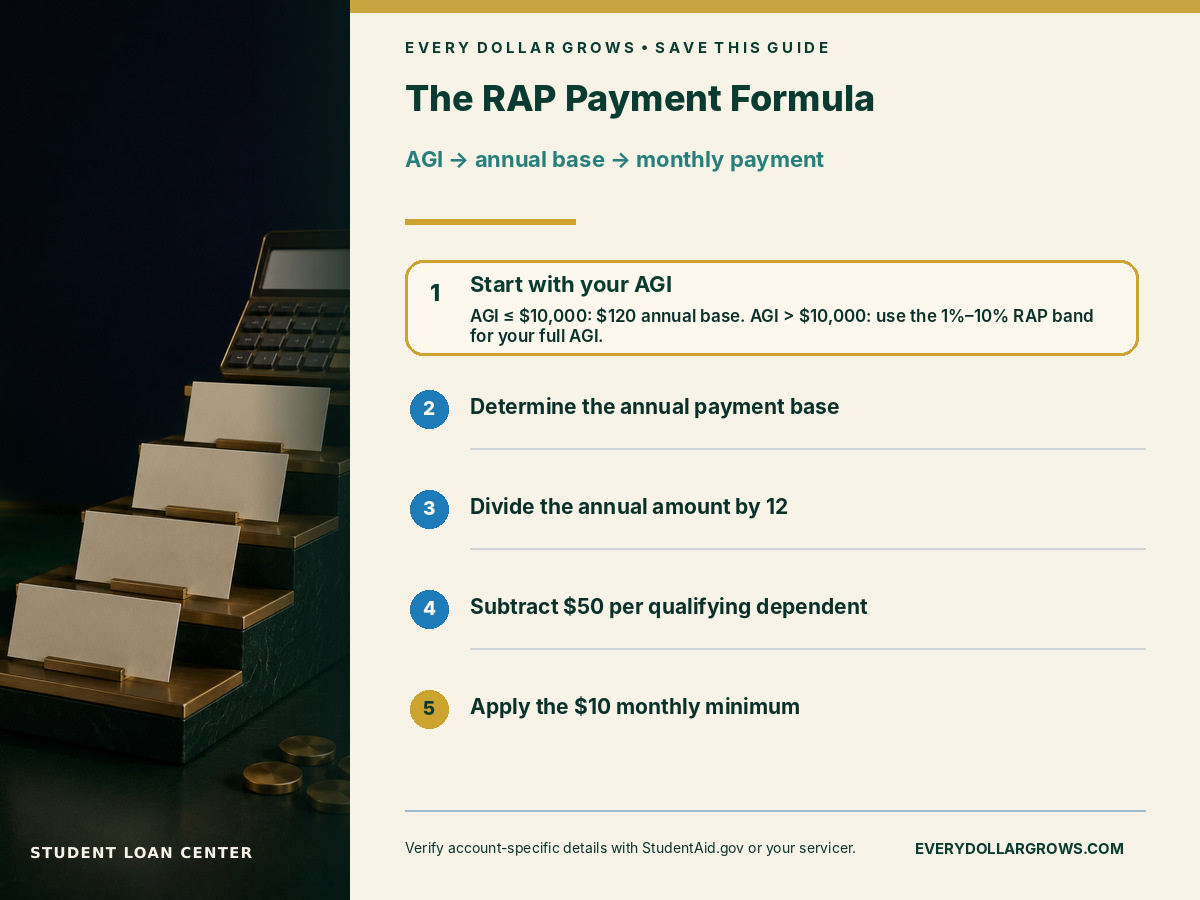
Repayment Assistance Plan: the RAP formula in plain language
RAP does not subtract a poverty allowance before calculating the payment. It uses the borrower’s adjusted gross income and selects one rate for the entire AGI based on the income band. This is a bracketed formula, not a marginal tax calculation.
Get Your Free Student Loan Snapshot
Create your free Every Dollar Grows account to save your Student Loan Snapshot and access it anytime.
- Find annual AGI and the applicable band.
- Apply the band percentage to the full AGI, or use the $120 annual base at $10,000 or less.
- Divide the annual base by 12.
- Subtract $50 for each dependent claimed on the federal return.
- If the result is below $10, use the $10 monthly minimum.
Income changes can move the entire AGI into a new band, so the payment can jump at a boundary. That is one reason to compare a pay raise’s full household impact rather than looking only at take-home pay.
RAP AGI bands and annual base
| Adjusted gross income | Annual RAP base before dependent reduction |
|---|---|
| $10,000 or less | $120 |
| More than $10,000 through $20,000 | 1% of full AGI |
| More than $20,000 through $30,000 | 2% of full AGI |
| More than $30,000 through $40,000 | 3% of full AGI |
| More than $40,000 through $50,000 | 4% of full AGI |
| More than $50,000 through $60,000 | 5% of full AGI |
| More than $60,000 through $70,000 | 6% of full AGI |
| More than $70,000 through $80,000 | 7% of full AGI |
| More than $80,000 through $90,000 | 8% of full AGI |
| More than $90,000 through $100,000 | 9% of full AGI |
| More than $100,000 | 10% of full AGI |
The result is reduced by $50 for each dependent claimed on the borrower’s federal tax return. A married-filing-separately borrower counts only dependents claimed on that borrower’s return.
Three worked RAP payment examples
Example 1: $45,000 AGI and no dependents
The $45,000 AGI is in the 4% band. $45,000 × 4% = $1,800 annually. $1,800 ÷ 12 = $150 per month.
Example 2: $45,000 AGI and one dependent
The monthly base is still $150. Subtract $50 for one dependent: $100 per month.
Example 3: $45,000 AGI and three dependents
$150 minus $150 would equal $0, but RAP applies the $10 minimum. Estimated payment: $10 per month.
These examples show the published formula, not eligibility. Married joint filers with two federal-loan borrowers can receive account-specific proration that requires both eligible balances.
Repayment Assistance Plan payment estimator
See the AGI band, annual base, dependent reduction, and estimated monthly minimum under the 2026 RAP formula.
Runs in your browser. No entries are stored or transmitted by this calculator.
RAP has real payment cliffs at AGI-band boundaries
Because RAP applies one percentage to the borrower’s full AGI after the income crosses a band boundary, a small increase in AGI can create a much larger increase in the annual RAP base. This is not a drafting error and it is not a marginal tax calculation.
| AGI | Band | Annual base before dependents | Monthly base |
|---|---|---|---|
| $50,000 | 4% | $2,000 | $166.67 |
| $50,001 | 5% | About $2,500 | About $208.34 |
| $60,000 | 5% | $3,000 | $250.00 |
| $60,001 | 6% | About $3,600 | About $300.01 |
A borrower near a boundary should not turn down income simply to preserve a lower payment. Instead, estimate the complete after-tax value of the raise, retirement contributions, health benefits, tax credits, and the repayment change. The RAP calculator makes the boundary visible so the household can plan for it.
Which loans can and cannot use RAP
RAP is available for eligible Direct Subsidized Loans, Direct Unsubsidized Loans, graduate or professional Direct PLUS Loans, and Direct Consolidation Loans that do not include Parent PLUS debt. FFEL and Perkins debt may need to be consolidated into the Direct Loan program before it can use RAP.
Parent PLUS loans are never eligible for RAP. That exclusion follows the debt through consolidation: a Direct Consolidation Loan that repaid Parent PLUS debt is also ineligible, including a later consolidation of that consolidation.
Defaulted loans cannot enter an income-driven plan until the default is resolved. Consolidation can sometimes resolve default and create RAP access for eligible debt, but rehabilitation may preserve different credit-report benefits. Compare through the default guide before choosing.
Use a four-question RAP eligibility screen
- Is the debt federal? Private loans cannot use RAP.
- Is it a Direct Loan or can it become an eligible Direct Loan? FFEL or Perkins debt may require consolidation.
- Does the loan contain Parent PLUS history? Parent PLUS loans and consolidations containing Parent PLUS debt are excluded from RAP.
- Is the loan in default? Default must be resolved before an income-driven repayment plan can be used.
Passing this screen still does not produce an official eligibility decision. Loan dates, consolidation history, status, and account records belong in the Federal Student Aid calculation.
RAP interest relief and principal reduction
If a full, on-time RAP payment does not cover the month’s accrued interest, the remaining unpaid monthly interest is waived. That prevents the balance from growing merely because the required payment is low.
After the payment is applied, the Department can reduce principal by an amount equal to the borrower’s payment, up to $50, under the federal matching formula. It is inaccurate to promise every borrower a flat $50 principal credit every month. The benefit is tied to the required payment and the account calculation.
These features depend on a full, on-time payment. Auto pay can reduce missed-payment risk, but the checking account needs enough margin to prevent a returned draft. Read the temporary auto-pay guide for the dated 2026 benefit.
What the RAP interest and principal benefits can change
Consider a borrower whose eligible loan accrues $250 of interest during a month but whose required RAP payment is $100. If the borrower makes the full, on-time required payment and the account satisfies the RAP rules, the remaining $150 of unpaid monthly interest can be waived instead of being allowed to grow the balance. The separate principal-reduction formula can then provide additional principal progress based on the required payment, up to the federal cap.
This is why RAP should not be modeled as “payment × 360” with ordinary interest simply piled on top. The payment formula, interest waiver, principal support, changes in annual income, and possible earlier PSLF discharge all affect the path. The EDG calculator intentionally estimates the payment formula only; it does not pretend to reproduce the federal account ledger.
How marriage and filing status affect RAP
For a joint return, the RAP formula can use joint AGI. If both spouses have eligible federal loans, the combined household payment is prorated according to each spouse’s share of eligible debt so the same joint income is not counted twice against the household.
For married filing separately, only the borrower’s income and the dependents claimed on that return are used. Filing separately can reduce an IDR payment in some households, but it can also increase total tax, change credits and deductions, and affect other goals. Compare the full tax return with a qualified tax professional rather than filing separately only because one loan calculator looks lower.
Use Student Loans and Marriage for the household framework.
Plan for annual income updates instead of treating today’s RAP payment as permanent
RAP is income-driven, so the payment can change when the income information used by Federal Student Aid changes. A borrower who receives a large raise, loses a job, marries, divorces, changes filing status, or changes the number of dependents can see a materially different required payment.
That makes a RAP budget different from a fixed-payment budget. Build the household plan with some margin around the current amount rather than using every dollar of the lower payment elsewhere. When income rises, decide in advance whether the extra cash will build savings, pay higher-rate debt, or make voluntary student-loan payments.
If current income has fallen materially below the tax-return AGI, use the official alternative-income documentation process when it is available instead of entering a made-up “current AGI” into an application. The calculator can model scenarios, but the federal application determines which documentation is accepted.
RAP forgiveness, PSLF, and taxes
RAP can discharge a remaining balance after 360 qualifying monthly payments—30 years. Switching plans, nonqualifying periods, and account history can affect the real timeline. A borrower should verify the official qualifying count rather than assuming 30 calendar years equals 360 credited months.
RAP payments can count toward PSLF when the borrower has eligible Direct Loans, works full time for a qualifying employer, and satisfies the other PSLF rules. PSLF targets 120 qualifying monthly payments, not the 360-payment RAP endpoint.
PSLF remains generally federally tax-free. A balance discharged through long-term RAP in 2026 or later is generally federal cancellation-of-debt income unless an exception or exclusion applies. See the forgiveness tax guide before treating a projected discharge as cost-free.
Do not confuse balance protection with tax protection
RAP’s unpaid-interest treatment can prevent a low required payment from causing the balance to grow solely because of unpaid monthly interest. That is a loan-balance benefit. It does not determine whether a future long-term discharge is taxable.
If the planning model shows a meaningful balance remaining near the 360-payment endpoint, create a separate tax-reserve estimate and update it annually. PSLF is different because qualifying PSLF discharge is generally federally tax-free. A borrower expecting PSLF should therefore model the 120-payment route separately from the 360-payment RAP endpoint.
RAP enrollment checklist
- Download the loan list and confirm each loan is eligible.
- Record the AGI and dependent information used for the estimate.
- Run RAP in the official Repayment Calculator.
- Compare at least one fixed path and IBR when the older loans are eligible.
- Check PSLF strategy and employer status before choosing a nonqualifying fixed plan.
- Submit the official application and save confirmation.
- Verify the plan name, payment, due date, and interest treatment on the first statement.
- Review the payment again after income, marriage, filing status, or household changes.
When RAP may help—and when another plan may cost less
RAP can be useful when the fixed payment is not sustainable, income is modest relative to debt, the interest benefit prevents balance growth, or the borrower is pursuing PSLF. It can also create a predictable income-responsive framework for a borrower whose earnings may change.
RAP may cost more when income produces a high payment, the borrower would repay quickly under a fixed plan, a 30-year path stretches debt far into the future, or a taxable discharge creates a reserve need. An eligible older borrower may find IBR’s discretionary-income formula or payment cap more useful in some scenarios.
Choose the plan that best supports the intended outcome—not the plan with the smallest first-month number.
Compare RAP with Tiered Standard and, when eligible, IBR. Confirm the final choice with the official federal calculator.
A RAP decision sheet should include more than the calculated payment
| Question | Why it matters |
|---|---|
| What is the current RAP payment? | Shows immediate cash-flow effect. |
| What happens at the next AGI band? | Reveals a possible payment cliff after income growth. |
| How much interest would otherwise go unpaid? | Shows the potential value of the interest waiver. |
| Is PSLF realistic? | Can shorten the practical horizon from 360 payments to 120 qualifying PSLF payments. |
| What balance might remain at long-term discharge? | Creates a possible future tax-reserve question. |
| Could a fixed plan repay the debt much sooner? | Tests whether RAP is buying useful flexibility or simply extending debt. |
Keep this decision sheet with the official Repayment Calculator results. Revisit it after major income or household changes.
Run RAP under three income paths
A borrower with variable income should not model RAP using one AGI forever. Create three simple paths:
- Lower-income path: job loss, reduced hours, or a career transition.
- Expected path: normal raises and stable employment.
- Higher-income path: promotion, overtime, bonuses, or a higher-paying role that moves AGI across RAP bands.
For each path, estimate the RAP payment, compare it with the fixed payment, and note whether PSLF remains realistic. The purpose is not to forecast 30 years perfectly. It is to find the years in which the strategy could change.
If a high-income path would repay the balance well before 360 payments, long-term discharge may not be the reason to choose RAP. If a lower-income path makes the fixed payment fragile, RAP’s flexibility can have substantial value even when no balance is ultimately forgiven.
RAP does not prohibit paying extra
RAP sets the required monthly payment. A borrower can generally make additional voluntary payments on federal student loans without a prepayment penalty. Whether that is a good strategy depends on the objective.
A PSLF borrower who expects a qualifying balance to be forgiven after 120 qualifying payments may destroy part of the forgiveness value by aggressively paying extra principal. A borrower with no forgiveness strategy and strong cash reserves may choose to pay more than the RAP minimum to shorten the debt horizon.
Before making extra payments, protect required bills, a starter emergency fund, and higher-rate debt. Then tell the servicer how extra payments should be applied and confirm that the account behaves as expected.
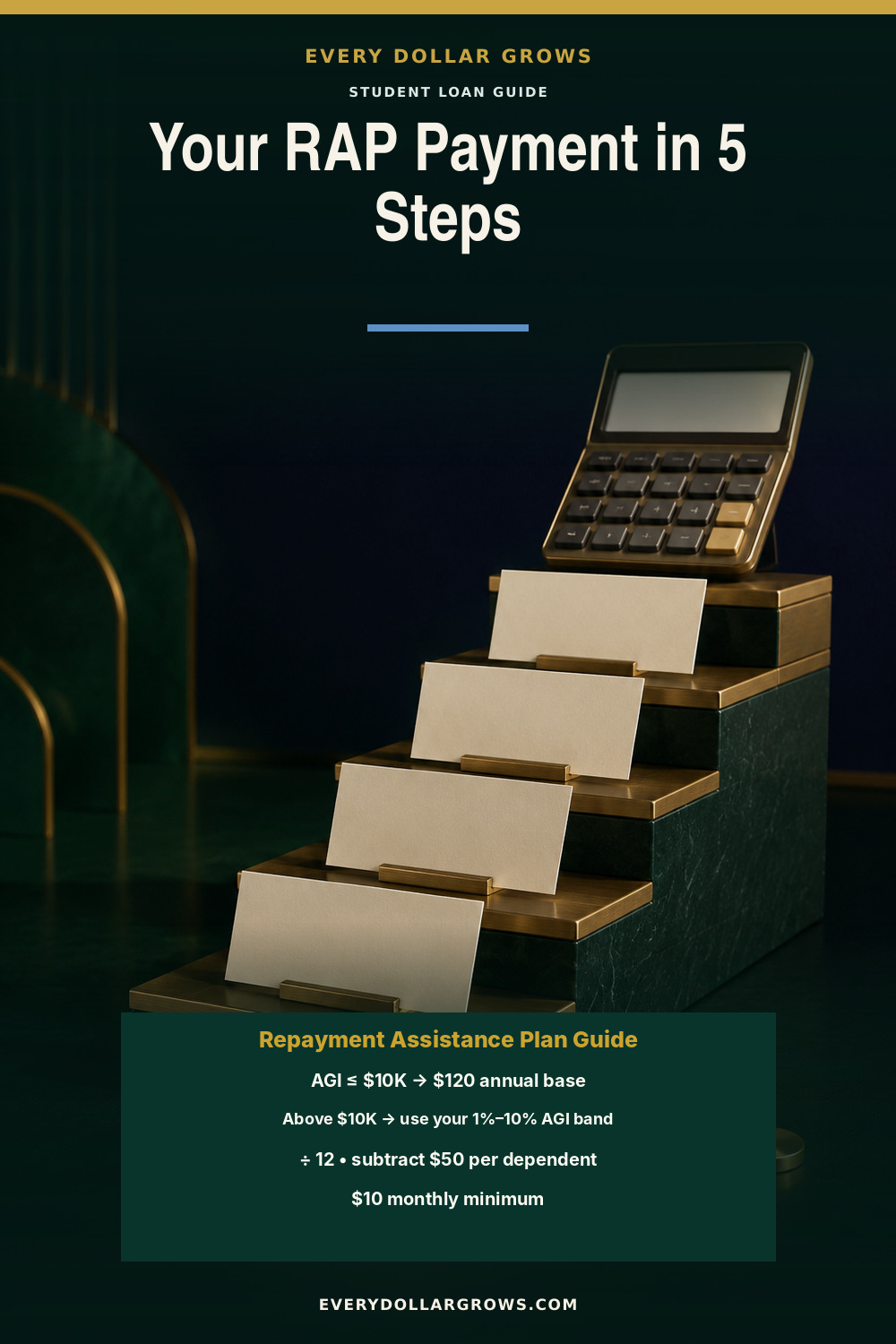
Save this RAP payment guide for later
Keep the RAP formula, AGI bands, eligibility rules, benefits, and tradeoffs handy while you compare repayment options.

Official sources used
Rules and dates can change. These primary sources were checked for this guide; confirm account-specific details with Federal Student Aid and your loan servicer.
Frequently asked questions
How is a RAP payment calculated?
Use the AGI band to calculate an annual base, divide by 12, subtract $50 per dependent claimed on the federal return, and apply the $10 monthly minimum.
Does RAP use discretionary income?
No. RAP uses adjusted gross income directly. IBR uses a discretionary-income formula tied to the poverty guideline.
Can Parent PLUS loans use RAP?
No. Parent PLUS debt and consolidations that include Parent PLUS debt are excluded.
Does interest grow under RAP?
When a borrower makes the full, on-time required payment, remaining unpaid monthly interest is waived. Other circumstances can be different.
Does RAP count for PSLF?
Full, on-time RAP payments can count when the borrower also satisfies Direct Loan, qualifying employment, and the other PSLF rules.
Educational information only. This page does not provide legal, tax, investment, or individualized financial advice and cannot determine your eligibility, official payment, qualifying-payment count, or tax liability. Verify your loans, dates, and options through StudentAid.gov, your servicer, and a qualified professional when appropriate.