
Tiered Standard Repayment Plan: Terms, Payments, and Total Cost
The Tiered Standard repayment plan gives larger balances more time, but time is not free. Use the four balance thresholds to estimate the fixed payment and the interest cost of the assigned term.
Part of the Complete EDG Student Loan Guide.
The short answer
- Tiered Standard is available when a Direct Loan borrower has at least one Direct Loan first disbursed on or after July 1, 2026.
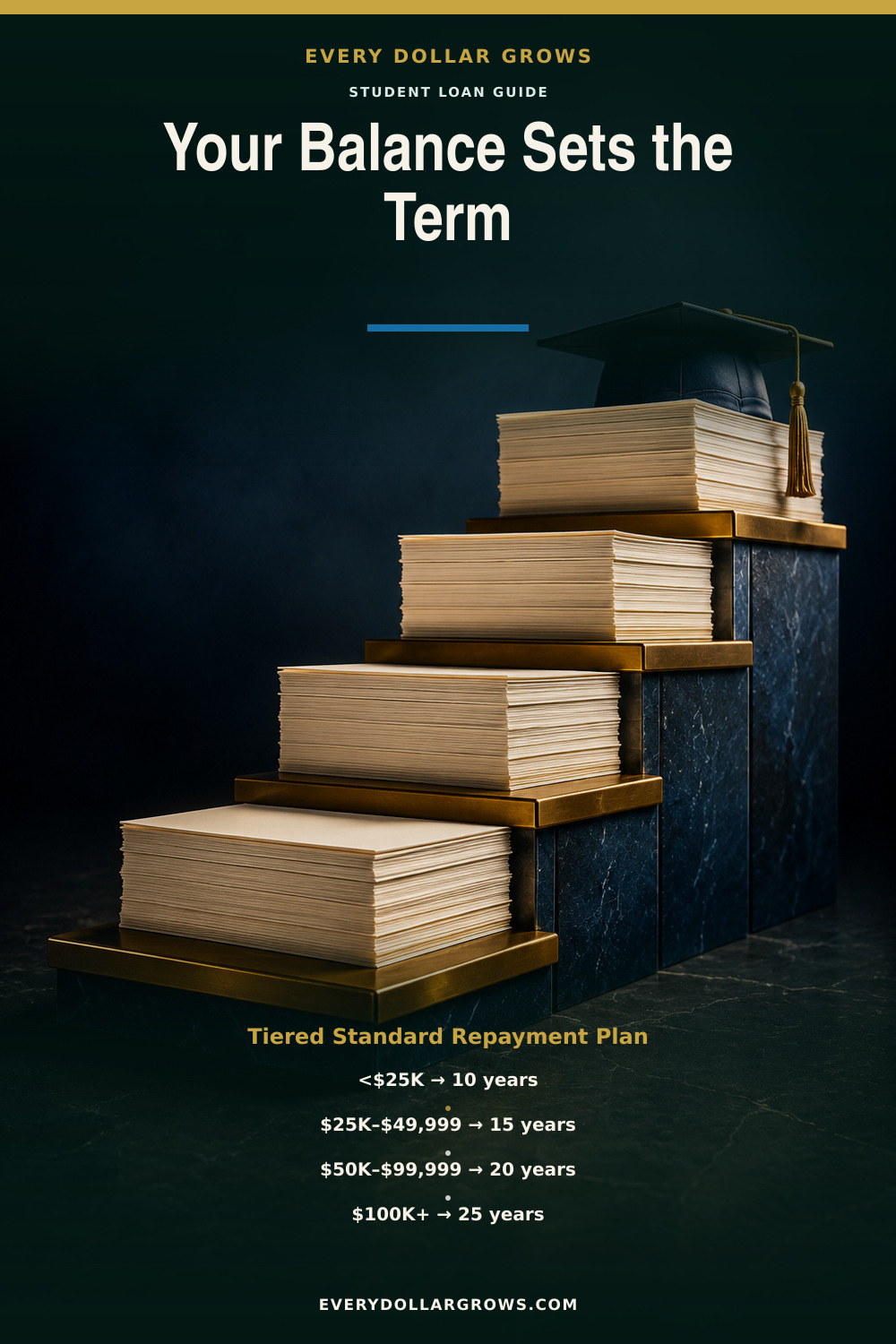
- The term is 10 years under $25,000; 15 years from $25,000 to $49,999; 20 years from $50,000 to $99,999; and 25 years at $100,000 or more.
- Payments are fixed and generally at least $50; they do not fall when income drops.
- Tiered Standard is not currently a qualifying repayment plan for PSLF or TEPSLF.
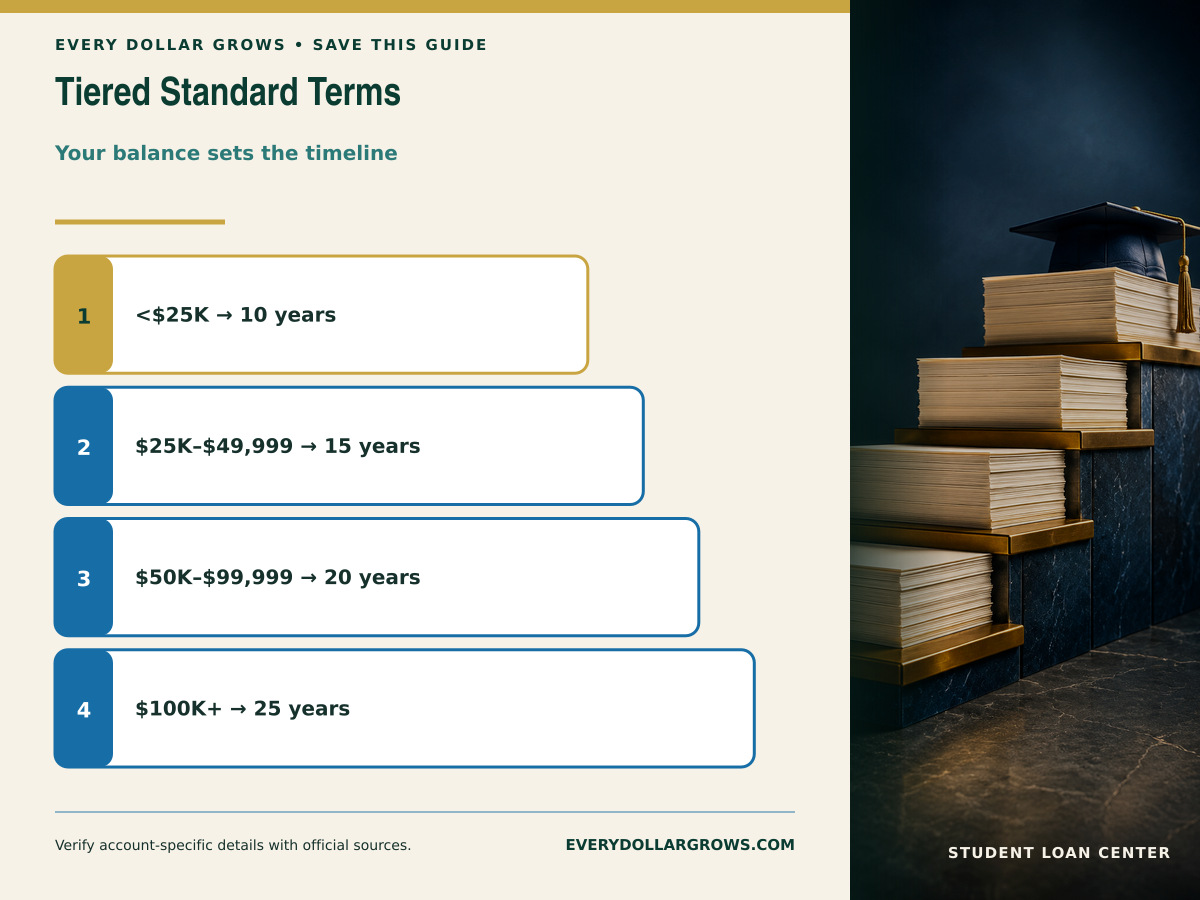
Tiered Standard Repayment Plan: the Four Balance Thresholds
| Outstanding principal | Maximum repayment term |
|---|---|
| Less than $25,000 | 10 years |
| $25,000 to less than $50,000 | 15 years |
| $50,000 to less than $100,000 | 20 years |
| $100,000 or more | 25 years |
The threshold uses outstanding principal across the loans included in the calculation. A balance exactly at $25,000 moves to 15 years; exactly $50,000 moves to 20; and exactly $100,000 moves to 25. The scheduled payment is at least $50 except for a final smaller payment.
Get Your Free Student Loan Snapshot
Create your free Every Dollar Grows account to save your Student Loan Snapshot and access it anytime.
Who can use Tiered Standard
Tiered Standard is not an across-the-board replacement for every older Standard-plan borrower. Current federal-servicer guidance says the plan is available when a Direct Loan borrower has at least one Direct Loan first disbursed on or after July 1, 2026. Once that condition is present, the borrower’s eligible Direct Loans can be placed into the new framework.
If all of the borrower’s loans were first disbursed before July 1, 2026, the traditional Standard, Graduated, or Extended plans may remain available instead, along with eligible income-driven options. Use the loan-level dates in StudentAid.gov rather than the year you graduated.
Tiered Standard payment and total-cost estimator
Estimate the term band, fixed payment, payoff time, total paid, and total interest.
Runs in your browser. No entries are stored or transmitted by this calculator.
How the fixed payment is estimated
A planning estimate amortizes principal and interest over the assigned number of months. The monthly formula uses balance, interest rate, and term. Borrowers with multiple loans can have several fixed rates, so a weighted average is useful for rough planning but does not reproduce each federal loan group.
Federal loans generally accrue simple interest daily. A servicer’s official schedule can differ slightly from a monthly amortization calculator because of day count, rounding, payment posting, and separate loan groups.
The calculator below applies the statutory term thresholds, a $50 minimum, and a monthly planning model. Use the official federal calculator for the payment actually offered.
Payment and cost examples at four balances
The examples below use a 6.52% planning rate. They are illustrations, not official offers.
| Balance | Term band | Estimated payment | Estimated total interest |
|---|---|---|---|
| $20,000 | 10 years | About $227 | About $7,300 |
| $35,000 | 15 years | About $305 | About $19,900 |
| $75,000 | 20 years | About $560 | About $59,400 |
| $120,000 | 25 years | About $811 | About $123,500 |
The high-balance examples show the tradeoff clearly: the longer term controls the monthly requirement, but lifetime interest can approach or exceed the original principal.
The payment does not adjust when income falls
Tiered Standard can be predictable when income is stable and the payment fits comfortably. It can become fragile after job loss, reduced hours, disability, divorce, or another household shock because the required amount is not calculated from income.
Before selecting it, run a 20% lower-income scenario. If the required payment would force rent, utilities, food, transportation, or insurance onto a credit card, compare RAP or another eligible income-driven plan before the deadline.
If income falls after enrollment, contact the servicer before missing a payment. Do not wait for the account to become delinquent.
Extra payments can undo part of the long-term interest cost
Tiered Standard sets the required payment, not a prohibition on paying more. Adding a consistent amount can shorten the term and reduce interest. Direct the servicer according to its instructions, and verify that the extra amount is applied as intended rather than merely advancing the due date.
Do not drain the emergency fund for one large payment. A better sequence is: keep the required payment current, maintain a starter cushion, eliminate more expensive debt, capture any employer match, and then automate a sustainable extra amount.
Use the student loan payoff calculator to compare the baseline and extra-payment paths.
Tiered Standard versus RAP
| Decision | Tiered Standard | RAP |
|---|---|---|
| Payment basis | Balance, rate, and fixed term | AGI band and dependents |
| Income changes | No automatic adjustment | Payment recalculated |
| Interest protection | None beyond normal payment amortization | Unpaid monthly interest waived after full, on-time payment |
| End point | Full payoff in 10–25 years | Up to 360 qualifying payments, then possible discharge |
| PSLF | Not a qualifying plan under current guidance | Can count when all PSLF rules are met |
| Tax issue | No discharge if fully repaid | Long-term discharge may be taxable |
Use the RAP guide and the official Repayment Calculator. A high initial RAP payment can make the fixed route attractive; a fixed payment that is too fragile can make RAP valuable. PSLF borrowers have an additional constraint because Tiered Standard does not create qualifying PSLF months.
Three eligibility examples that prevent a common date mistake
Example 1: only older Direct Loans. A borrower whose Direct Loans were all first disbursed before July 1, 2026 generally does not use Tiered Standard. The borrower may instead have the traditional Standard, Graduated, Extended, RAP, IBR, or limited transition options depending on the exact loans.
Example 2: one new Direct Loan. A borrower with older Direct Loans plus at least one Direct Loan first disbursed on or after July 1, 2026 can fall into the new framework for eligible Direct Loans. Tiered Standard can then be one of the fixed repayment options shown by the official system.
Example 3: Parent PLUS history. Parent PLUS and consolidation history can change which plan rules apply. Do not infer eligibility from the balance tier alone; the balance determines the maximum Tiered Standard term only after the borrower and loans qualify for that plan.
Tiered Standard and PSLF are different strategies
Current federal-servicer guidance states that Tiered Standard is not a qualifying repayment plan for PSLF or TEPSLF. That makes the plan a poor fit for a borrower whose primary strategy is to earn Public Service Loan Forgiveness, even if the fixed payment looks comfortable.
Before switching, separate two questions: “Can I afford this payment?” and “Does this payment advance the outcome I am pursuing?” A public-service borrower generally needs an eligible repayment path plus qualifying employment and qualifying payments. Use the PSLF guide and the official federal tools before changing plans.
Save this Tiered Standard repayment guide for later
Keep the balance thresholds, repayment terms, payment estimator, total-cost tradeoffs, and PSLF warning handy while comparing fixed repayment options.

Official sources used
Rules and dates can change. These primary sources were checked for this guide; confirm account-specific details with Federal Student Aid and your loan servicer.
Frequently asked questions
How long is the Tiered Standard repayment plan?
The term is 10, 15, 20, or 25 years based on outstanding principal and the statutory thresholds.
Is the Tiered Standard payment based on income?
No. It is a fixed repayment plan based on loan balance, rate, and term.
Can I pay Tiered Standard loans off early?
Federal student loans generally have no prepayment penalty. Confirm how the servicer applies extra payments and whether another forgiveness strategy changes the decision.
Does Tiered Standard qualify for PSLF?
No under current federal-servicer guidance. Tiered Standard is not a qualifying repayment plan for PSLF or TEPSLF. Borrowers pursuing PSLF should verify an eligible repayment path through Federal Student Aid.
Educational information only. This page does not provide legal, tax, investment, or individualized financial advice and cannot determine your eligibility, official payment, qualifying-payment count, or tax liability. Verify your loans, dates, and options through StudentAid.gov, your servicer, and a qualified professional when appropriate.