
The Complete Student Loan Guide for 2026
A practical, source-checked roadmap for borrowing less, understanding every loan, choosing a repayment path, using calculators correctly, and avoiding expensive student loan mistakes.
The short answer
- Borrow in order: grants, scholarships, work and cash first; federal student loans before private loans when borrowing is still necessary.
- Identify your exact loans and dates: disbursement dates now determine which federal repayment plans are available.
- Do not choose from payment alone: compare total interest, repayment time, forgiveness strategy, taxes, and loss of federal protections.
- Use calculators as planning screens: only Federal Student Aid and your servicer can confirm eligibility and an official payment.
Start with a student loan inventory—not a guess
The student loan system became materially different on July 1, 2026. A borrower with only older loans can have a different repayment menu from a borrower who received one new Direct Loan after that date. Parent PLUS debt follows a separate set of rules. Private loans are governed by their contracts, not federal income-driven repayment law.
Before comparing plans, download or write down five facts for every loan: the loan type, current principal, interest rate, first disbursement date, and servicer. For federal loans, start in your StudentAid.gov dashboard. For private loans, use lender statements and your credit reports. Do not combine everything into one balance until you have preserved the details.
If payments are already pressuring the household budget, connect the inventory to the EDG debt payoff plan and the complete budgeting guide. A repayment plan is only sustainable when it fits beside housing, food, transportation, insurance, and emergency savings.
Build the loan inventory one line at a time
A useful inventory keeps each loan separate even when the servicer shows one combined account total. For example, a borrower might have a $5,500 Direct Subsidized Loan at one fixed rate, a $7,000 Direct Unsubsidized Loan from a later year at another rate, a $12,000 FFEL balance owned by a different holder, and a private cosigned loan. Those four balances can have four different repayment or relief rules.
For every line, record the original loan type, current owner or servicer, first disbursement date, current principal, accrued unpaid interest, fixed or variable rate, repayment status, and current plan. Add a separate column for PSLF or IDR payment counts when relevant. For a consolidation loan, record what original loans were paid off by the consolidation and the consolidation disbursement date.
Do not delete an old loan from your spreadsheet simply because it was consolidated. Mark it as paid by consolidation and keep the history. Parent PLUS and old FFEL history can still matter when determining what the new consolidation can do.
Federal and private student loans solve different problems
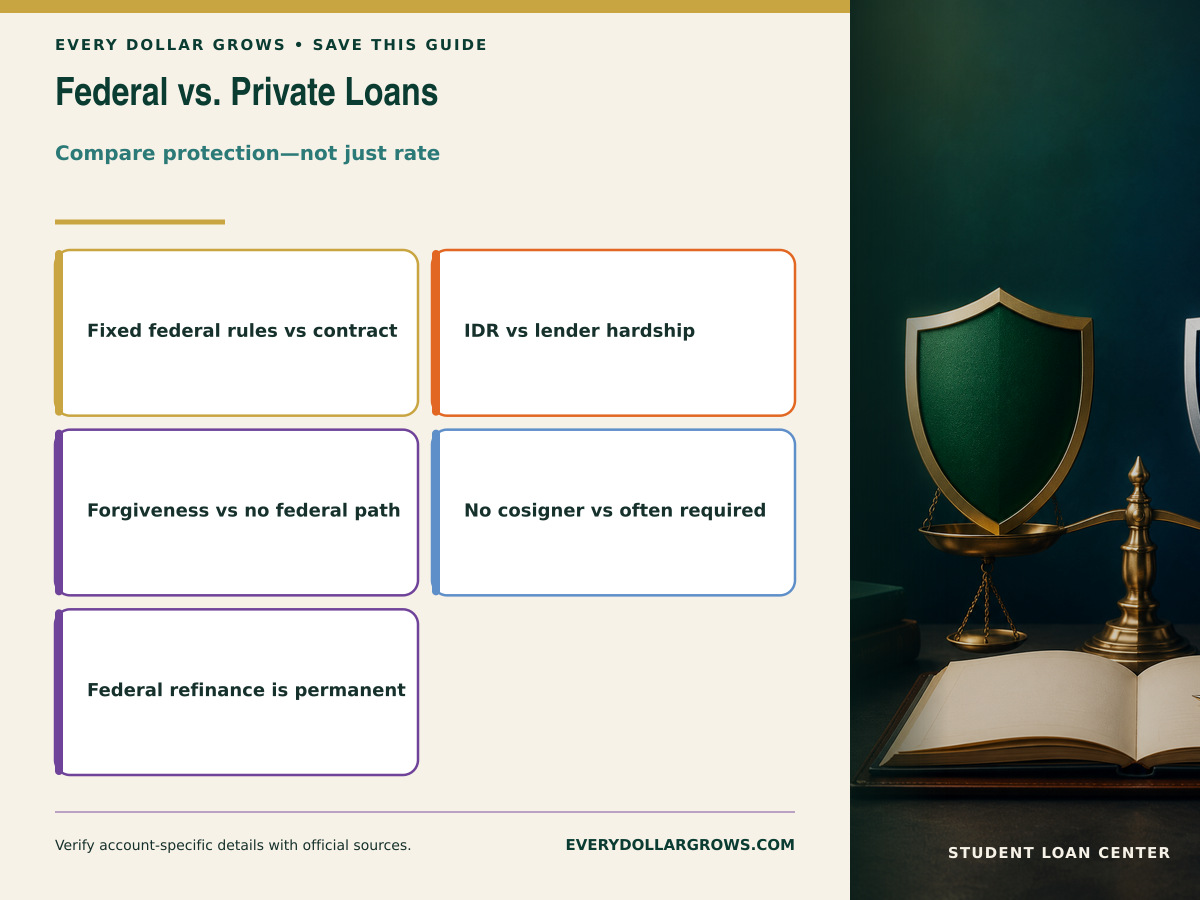
Federal student loans are made under federal programs and can include fixed federal rates, deferment or forbearance options, federal consolidation, income-driven repayment, and qualifying forgiveness or discharge programs. Those protections have value even when a private lender advertises a lower rate.
Private student loans come from banks, credit unions, state-affiliated programs, schools, and online lenders. Approval, rate, cosigner requirements, hardship options, and default terms depend on the contract. A private loan generally cannot be converted into a federal loan later.
| Question | Federal loan | Private loan |
|---|---|---|
| Where to verify | StudentAid.gov and federal servicer | Lender contract and statements |
| Income-driven plans | Available for eligible loans | Not a federal right |
| Federal forgiveness | Possible when program rules are met | Generally not available |
| Rate | Fixed by loan and disbursement year | Fixed or variable by lender and credit |
| Refinancing | Private refinancing permanently gives up federal status | May refinance under a new private contract |
Use Federal vs. Private Student Loans before signing any private loan or refinancing federal debt. The point is not that one label is always good and the other always bad. The point is that the protections, eligibility rules, and risks are different.
Know what each federal loan label actually changes
Direct Subsidized Loans
These are undergraduate federal loans for eligible students with financial need. The federal interest subsidy during specified periods can make them the first federal loan to accept when both subsidized and unsubsidized amounts are offered. Annual and aggregate limits still apply, so they rarely cover the entire cost of college by themselves.
Direct Unsubsidized Loans
These loans can be available to undergraduate, graduate, and professional students, subject to federal limits. Interest generally begins accruing after disbursement, including while the borrower is in school. A student who borrows the same nominal amount each year can therefore graduate owing different balances depending on rates, timing, and unpaid interest.
Direct PLUS Loans
Parent PLUS is legally the parent’s debt. Existing graduate PLUS loans remain federal Direct Loans, but new Grad PLUS lending generally ended for borrowers outside the 2026 transition exception. PLUS loans have their own interest rates and credit-related eligibility rules.
Direct Consolidation Loans
Federal consolidation replaces eligible federal loans with a new Direct Consolidation Loan. It can simplify billing or change plan access, but it is not a refinance discount and can change repayment eligibility or payment-credit treatment. Consolidation history is especially important when Parent PLUS debt is involved.
Use Subsidized vs. Unsubsidized Loans, Parent PLUS Repayment Options, and Federal Student Loan Consolidation for the detailed rules.
RAP vs. Tiered Standard quick estimator
Compare a basic RAP payment estimate with the fixed-payment structure of Tiered Standard. This is not an eligibility determination.
Runs in your browser. No entries are stored or transmitted by this calculator.
A practical order for paying for college
Borrowing is usually the last layer of the college-funding stack, not the first. A practical order is to use grants and scholarships, realistic current income, employer or military education benefits when available, affordable family cash contribution, and then federal student loans. Private student loans belong after the federal options have been understood, because private debt generally does not carry federal repayment and forgiveness protections.
This order does not mean emptying retirement accounts or emergency savings to avoid every dollar of student debt. A parent who stops retirement contributions for four years or drains the household reserve can trade one financial problem for another. The objective is to reduce avoidable borrowing while protecting the household’s basic resilience.
When a school’s remaining gap is too large after these steps, treat that as a price signal. Compare another school, living arrangement, transfer path, work schedule, or enrollment timeline before assuming the only solution is a larger private loan.
What changed for federal student loans in 2026
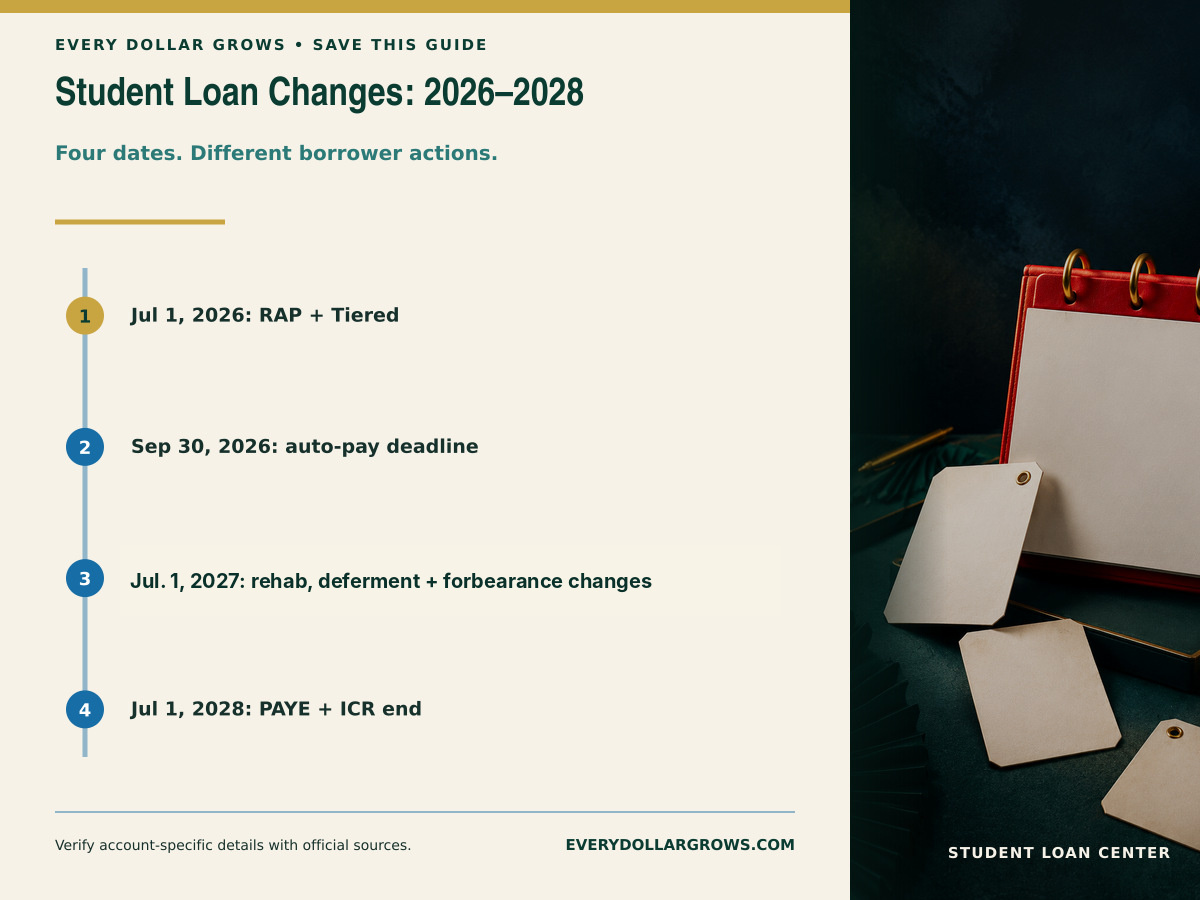
The federal student-loan system changed materially on July 1, 2026. The new income-driven Repayment Assistance Plan (RAP) became available, and a new fixed Tiered Standard plan became available for Direct Loan borrowers with at least one Direct Loan first disbursed on or after July 1, 2026. Borrowers whose Direct Loans are all older generally continue to compare the traditional Standard, Graduated, Extended, and eligible legacy income-driven options instead of assuming Tiered Standard applies.
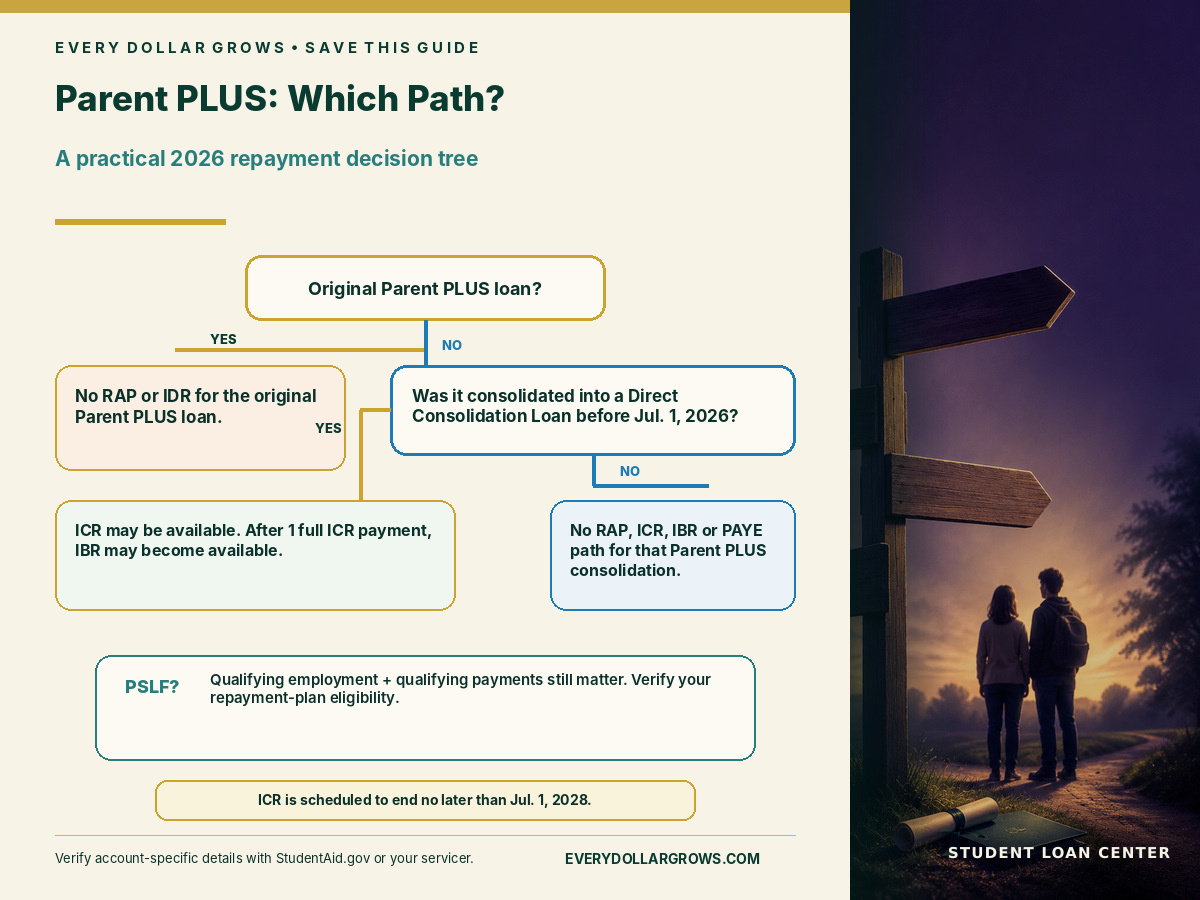
SAVE ended after a federal court order. PAYE and ICR remain temporary transition options only for borrowers who meet their eligibility rules and are scheduled to end no later than July 1, 2028. IBR remains relevant for eligible older loans. Parent PLUS debt follows its own rules and is excluded from RAP.
Borrowing also changed. New federal limits apply to graduate, professional, and Parent PLUS borrowing; new Grad PLUS lending generally ended outside a limited transition exception; an overall $257,500 affected lifetime cap applies with specified exclusions; schools can set consistent program-level caps; and less-than-full-time enrollment can reduce annual eligibility.
Read Student Loan Repayment Changes 2026 for the complete timeline. If you were enrolled in SAVE, use The SAVE Plan Ended: What to Do and follow the individual deadline in your servicer notice.
Use the July 1, 2026 cutoff as a sorting tool—not a shortcut
The most useful first split is not “old borrower” versus “new borrower.” It is the first disbursement date and type of each individual loan. A household can have older Direct Loans, a newer Direct Loan, an FFEL loan, and a Parent PLUS loan at the same time. Those loans do not necessarily share one repayment menu.
| Loan situation | Planning starting point | What to verify |
|---|---|---|
| All Direct Loans first disbursed before July 1, 2026 | Compare eligible legacy IDR plans and the traditional fixed plans; RAP may also be available for eligible Direct debt. | IBR/PAYE/ICR eligibility, remaining transition deadlines, consolidation history, and whether RAP improves the long-term outcome. |
| At least one Direct Loan first disbursed on or after July 1, 2026 | For eligible Direct debt, compare RAP with Tiered Standard. | Whether any non-Direct or Parent PLUS debt needs a separate plan. |
| Parent PLUS or consolidation containing Parent PLUS | Do not use a RAP calculator as the answer. | Original loan dates, consolidation date, ICR history, fixed-plan availability, and PSLF strategy if applicable. |
| FFEL or Perkins loans | Identify whether the current plan is already useful before consolidating. | What Direct Consolidation would change: plan access, payment credit, interest treatment, and federal benefits. |
The purpose of this table is triage. It narrows the questions you bring to StudentAid.gov and your servicer; it does not replace the official account calculation.
Choose a repayment plan with a five-part comparison
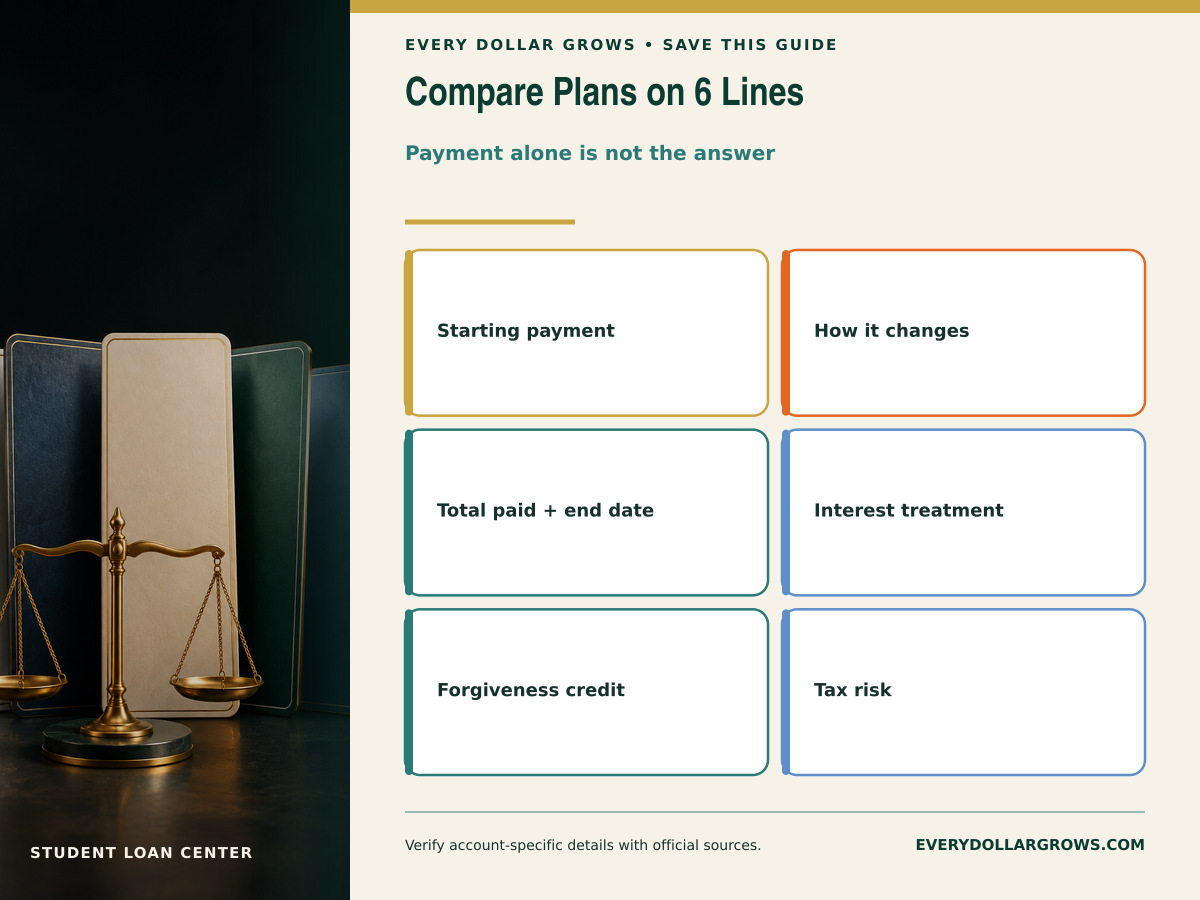
Monthly payment matters, but it is only the first line of the comparison. For every available plan, record the starting payment, how the payment can change, expected payoff or discharge date, estimated total paid, interest treatment, forgiveness eligibility, and any tax exposure.
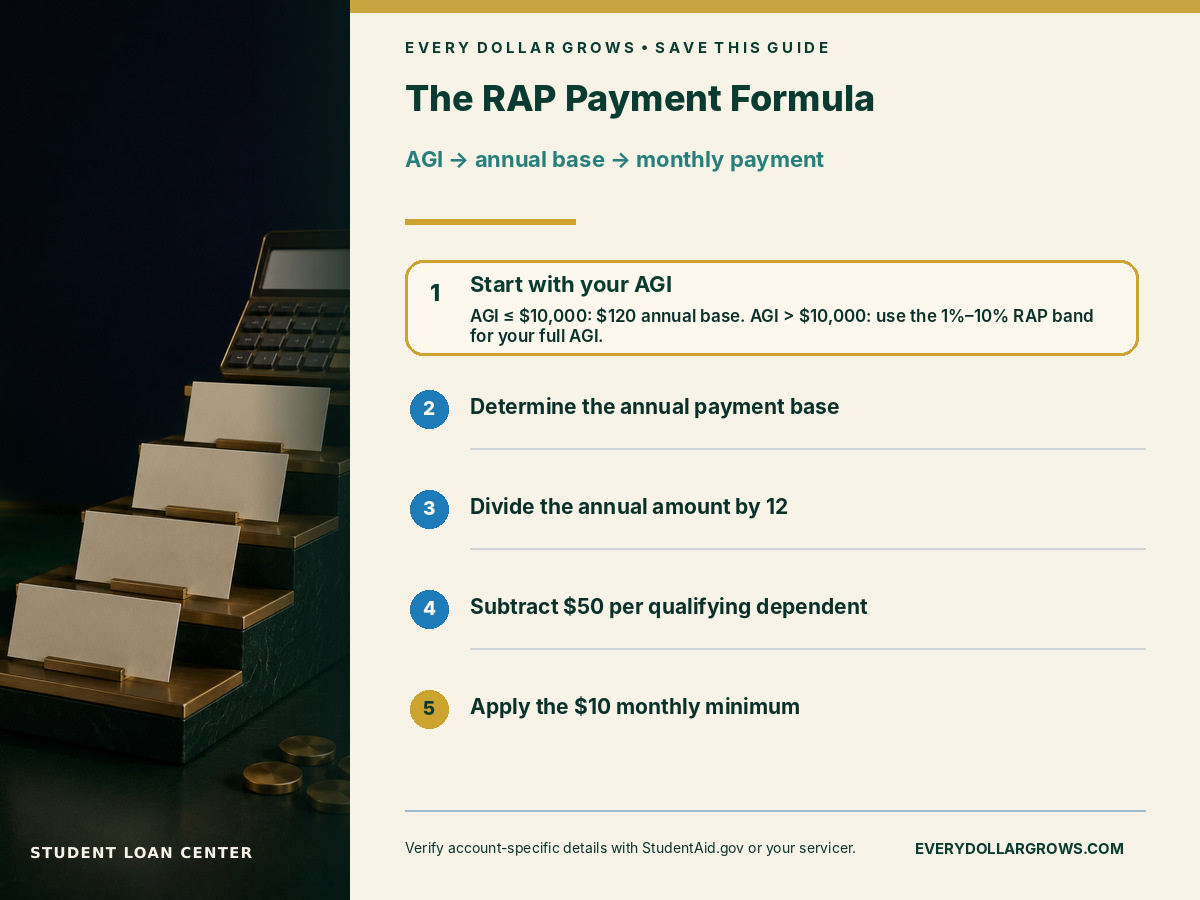
RAP calculates a payment from the borrower’s AGI band, divides the annual base by 12, subtracts $50 per dependent claimed on the federal return, and applies a $10 monthly floor. At $10,000 AGI or less, RAP uses a $120 annual base instead of a percentage. Full, on-time RAP payments can receive an unpaid-interest waiver and a principal-reduction benefit under the federal formula. Remaining balance can be discharged after 360 qualifying payments, and RAP payments can count for PSLF when the other PSLF conditions are met.
Tiered Standard is different. It is a fixed plan available when the Direct Loan portfolio includes at least one loan first disbursed on or after July 1, 2026. Its term is 10, 15, 20, or 25 years based on total outstanding principal. A longer term can reduce the required payment while increasing lifetime interest. Under current federal-servicer guidance, Tiered Standard is not a qualifying repayment plan for PSLF or TEPSLF.
Borrowers whose Direct Loans are all older may instead compare the traditional Standard, Graduated, or Extended plans plus any income-driven plans for which they remain eligible. Start with Student Loan Repayment Plans and use RAP vs. IBR only if your loans appear eligible for both.
Compare repayment plans with one complete example
Suppose a borrower has $55,000 of eligible Direct Loans at a weighted 6.52% rate and $55,000 of AGI with one qualifying dependent. A RAP estimate begins with the 5% AGI band: $55,000 × 5% = $2,750 annually, or $229.17 monthly, then subtracts $50 for the dependent for an estimated $179.17 payment. A fixed 20-year payment on $55,000 at 6.52% would be roughly in the low-$400s per month under a monthly amortization estimate.
That does not prove RAP is “better.” A useful comparison asks what happens if income rises to $80,000, whether the borrower expects qualifying public-service work, how much interest is waived under RAP, whether a taxable balance may remain after 30 years, and whether the borrower values a fixed payoff date more than payment flexibility.
The lesson is simple: run at least three scenarios—current income, lower income, and higher income—and compare the total strategy, not the first payment. The payment calculator, RAP calculator, and official federal Repayment Calculator are designed for different parts of that job.
Three repayment case studies show why “best plan” is personal
Case 1: modest debt, high income
A borrower owes $22,000 and earns $85,000. A fixed 10-year payoff may be manageable and could minimize interest. RAP may calculate a payment that is not meaningfully lower, and long-term forgiveness may never become relevant because the balance would be repaid first.
Case 2: high debt, early public-service career
A borrower owes $95,000, earns $58,000, and works full time for a qualifying government employer. RAP may provide a manageable payment and can count toward PSLF when all conditions are met. Tiered Standard may show a fixed payment, but it is not a qualifying PSLF plan under current guidance. The forgiveness strategy changes the comparison completely.
Case 3: parent debt approaching retirement
A parent owes $70,000 from Parent PLUS borrowing and expects to retire within seven years. RAP is unavailable. The parent must examine the exact consolidation history, fixed options, possible transition IDR path, retirement income, and PSLF eligibility if employed by a qualifying organization. The student’s income does not legally transfer the debt away from the parent.
These examples are not recommendations. They show why balance, income, employer, loan type, date, and life stage must be considered together.
Borrow less before trying to repay cleverly
The highest-return student loan decision usually happens before the first disbursement. Complete the FAFSA every year, compare net price rather than sticker price, appeal aid when circumstances changed, pursue grants and scholarships, and calculate the remaining funding gap by semester.
For undergraduates, Direct Subsidized Loans are generally preferable to Direct Unsubsidized Loans when both are offered because the federal government pays interest during specified subsidized periods. The annual federal limits are not affordability recommendations. A school may offer an amount that is technically available but too large for the expected career income.
Use the FAFSA Guide, Subsidized vs. Unsubsidized Loans, and Safe Student Loan Debt Calculator before accepting the full award. Build a low-income scenario, not just an optimistic salary scenario.
Read the financial-aid offer as a financing proposal
A financial-aid offer can combine grants, scholarships, work-study, federal student loans, and Parent PLUS eligibility under one “aid” heading. Those categories are not economically equivalent. Grants and scholarships generally reduce the price. Work-study must be earned. Student and parent loans create future repayment obligations.
Normalize every school offer into the same worksheet:
- Total cost of attendance for one year.
- Minus grants and scholarships that do not require repayment.
- Minus realistic cash and employer education benefits.
- List work-study separately as earned income, not guaranteed upfront cash.
- List federal student loans by type and borrower.
- List Parent PLUS and private loans separately.
- Calculate the remaining uncovered gap.
Repeat the worksheet for every year of the program and include reasonable tuition increases. A first-year package can be misleading when a scholarship is nonrenewable or later-year housing costs rise.
The FAFSA Guide explains how to apply and compare offers without mistaking borrowed money for a discount.
Example: the four-year cost can look very different from the first aid offer
Imagine a school with a $32,000 first-year cost of attendance. The student receives $8,000 in grants and scholarships, earns $4,000 from work, and accepts $5,500 in federal student loans. The apparent remaining gap is $14,500. If the family covers that gap with $10,000 of Parent PLUS and $4,500 of private borrowing, the first year may appear “funded.”
Now repeat the math for four years. If grants stay flat while tuition and housing rise 4% annually, the family could easily add more than $40,000 of Parent PLUS debt and tens of thousands of private debt on top of the student’s own federal loans. The decision is no longer whether the first-year monthly payment fits; it is whether the full credential can be financed without creating multiple unaffordable borrowers.
Before accepting the first loan, build a four-year estimate with conservative assumptions. If the model only works because later years are left blank, the financing plan is not complete.
Understand the math that makes balances grow
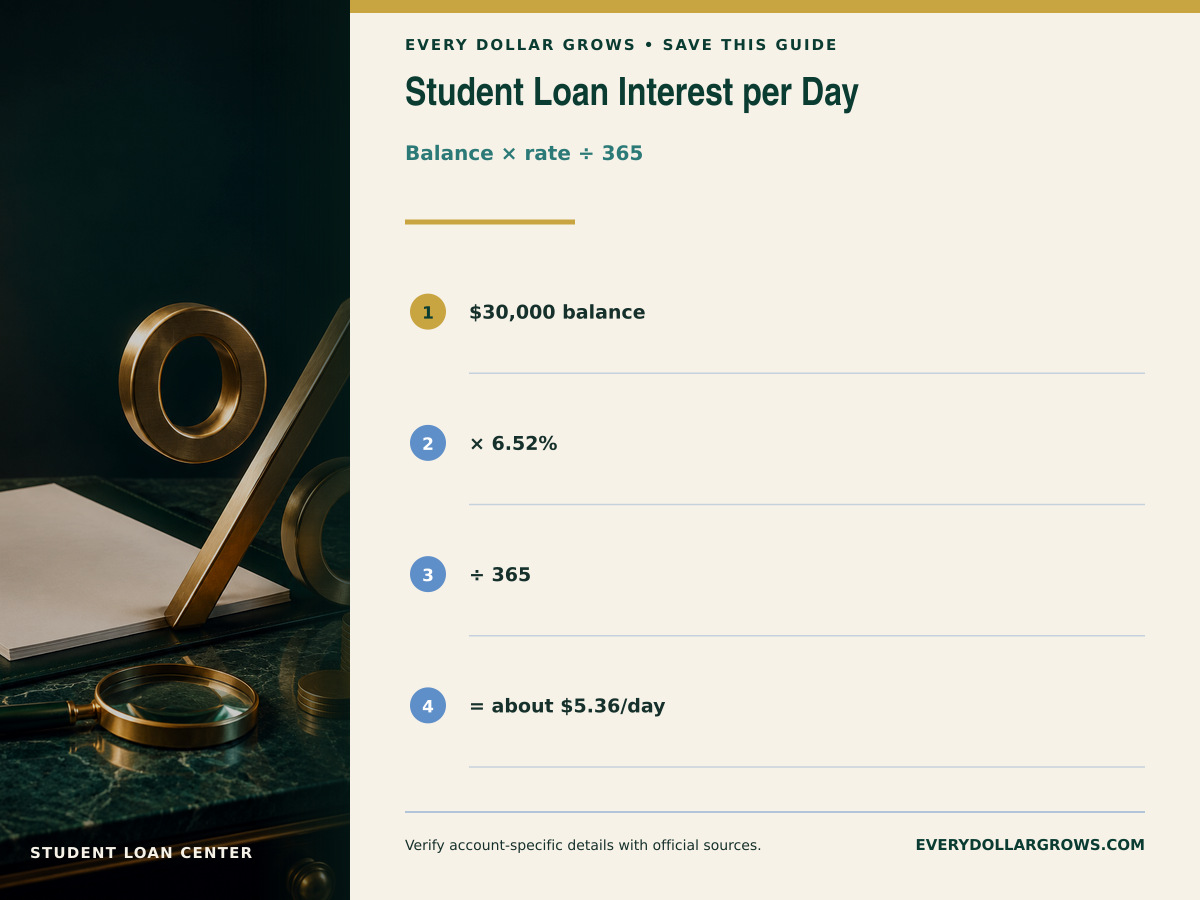
Federal student loans generally accrue simple interest daily. A useful planning estimate is principal × annual rate ÷ 365 × days. Payments normally cover outstanding interest before principal. Capitalization is different: accrued interest is added to principal after certain events, so future interest can accrue on a larger amount.
For Direct Loans first disbursed from July 1, 2026 through June 30, 2027, the fixed rates are 6.52% for undergraduate Direct Subsidized and Unsubsidized Loans, 8.07% for graduate and professional Direct Unsubsidized Loans, and 9.07% for Direct PLUS Loans. A borrower can hold several federal loans at several fixed rates.
Use Student Loan Interest Rates Explained, the Student Loan Interest Calculator, and the Student Loan Payment Calculator to turn rates into daily and monthly dollars.
Turn the interest rate into dollars before accepting a loan
A percentage is hard to feel until it is translated into dollars. At 6.52%, a $30,000 principal balance generates roughly $5.36 of simple interest per day at the start of repayment. A $75,000 balance at the same rate starts around $13.40 per day. The exact daily figure declines as principal falls and can differ slightly by servicer day-count and posting details.
For an unsubsidized loan, interest can accrue while the student is in school. That means the amount originally borrowed and the balance entering repayment may not be the same. Before accepting a multi-year borrowing plan, estimate the interest that can build before graduation and identify when capitalization may occur.
The Student Loan Interest Calculator is designed for this specific question. Use the payment calculator separately when you are ready to estimate an amortized fixed payment.
What happens when school ends
Leaving school, graduating, or dropping below the enrollment level required by the loan can trigger the transition toward repayment. Some federal loans have a grace period; others can have different timing. Private loans follow their contracts. During this transition, verify the servicer, contact information, loan balance, interest rate, first due date, and repayment plan.
Do not wait for the first bill to learn the payment. Use the months before repayment to compare plans, update the household budget, build a small checking-account buffer, and confirm whether auto pay is appropriate. If the borrower expects PSLF-qualifying employment, set up documentation from the beginning rather than trying to reconstruct the first years later.
A borrower who leaves school without completing the credential needs the same repayment inventory. Federal repayment obligations are tied to the loans, not to whether the degree was completed.
Treat forgiveness as a documented program—not a hope
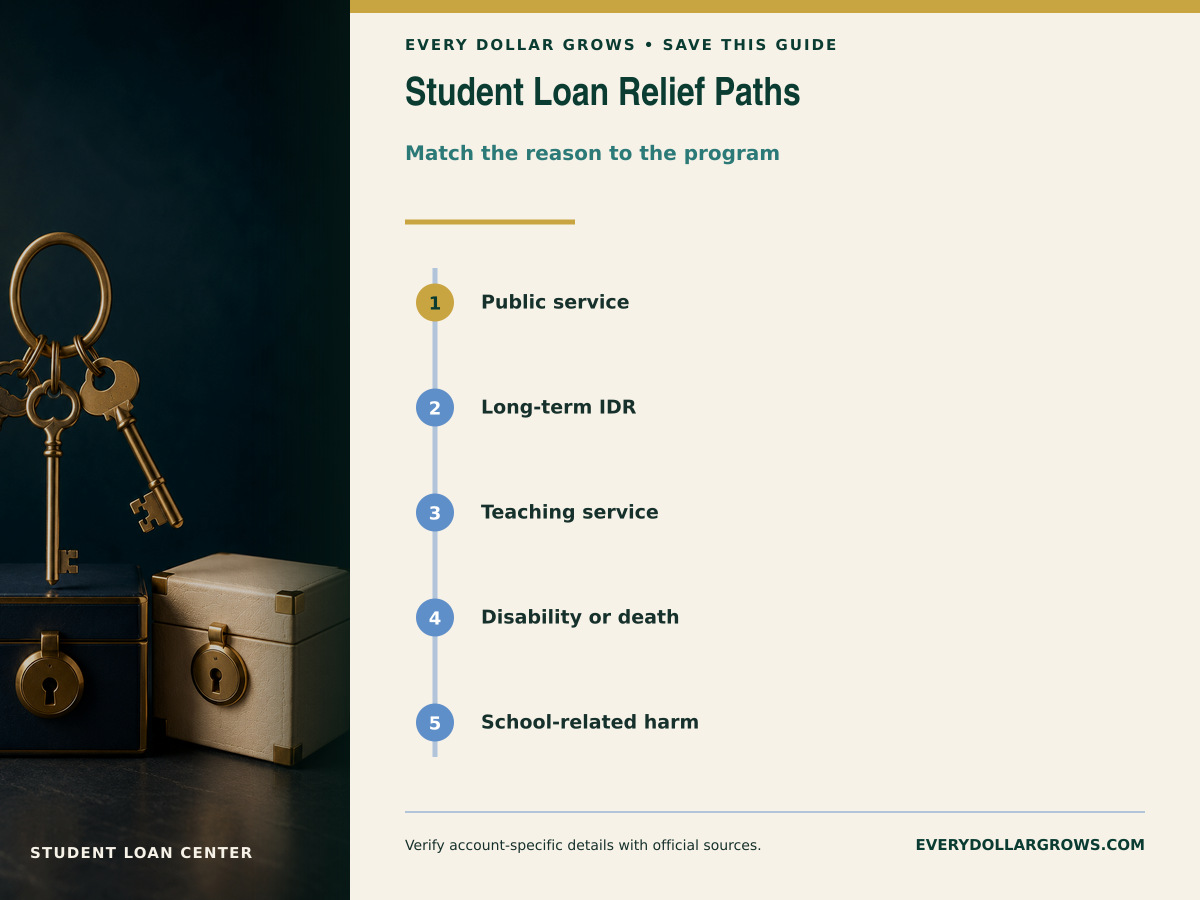
Forgiveness and discharge programs have different triggers. PSLF focuses on eligible Direct Loans, qualifying employment, a qualifying repayment path, and 120 qualifying monthly payments. Teacher Loan Forgiveness has separate employment and service rules. Borrower defense, closed-school discharge, total and permanent disability discharge, death discharge, and IDR discharge are different programs again.
Keep copies of applications, employment certifications, servicer messages, tax returns used for IDR, payment histories, and official counts. Do not pay a company to access a federal application that is free.
Taxes matter. IDR balances discharged in 2026 or later are generally treated as federal cancellation-of-debt income unless an exception or exclusion applies. PSLF, Teacher Loan Forgiveness, and certain discharges remain federally tax-free. State treatment can differ. Use Student Loan Forgiveness Guide, PSLF Guide, and Student Loan Forgiveness Taxes in 2026.
PSLF has a current 2026 legal-status note
Public Service Loan Forgiveness still requires eligible Direct Loans, qualifying full-time employment, a qualifying repayment path, and 120 qualifying monthly payments. One proposed 2026 employer-rule change did not take effect as planned: on June 30, 2026, a federal judge vacated the rule one day before its effective date. The Department then removed the related employer attestation from the PSLF form and stated that no other changes were being made at that time.
For borrowers, the practical rule is to use the current PSLF Help Tool and current Federal Student Aid guidance rather than relying on articles written before the June 30 court decision. Read the PSLF Guide for the current documentation workflow.

Parent and graduate borrowing needs a separate risk test
Parent PLUS debt legally belongs to the parent borrower, not the student. Starting with the 2026–27 award year, total Parent PLUS borrowing by all parents is capped at $20,000 per academic year and $65,000 per dependent student for borrowers subject to the new limits, with a limited transition exception for certain continuing students. Parent PLUS debt is excluded from RAP, including consolidations that contain Parent PLUS debt.
Graduate borrowing changed just as dramatically. New Grad PLUS lending generally ended for borrowers who do not qualify for the transition exception. Graduate students are generally limited to $20,500 annually and $100,000 in aggregate; professional students can have higher $50,000 annual and $200,000 aggregate limits when the program is treated as a professional program for federal loan-limit purposes.
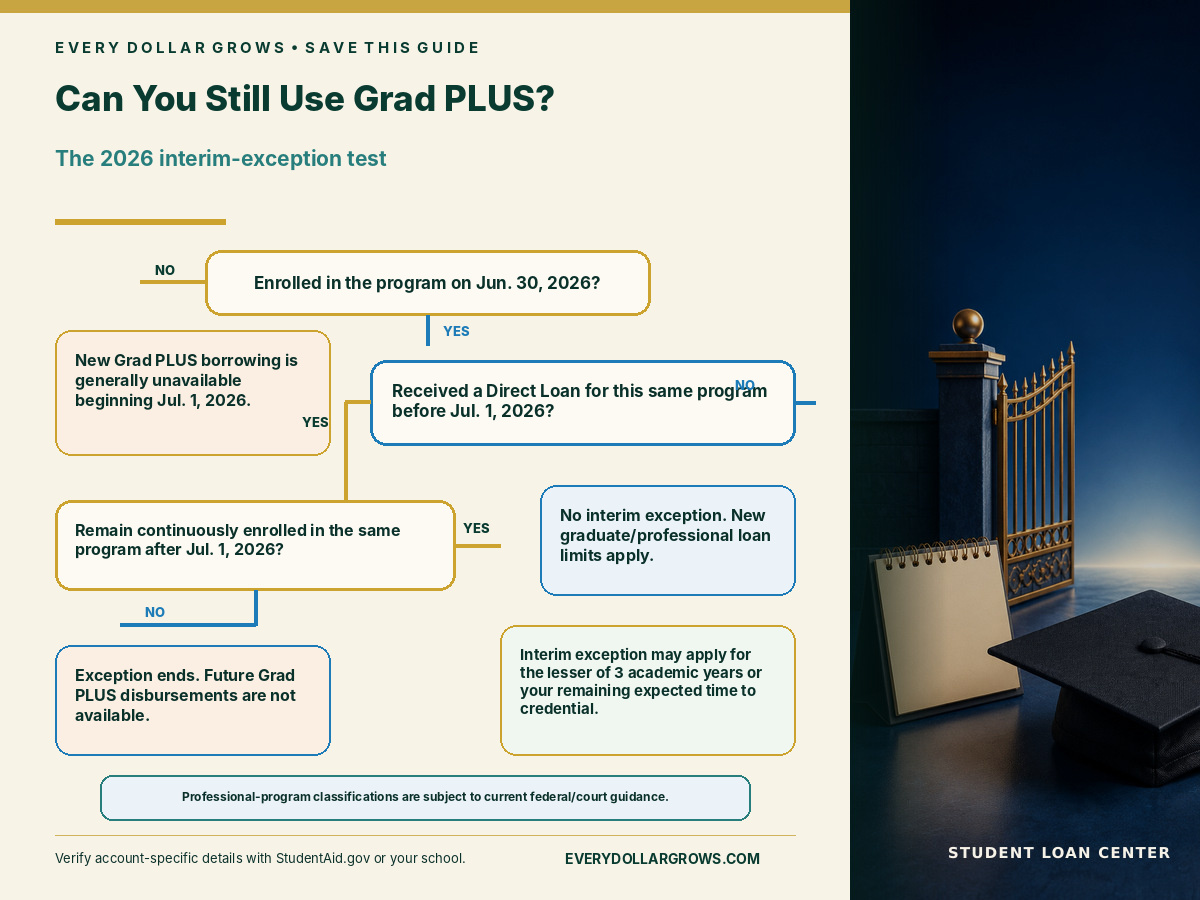
Parents should read Parent PLUS Repayment Options and Student Loans for Parents. Graduate borrowers should use Grad PLUS Changes 2026 and Student Loans for Graduate School before committing to the program.
Put the degree and school through an affordability test before borrowing
Student-loan strategy begins before the loan exists. Compare the full cost to credential—not only first-year tuition—with the realistic earnings range for the exact occupation and region. Add housing, fees, books, equipment, licensing exams, transportation, childcare, and the possibility of an extra semester or year. Then subtract grants, scholarships, employer assistance, cash contribution that does not destroy emergency savings, and federal aid.
The remaining gap is the amount the family must solve. If that gap requires maximum private borrowing every year, Parent PLUS debt that competes with retirement, or assumptions about a top-quartile starting salary, the program deserves a second comparison before enrollment.
- Compare at least one lower-cost school with similar credential outcomes.
- Check graduation, licensing, and placement outcomes—not only admitted-student marketing.
- Calculate debt at completion, not just this year’s amount.
- Run the payment using a lower-than-expected starting salary.
- Ask what happens financially if graduation takes one extra year.
Use How Much Student Loan Debt Is Too Much? and the Student Loan Affordability Stress Test before accepting a funding plan that depends on everything going right.
Consolidation, refinancing, delinquency, and default are not interchangeable
Federal consolidation combines eligible federal loans into a new Direct Consolidation Loan. It may simplify bills or change plan access, but it does not create a market-rate discount. The new rate is based on the underlying federal loans, and consolidation can change unpaid-interest treatment, timelines, and payment credits.
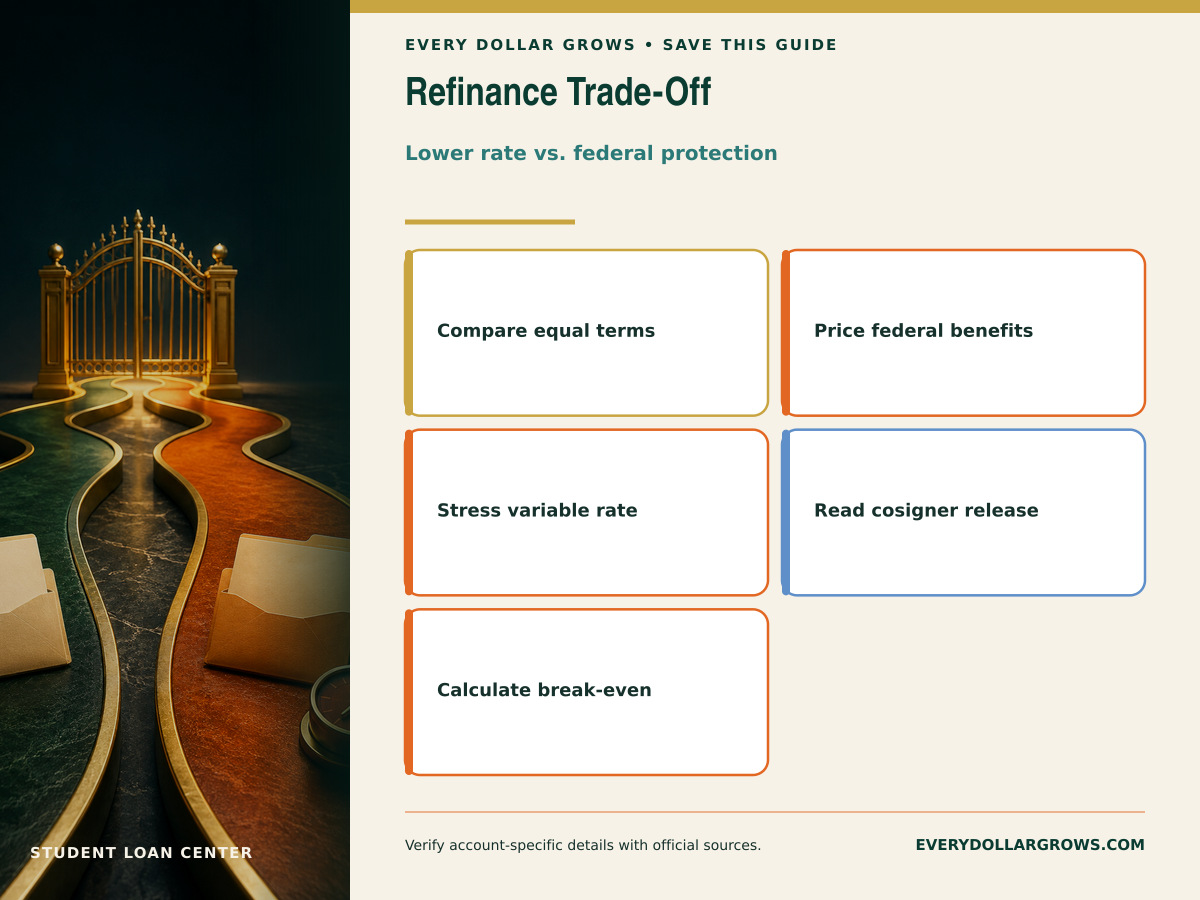
Private refinancing replaces one or more loans with a private loan. Refinancing federal loans permanently gives up federal status and the benefits tied to it. A lower quoted rate should be weighed against RAP or IBR eligibility, PSLF, discharge protections, deferment, and hardship options.
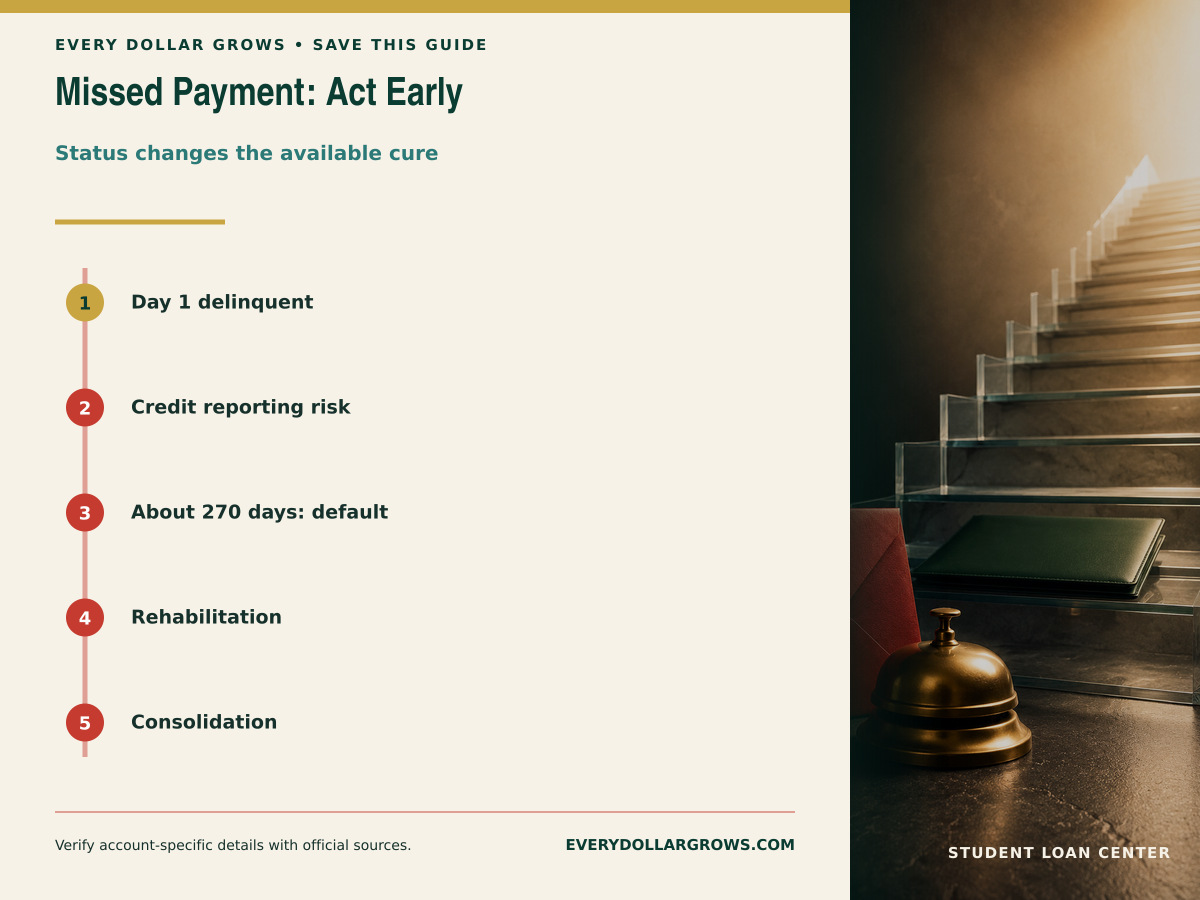
A federal loan becomes delinquent after a missed due date and typically enters default after more than 270 days without required payment. Contact the servicer before the account reaches that point. If default already occurred, compare rehabilitation, Direct Consolidation, and repayment in full rather than ignoring collection notices.
Use Federal Student Loan Consolidation, Student Loan Refinancing, and Student Loan Delinquency and Default for the decision that matches the actual problem.
Use a federal-benefits gate before refinancing
Private refinancing can reduce an interest rate, combine bills, or remove a cosigner under a new contract, but refinancing federal loans is irreversible. Once a federal loan is refinanced into private debt, the borrower generally gives up RAP, IBR, PSLF, federal discharge programs, and federal deferment or forbearance rights tied to that loan.
Before comparing private refinance offers, write down the federal benefits you are giving up and assign a realistic value to the ones you might use. A borrower five years into qualifying PSLF employment should evaluate refinancing very differently from a high-income borrower with a small federal balance and no forgiveness strategy.
Use Student Loan Refinancing for the benefit-loss checklist and Federal Student Loan Consolidation when the goal is to simplify or change federal plan access without giving up federal status.
Use a contract checklist for any private student loan
Private lenders can differ materially even when two offers display the same initial rate. Read the promissory note and disclosure before signing. Check whether the rate is fixed or variable, when repayment begins, whether interest capitalizes, whether payments are required during school, and whether there is a prepayment penalty.
If a cosigner is involved, find the release requirements and confirm whether release is discretionary or automatic after specified conditions. Review what happens after the borrower’s death or disability and whether the lender can pursue the cosigner. Also check hardship forbearance, late fees, default triggers, collection costs, and arbitration provisions.
The Federal vs. Private Student Loans guide turns these contract terms into a side-by-side decision framework.
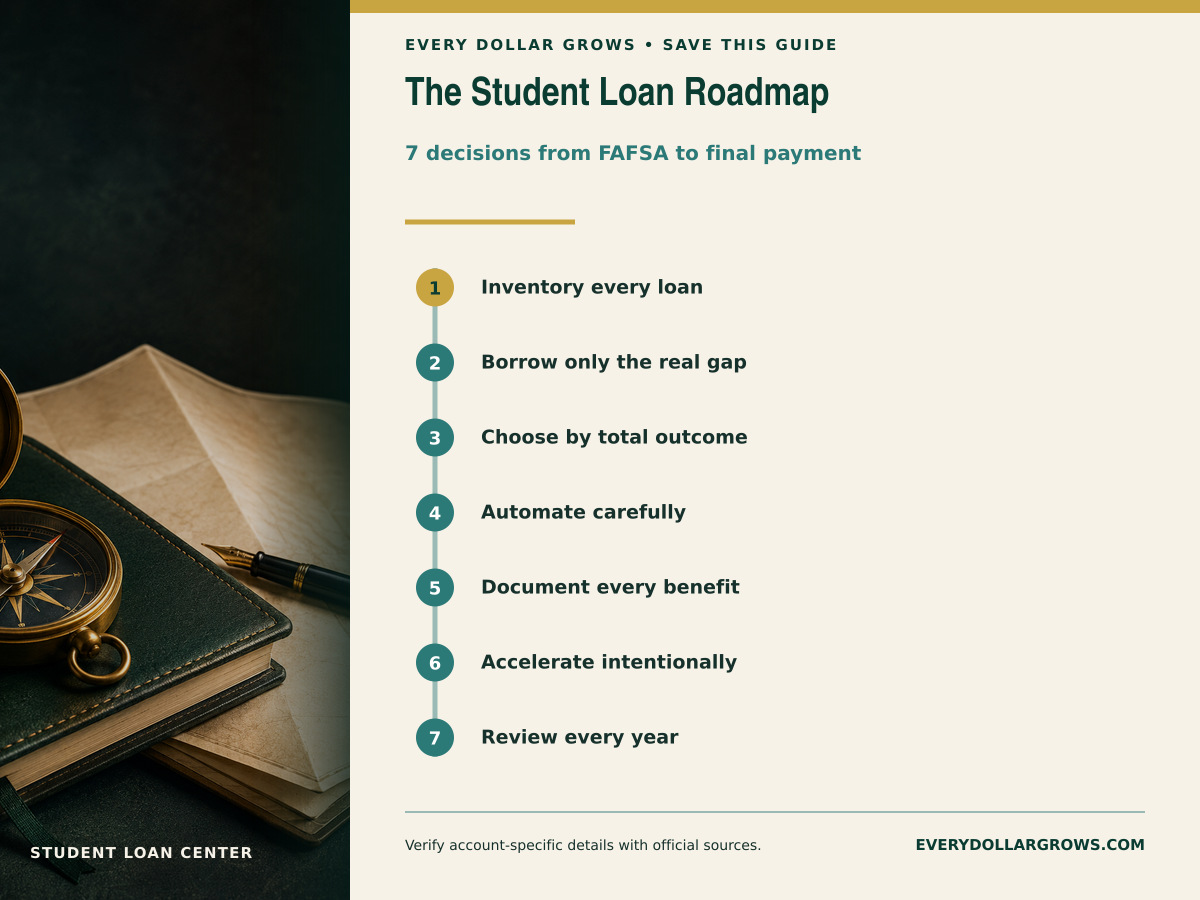
The EDG student loan roadmap
- Inventory: identify every loan, rate, date, status, and servicer.
- Stabilize: stop delinquency, cover essentials, and build a starter emergency cushion.
- Choose: compare only plans and programs your exact loans can use.
- Automate carefully: schedule required payments while keeping enough checking-account margin to prevent overdrafts.
- Document: save confirmations, certifications, counts, notices, and annual recertification records.
- Accelerate intentionally: make extra payments only after testing forgiveness, taxes, cash flow, and competing high-interest debt.
- Review annually: recheck income, dependents, tax filing, rates, plan rules, and career direction.
The Student Loan Glossary is the reference page for unfamiliar terms. For the household system around the loan, use the EDG Start Here roadmap, $1,000 emergency fund guide, and past-due bill catch-up plan.
What to review once a year
A student-loan plan should not be set once and ignored for a decade. At least annually—and after marriage, divorce, a major income change, a new loan, consolidation, a job change, or a new servicer—review the account as if you were choosing the strategy again.
- Confirm every loan balance, fixed rate, status, and servicer.
- Confirm the repayment plan shown on each loan group.
- Update income-driven repayment information when required.
- Check the official PSLF or IDR qualifying-payment count when relevant.
- Recalculate the value of extra payments versus forgiveness.
- Review beneficiary, death, disability, and cosigner provisions on private loans.
- Save a fresh PDF or screenshot of the important account pages and notices.
This annual review is also when you should check EDG’s dated 2026 articles for updates. The evergreen hub explains the framework; dated pages document rules that may change.
Use each EDG student-loan calculator for one job
| Tool | Use it for | Do not use it for |
|---|---|---|
| RAP Calculator | Estimate the published AGI-band payment formula | Official eligibility, spouse proration, or qualifying-payment credit |
| Student Loan Payment Calculator | Estimate a level fixed payment, total paid, and interest | Income-driven payments |
| Interest Calculator | Translate balance and rate into daily or period interest | Exact servicer posting or capitalization history |
| Payoff Calculator | Compare current versus extra-payment payoff paths | Deciding whether to abandon forgiveness |
| Affordability Stress Test | Screen debt against starting salary, take-home pay, and other obligations | Federal loan approval or a guarantee that debt is “safe” |
| PSLF Planner | Estimate remaining months from an official count | Determining whether employment or a month qualifies |
The calculators deliberately stop where account-specific law begins. Use them to understand scale and ask better questions; use Federal Student Aid, the servicer, and qualified tax or legal professionals for official account decisions.
Where to start based on where you are today
If you have not borrowed yet
Start with FAFSA, net price, the borrowing order, federal-versus-private comparison, and the affordability stress test. The highest-value decision may be reducing the amount borrowed before repayment ever begins.
If you are in school now
Inventory every disbursement and rate, track how much total debt is accumulating, and recalculate the remaining years. Do not wait until graduation to discover that the final-year funding plan requires private debt you cannot comfortably repay.
If you are entering repayment
Use the disbursement-date map, official Repayment Calculator, RAP and fixed-plan comparisons, and a full monthly budget. Confirm the first bill and auto-pay settings.
If you are struggling with payments
Contact the servicer before delinquency becomes default. Compare eligible income-driven options, deferment or forbearance only when appropriate, and the household bill triage needed to keep essentials current.
If you are pursuing forgiveness
Focus on documentation. Verify loan type, plan, employer, qualifying count, and tax treatment. Keep records rather than relying on memory or a future promise.
How EDG handles changing student-loan rules
Student-loan law is unusually sensitive to effective dates, loan type, and litigation. This hub therefore separates evergreen financial principles from dated federal rules. The evergreen principle—borrow the smallest reasonable amount, understand the contract, preserve cash-flow resilience, and document forgiveness—changes slowly. The exact plan eligibility can change quickly.
For federal rules, EDG prioritizes Federal Student Aid, Department of Education, Federal Register, and federal-servicer operational guidance. Dated articles include a last-reviewed date and official sources. When a court order or later federal announcement changes the rule, the dated article should be updated before its advice is reused elsewhere in the cluster.
For your own account, the official StudentAid.gov dashboard and servicer record control facts such as loan type, disbursement date, payment count, plan status, and due date. This guide explains how to interpret those facts; it does not replace them.
Ten questions to answer before signing a student loan
- What exact loan type am I accepting?
- Who is legally responsible for repayment?
- What is the fixed or variable interest rate?
- When does interest begin accruing?
- What will my total debt be at graduation or credential completion?
- What is the expected monthly payment under a realistic repayment path?
- What starting salary range supports that payment after taxes and essential expenses?
- What protections or forgiveness programs would I lose if this is a private loan or later refinance?
- What happens if school takes an extra year or I earn 25% less than expected?
- What lower-cost alternative have I actually compared?
If several answers are unknown, the loan decision is not ready. Pause long enough to obtain the promissory note, aid offer, school-cost data, and official federal account information. Borrowing can be necessary and reasonable; borrowing without understanding the obligation is avoidable risk.
Live student loan calculators
These tools appear here automatically as their EDG pages are published. Scheduled and draft calculators stay hidden until they are live.
Complete Student Loan Guide
A practical, source-checked roadmap for borrowing less, understanding every loan, choosing a repayment path, using calculators correctly, and avoiding expensive student loan mistakes.
Open calculatorStudent Loan Changes 2026
The July 1 rules changed both how some borrowers repay and how much students and parents can borrow. This guide separates the dates, the loan groups, and the next actions.
Open calculator1% Auto-Pay Reduction
Eligible Direct Loan borrowers who enrolled by September 30, 2026 can receive a temporary 1% interest-rate reduction through June 30, 2028. Here is how to verify the benefit and estimate what it may save.
Open calculatorSAVE Plan Ended: What to Do
There is no single SAVE deadline for every borrower. Your action window is tied to your individual servicer notice, so the safest response is a documented five-step transition.
Open calculatorRepayment Assistance Plan Guide
RAP uses full adjusted gross income, a 1%–10% band, a $50 dependent reduction, and a $10 floor. The payment can be straightforward; the long-term decision is not.
Open calculatorRAP Student Loan Calculator
Enter AGI and dependents to see the published RAP band, annual base, monthly base, dependent reduction, and $10 floor—without storing or transmitting your numbers.
Open calculatorStudent Loan Repayment Plans
The right comparison starts with loan dates and types, then measures payment, total cost, forgiveness credit, taxes, and risk—not just the smallest first bill.
Open calculatorTiered Standard Repayment Plan
Tiered Standard gives larger balances more time, but time is not free. Use the four balance thresholds to estimate the fixed payment and the interest cost of the assigned term.
Open calculatorRAP vs. IBR
Eligible older borrowers may be able to choose between two very different income-driven formulas. Compare the payment, cap, term, interest treatment, marriage rules, and tax outcome before switching.
Open calculatorParent PLUS Repayment Options
Parent PLUS debt belongs to the parent and follows a narrower repayment menu. The 2026 borrowing caps, RAP exclusion, and consolidation dates make old advice especially dangerous.
Open calculatorStudent Loan Payment Calculator
Estimate a fixed monthly payment, then look past that one number. The term, rate, total interest, repayment plan, and protections determine whether a loan actually fits your life.
Open calculatorStudent Loan Interest Calculator
Student loan interest can feel invisible because it appears between statements. Use principal, annual rate, and days to estimate daily accrual and see how much of a payment may reach principal.
Open calculatorStudent Loan Payoff Calculator
Test a current payment against an extra-payment plan to estimate payoff time and interest saved—then check whether acceleration supports your full financial plan.
Open calculatorStudent Loan Affordability Stress Test
Stress-test expected student debt against starting salary, take-home pay, and other required debt. The EDG planning zones are screening thresholds—not federal standards, lender approval rules, or guarantees.
Open calculatorPSLF Guide
PSLF can forgive a remaining eligible Direct Loan balance without federal income tax, but only the official loan, employer, repayment, and payment records decide whether a month counts.
Open calculatorStudent Loan Forgiveness Taxes
The broad temporary federal exclusion expired after 2025. In 2026, the name of the forgiveness program matters again—some paths remain federally tax-free while many income-driven discharges can be taxable.
Open calculatorOfficial sources used
Rules and dates can change. These primary sources were checked for this guide; confirm account-specific details with Federal Student Aid and your loan servicer.
- Federal Student Aid: 2026 student aid and repayment updates
- U.S. Department of Education: final-rule fact sheet
- Federal Student Aid: federal student loan repayment plans
- Federal Student Aid: income-driven repayment FAQs
- Federal Student Aid: Direct Loan interest rates for 2026–27
- Federal Student Aid: forgiveness, cancellation, and discharge
- Federal Student Aid: FAFSA application
- Federal Student Aid: professional-degree program list under June 2026 court order
- Federal Student Aid servicer: Tiered Standard eligibility and PSLF treatment
- Federal Student Aid: July 2026 PSLF form update after court decision
Frequently asked questions
What is the first thing I should do with student loans?
List every loan separately with its type, disbursement date, current principal, interest rate, servicer, repayment status, and any qualifying-payment count. Plan eligibility depends on those details.
Are federal student loans always better than private loans?
Federal loans normally offer protections and programs that private loans do not, so they are generally the first borrowing option after grants, scholarships, work, and cash. But affordability still depends on the amount, program cost, completion risk, and expected income.
What repayment plans are available after July 1, 2026?
Borrowers with at least one Direct Loan first disbursed on or after July 1, 2026 generally use RAP or Tiered Standard for eligible Direct Loans. Borrowers whose loans are all older may have additional legacy IDR and traditional fixed-plan choices. Parent PLUS, FFEL, Perkins, mixed portfolios, and consolidation history can change the answer.
Can an online calculator tell me which plan I qualify for?
No. A calculator can model published formulas, but Federal Student Aid and the servicer must confirm loan eligibility, marital proration, official payments, forgiveness credit, and account-specific details.
Should I pay student loans off early?
Sometimes, but first protect required bills and a starter emergency fund, address higher-rate debt, and check whether the loan is part of a deliberate PSLF or other forgiveness strategy.
Educational information only. This page does not provide legal, tax, investment, or individualized financial advice and cannot determine your eligibility, official payment, qualifying-payment count, or tax liability. Verify your loans, dates, and options through StudentAid.gov, your servicer, and a qualified professional when appropriate.